

In 1985, a young Hong Kong actor sat across a table from executives at TVB — the network that had trained him, cast him, made him famous — and refused to sign a five-year exclusive contract. The room went quiet. TVB in the 1980s did not lose those arguments. But this actor wanted to make films too, and he wasn't going to be told he couldn't. So they froze him out. For over half a year, one of the network's rising Five Tiger Generals was pushed to the margins, given menial assignments, quietly told to break. He didn't. That actor was Andy Lau — 華仔 — and his refusal to sign is one of the origin stories of modern Cantopop.

The kid from Diamond Hill
Lau Tak-wah was born on 27 September 1961 in Tai Po. His father was a Hong Kong fireman. When Andy was six, the family moved to the wooden-shack slums of Diamond Hill — a district where houses had no plumbing and a boy had to fetch water eight times a day just to keep his family going. When he was eleven, fires tore through the settlement and destroyed most of what they had. Read that back once: fireman's son, Diamond Hill, no water. Then look up how many films he's made. It clicks.
Andy graduated from Ho Lap College in San Po Kong and enrolled in TVB's Artiste Training Class — the same "star factory" that would later launch Stephen Chow and Tony Leung Chiu-wai. He signed with TVB and made his film debut in Once Upon a Rainbow in 1981. He was 20 years old. He has barely stopped working since.
His Cantonese roots — and why they matter
Andy's Cantonese isn't the polished Cantonese of drama school. It's Hong Kong Cantonese — quick, rhythmic, built from Diamond Hill afternoons and TVB dressing rooms. When he sings, the language sits inside the melody instead of on top of it. When he acts, his line delivery has the underhand jokes and hesitations of everyday Kowloon speech. That grounded Cantonese is one reason Hong Kong took him in the way it did: he sounded like someone you could meet on the MTR.
Four surprising things about 華仔
🎬 He was blacklisted by TVB — and Run Run Shaw personally unfroze him
After Andy refused TVB's five-year exclusive contract in 1985, the network sidelined him for months. It took the personal intervention of Sir Run Run Shaw — the studio mogul who essentially built Hong Kong entertainment — to broker a reconciliation. They ended up signing a one-year deal. That freeze-out taught Andy a lifelong lesson about controlling his own career, and shaped the businessman he'd become.
🎬 He quietly funded a whole generation of new Hong Kong filmmakers
In 1991, Andy founded his own production company, Teamwork Motion Pictures — renamed Focus Group Holdings in 2002. In 2006, its "FOCUS: First Cuts" initiative bankrolled six young directors from Hong Kong, mainland China, Malaysia, Singapore and Taiwan. One of those films, Ning Hao's Crazy Stone, became a mainland hit and launched a whole new generation of Chinese comedy. Andy backed it before anyone knew Ning's name.
🎬 He entered the Guinness Book for the most Cantopop awards ever won
In 2000, Guinness World Records recognised Andy for "Most Awards Won by a Cantopop Male Artist." By 2006 his lifetime tally had passed 444 music awards. He is one of four Heavenly Kings (四大天王) of the era — alongside Jacky Cheung, Aaron Kwok and Leon Lai — a title that defined 1990s Cantopop.
🎬 His work ethic is now local folklore
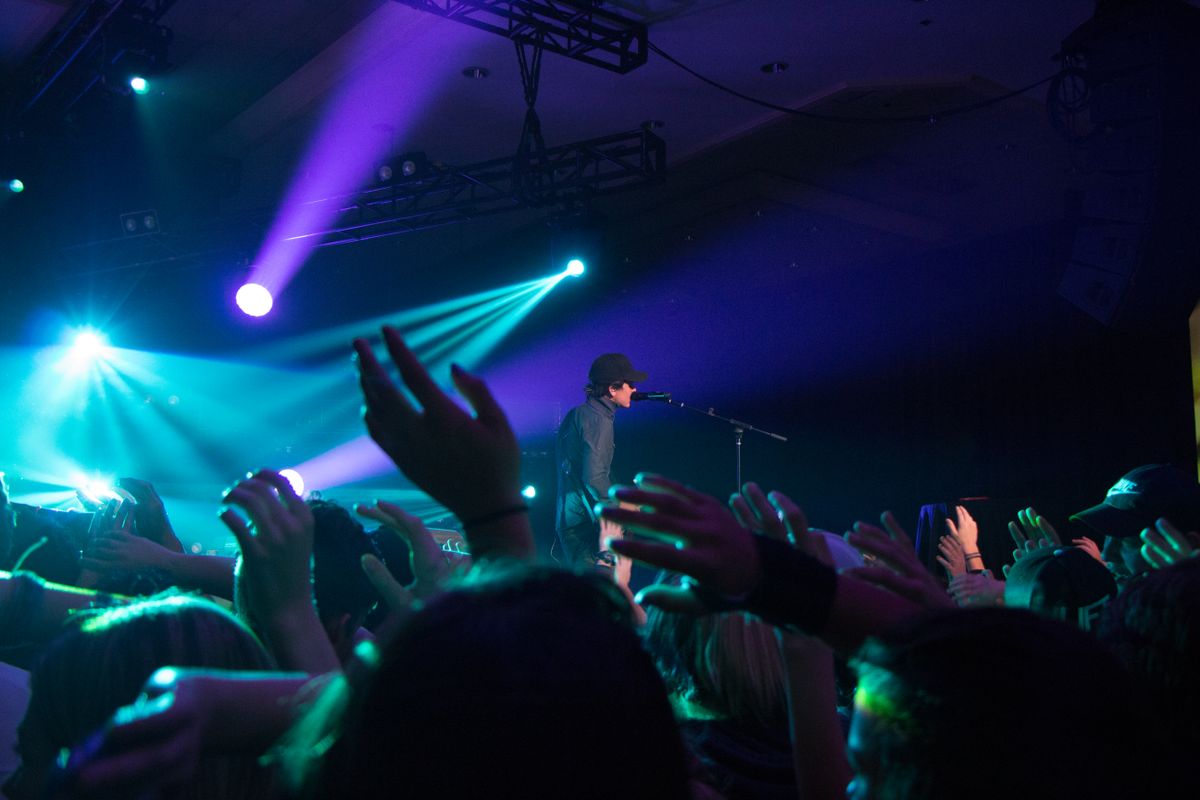
Ask any veteran on a Hong Kong film set who works the hardest, and the answer is a shrug and one syllable: 華仔. He's starred in more than 160 films. He's released roughly 100 Cantopop albums. He's said in interviews: "Some people work hard and play hard. I only work hard." Colleagues describe him waking at dawn for meditation and basic training no matter what time the previous night's shoot wrapped. That's how three decades on top actually looks in practice.
What he means to the Cantonese diaspora
For Cantonese kids growing up in London, Vancouver, San Francisco or Sydney, Andy Lau was often the first Chinese superstar they saw who felt fully theirs. Not because he was untouchable — but because he was recognisable. Working-class background. Diaspora-friendly Cantonese. Songs your uncle sang at karaoke. Films your parents watched on VHS. When Cantonese kids in the West wanted proof that Cantonese cool existed, they had 華仔 on the TV to point to. That mattered.
He also managed to do something rare in the industry: he stayed. Through the golden age, the industry crash, the mainland pivot, the streaming era — he kept working, kept releasing music, kept showing up. In 2002 he anchored Infernal Affairs, the film that revived Hong Kong cinema when many had written it off. He is the sound of persistence.
Cantonese words that come with the territory
華仔
waa4 zai2 — Jyutping romanisation
Meaning: "Little Wah" — Andy Lau's affectionate Cantonese nickname.
Explanation: The 仔 (zai2) suffix in Hong Kong means "little" or "kid" — a warm, familiar diminutive. Every Cantonese speaker knows exactly who you mean when you say 華仔. No last name, no clarification needed.
四大天王
sei3 daai6 tin1 wong4 — Jyutping romanisation
Meaning: "The Four Heavenly Kings" — the four biggest Cantopop stars of the 1990s: Andy Lau, Jacky Cheung, Aaron Kwok and Leon Lai.
Explanation: A phrase borrowed from Buddhism (the Four Heavenly Kings guard the world) and repurposed to name a cultural moment. If you grew up Cantonese in the 90s, this term defined your radio dial.
Why 華仔 still matters
There's a particular kind of Cantonese icon who doesn't burn bright and short — they simply keep going, and after four decades you look up and realise they've shaped what it means to be a working Cantonese artist. Andy Lau is that icon. He's not the most virtuosic singer of his generation (that's Jacky Cheung). He's not the coolest actor (arguments for Leslie Cheung and Tony Leung). But he might be the most emblematic: a Diamond Hill kid who refused a bad contract, built a business, funded new voices, kept releasing songs your grandmother still hums. In a diaspora obsessed with staying power, he is the case study. 華仔 lasts.
📖 Related Articles
👉 Shop Cantonese Guy — Modern Streetwear for the Global Cantonese Community