

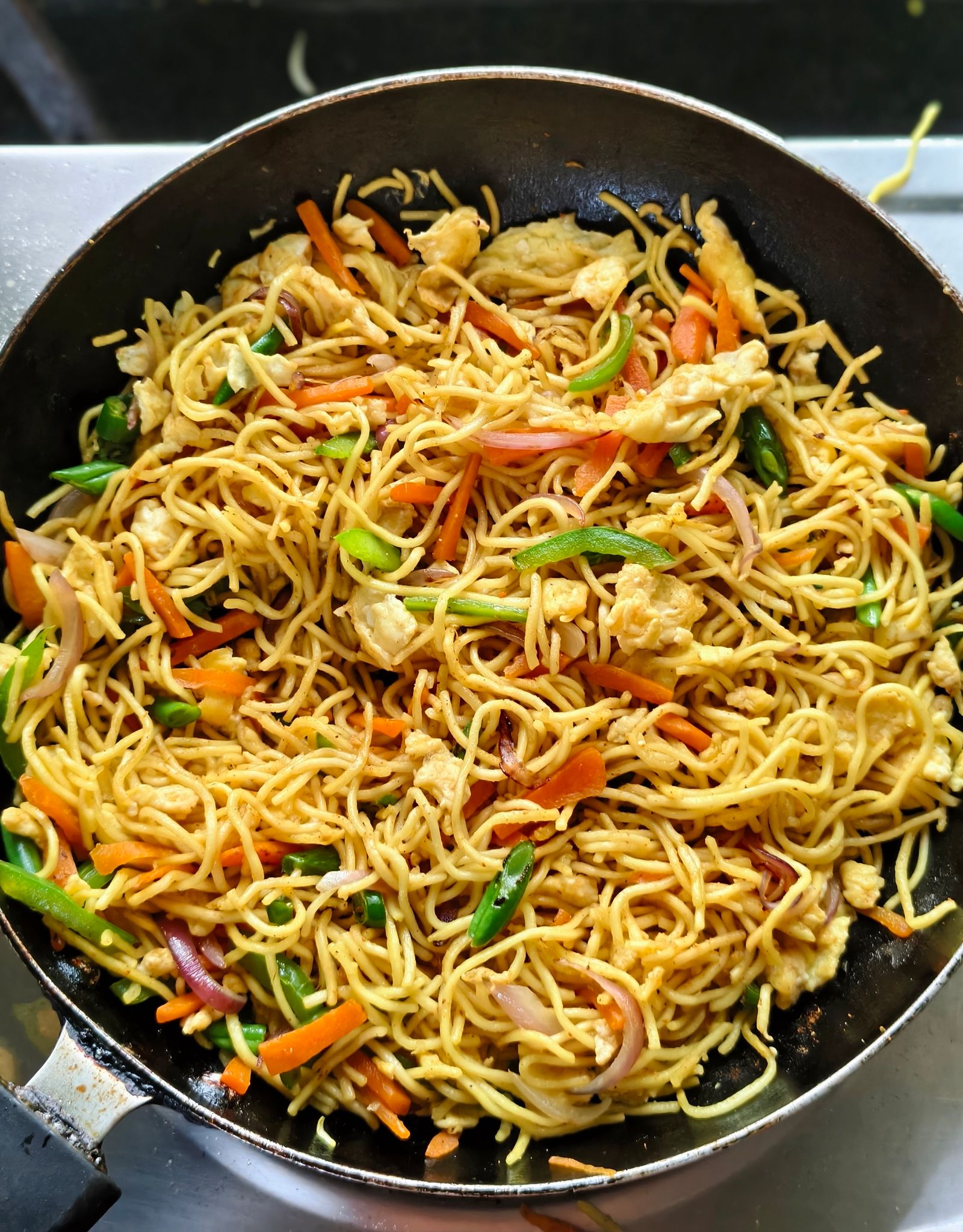
Ask a Cantonese chef what dish you should order to test a kitchen you've never been to, and nine times out of ten the answer is the same: dry-fried beef hor fun. 乾炒牛河 (gon1 caau2 ngau4 ho2). Flat rice noodles tossed with marinated beef, bean sprouts and spring onions in a wok hot enough to sear the sauce onto the noodles in seconds. On paper it is one of the simplest Cantonese dishes. In practice, it is one of the hardest, and generations of Hong Kong chefs have agreed to use it as the single plate that reveals whether a kitchen has mastered the one thing Cantonese cooking is built on: wok hei.

What makes it so hard
The dish has only a handful of ingredients: wide flat rice noodles (ho fan, or shahe fen, originally from the Shahe neighbourhood of Guangzhou), marinated beef slices, bean sprouts, spring onions, a splash of soy sauce. No cornstarch slurry. No heavy sauce. Nothing to hide behind. Every mistake shows.
A good plate of 乾炒牛河 has three qualities, and all three fight each other. First, the noodles must stay intact — ho fan is fragile and if you stir too hard, you get a plate of mush. Second, the sauce must coat the noodles evenly — the dark colour has to kiss every strand without pooling. Third, the whole plate must carry the smoky, barely-charred flavour the Cantonese call 錈氣 (wok6 hei3) — the "breath of the wok" — which is physically impossible to achieve on anything less than a screaming-hot burner that most home stoves cannot produce. If you have ever wondered why your at-home attempts never quite taste the same, the answer is almost always: your flame is too small.

The wartime legend
The origin story Cantonese chefs still tell is a wartime one. During the Japanese occupation of Guangzhou in the early 1940s, a chef named Hui ran a small food stall. One night a Japanese military officer arrived after curfew demanding hor fun. Hui had no potato starch left to make the usual wet-sauced version. Rather than refuse — which was dangerous — he improvised: tossed the plain noodles with soy sauce, marinated beef and whatever vegetables he had, cranked the heat and prayed. The officer liked it. Word spread. A dry-fried emergency became a signature dish.
The story is probably half-legend, half-truth. What is verifiable is that by the mid-1950s dry-fried beef hor fun had completely overtaken the older wet-sauced version on Hong Kong menus. Today, when you order "牛河" at any Hong Kong cha chaan teng or dai pai dong, "dry-fried" is the unstated default; if you want it with sauce you have to say so.
Why Cantonese chefs call it the audition dish
Walk into any Hong Kong Chinese restaurant that is hiring, and the first dish the owner will ask a wok cook to make is 乾炒牛河. Not a complex banquet dish — this one plate. Because 乾炒牛河 will tell them, in under three minutes, whether the candidate can:
Control a flame big enough to warm an apartment. Toss a wok hard enough to lift two pounds of noodles into the air without a single strand touching the sides, then catch it. Season by eye — soy, dark soy, a pinch of sugar, nothing weighed. Marinate the beef the day before so the slices stay tender in the ten-second sear. Plate the whole thing before the noodles cool enough to clump. If any one of these falls short, the dish looks fine but tastes dead. If all five land, you taste something that only comes from a kitchen that knows what it is doing.
You can see this test in action at any old-style dai pai dong in Sham Shui Po — those are the stalls still cooking on burners powerful enough to send a column of flame over the pan, and 乾炒牛河 is why. If you are a wok-hei purist and want to wear the obsession out, the 食飯 Dinner is Ready! embroidery heavyweight tee is the universal Cantonese invitation that follows a plate like this to the table.
The three signs you ordered well
Here is how you grade the plate when it lands in front of you. First, lift a strand with your chopsticks — the noodle should hold its shape, not break halfway. A good 牛河 flexes like a ribbon. Second, look at the plate when the noodles are gone. If there is a slick of oil pooled underneath, the chef used too much. If the plate is almost dry with only faint streaks of dark soy, the wok was hot enough to flash off the moisture. Third, breathe in — if there is a faint charred-caramel aroma from the Maillard reaction between beef, sugar and wok, that is wok hei. It fades in under a minute, which is why Cantonese elders always say 牛河 must be eaten the second it is served.
If any part of that review feels like a lot of pressure for a HK$55 plate of noodles, welcome to Cantonese food culture — where simple dishes carry the heaviest expectations and the dai pai dong auntie has been grading your palate since you were five.
The home-cook workaround
Most Hong Kong home kitchens cannot do real 乾炒牛河 because standard apartment burners top out at around 10,000 BTU — about a quarter of what a dai pai dong wok station runs. The compromise home cooks make is to cook in very small batches (never a full plate at once), use a carbon steel wok that stores heat aggressively, and keep the noodles moving for less than 90 seconds total. You will not get real wok hei at home. You will get something edible, and your respect for the aunties at Mak's and Tsim Chai Kee will go up.
That gap — the one between what a professional Cantonese kitchen can do and what you can manage at home — is a big reason the diaspora flies back for this stuff. There is a specific plate of noodles waiting in a Sham Shui Po stall that just does not travel. For everyone chasing the dai pai dong feeling in Toronto, Melbourne, London — the 叉燒 Char Siu oversized tee is one small way to carry Cantonese food culture around on your chest while you wait for the flight home.
📖 Related Articles
👉 Shop the Mami Says collection
Modern streetwear for the global Cantonese community.