

Cantonese people love to talk. Whether it's an aunty leaning over the counter at a wet market or two uncles slurping wonton noodles at a cha chaan teng, the language is built for chatter — endlessly expressive, layered, and full of colour. This volume covers the words Cantonese speakers reach for when they want to chat, gossip, joke, complain, or share something that really matters. If you want to wear that identity as well as speak it, our 廣東仔 CANTONESE GUY oversized tee puts the whole idea in three characters. Master these ten words, and you'll understand what's actually happening at every yum cha table in Hong Kong.
The 10 Words
1. 傾偈
king1 gai2 — Jyutping romanisation
Meaning: To chat, to have a conversation.
Explanation: The everyday Cantonese word for chatting — warm, casual, and social. Unlike more formal words for conversation, 傾偈 implies you're settling in, taking your time, and probably ordering another cup of milk tea.
2. 講嘢
gong2 je5 — Jyutping romanisation
Meaning: To speak, to say something.
Explanation: Literally "speak things." This is the most everyday way to describe talking. It's neutral — you can say it about a baby learning to talk, a boss making a speech, or a friend finally opening up.
3. 吹水
ceoi1 seoi2 — Jyutping romanisation
Meaning: To chit-chat, to shoot the breeze — or to talk hot air / brag.
Explanation: Literally "blow water." A brilliantly Cantonese word that captures aimless, freewheeling talk. Depending on tone, it can mean cheerful chatter with friends, or someone exaggerating and talking nonsense. Context tells you which. If you know someone who’s a professional-grade 吹水王, our 把砲 Capable oversized tee is basically a portrait.
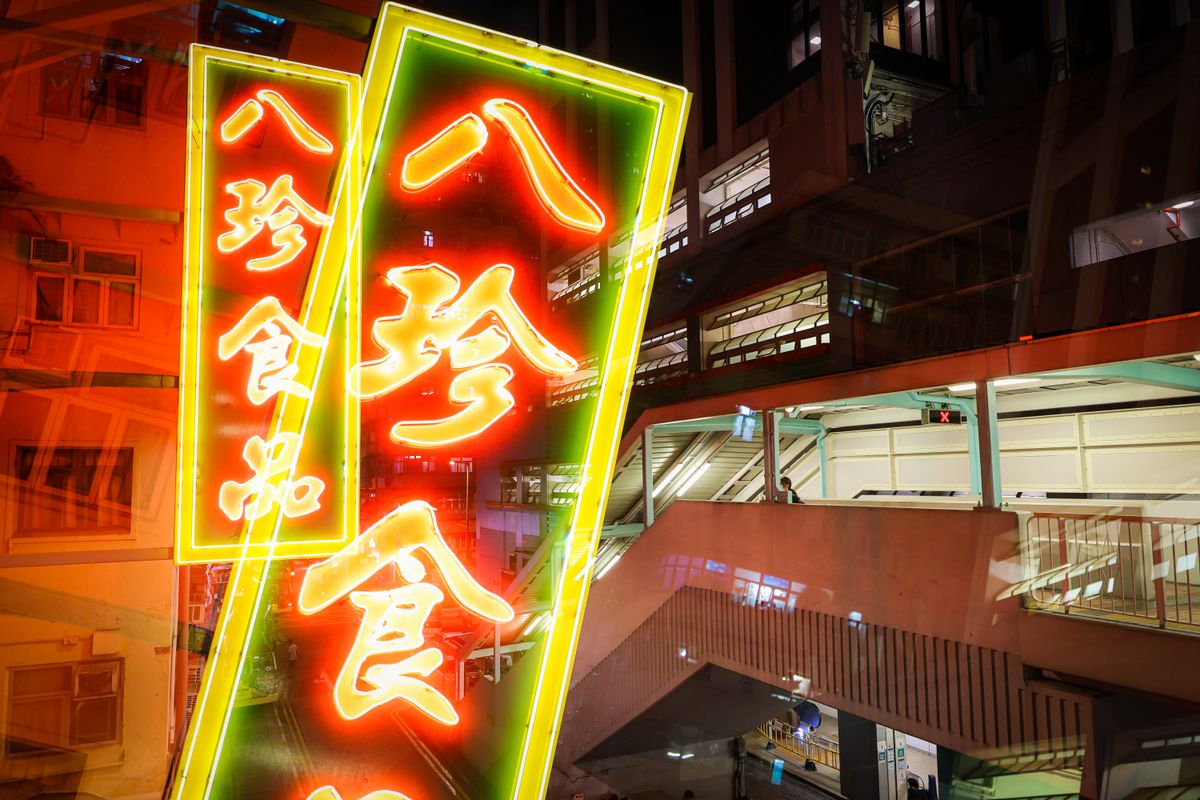
4. 八卦
baat3 gwaa3 — Jyutping romanisation
Meaning: Gossip; to be nosy.
Explanation: Literally "eight trigrams" from the I Ching. The gossip meaning is said to come from Hong Kong tabloids in the 1970s and 80s that used trigram graphics to censor scandalous photos — the association stuck. Today, calling someone 八卦 means they love a good rumour.
5. 是非
si6 fei1 — Jyutping romanisation
Meaning: Malicious gossip; talk that causes trouble.
Explanation: Literally "right and wrong." While 八卦 gossip is often harmless and fun, 是非 is the kind of talk that stirs up conflict and hurts reputations. A 是非精 (si6 fei1 zing1) is a professional-grade rumour-stirrer.
6. 講笑
gong2 siu3 — Jyutping romanisation
Meaning: To joke, to be kidding.
Explanation: The classic Cantonese cover after saying something that landed a little too honestly. Half a friendship is built on 講笑 — teasing, roasting, back-and-forth banter that only works because there's affection underneath.
7. 詐傻扮懵
zaa3 so4 baan6 mung2 — Jyutping romanisation
Meaning: To play dumb; to feign ignorance.
Explanation: A brilliantly specific four-character phrase — literally "fake stupid, pretend confused." Hong Kongers use it when someone deliberately acts clueless to avoid responsibility, especially at work, in relationships, or when their turn to pay the bill mysteriously arrives. The mischievous energy is basically what our 鬼馬 Ghost Horse hoodie was made to wear.
8. 講三講四
gong2 saam1 gong2 sei3 — Jyutping romanisation
Meaning: To talk this and that; to gossip idly about someone.
Explanation: Literally "say three, say four." A dismissive way to describe idle chatter that runs on and on — usually about someone who isn't in the room. It's what your mother tells you not to do about relatives.
9. 諸事八卦
zyu1 si6 baat3 gwaa3 — Jyutping romanisation
Meaning: Nosy about everything; can't mind their own business.
Explanation: A stronger, four-character version of 八卦. Literally "all-matter eight-trigrams." Used to describe the aunty who knows your neighbour's rent, salary, and which university their kid didn't get into. Every Cantonese building has at least one.
10. 講心事
gong2 sam1 si6 — Jyutping romanisation
Meaning: To confide; share what's on your heart.
Explanation: Literally "speak heart matters." The counterweight to all the gossip on this list — this is what real, close conversation looks like in Cantonese. Reserved for people you trust enough to drop your guard around.
Why This Vocabulary Matters
Cantonese has an unusually rich vocabulary for the many textures of conversation — from harmless chatter to malicious gossip to sincere confiding. That's not an accident. Cantonese society, especially in Hong Kong and the Pearl River Delta, has always been dense, social, and layered with relationships. The language evolved to describe them. Learn these ten words and you'll start hearing them everywhere — in dim sum halls, on family group chats, in every taxi driver's monologue. If you take the everyday-attitude route, our Hea heavyweight tee is the closest thing to a wearable version of that Cantonese chill.
📖 Related Articles
👉 Shop the Cantonese Slang collection
Modern streetwear for the global Cantonese community.