

Time in Cantonese is not the neat, clock-shaped thing English makes it out to be. When a Hong Konger says jat1 zan6 gaan1 — "in a moment" — they might mean two minutes or forty. When someone tells you they'll do something ci4 di1, "a little later," nobody actually gets out a stopwatch. Cantonese time words are elastic, warm, and doubling as social lubricant. Volume 74 covers the 10 timing words that fill the gaps between every real conversation in Hong Kong — from the milk-tea queue at the cha chaan teng to the last MTR home.
If you can drop these 10 words correctly, you'll sound less like a textbook and more like someone who grew up in a Wan Chai walk-up. And if any of them make you laugh — the language has done its job. (Feel free to wear the mood too — our Hea Heavyweight T-shirt is basically a time-management philosophy printed on cotton.)
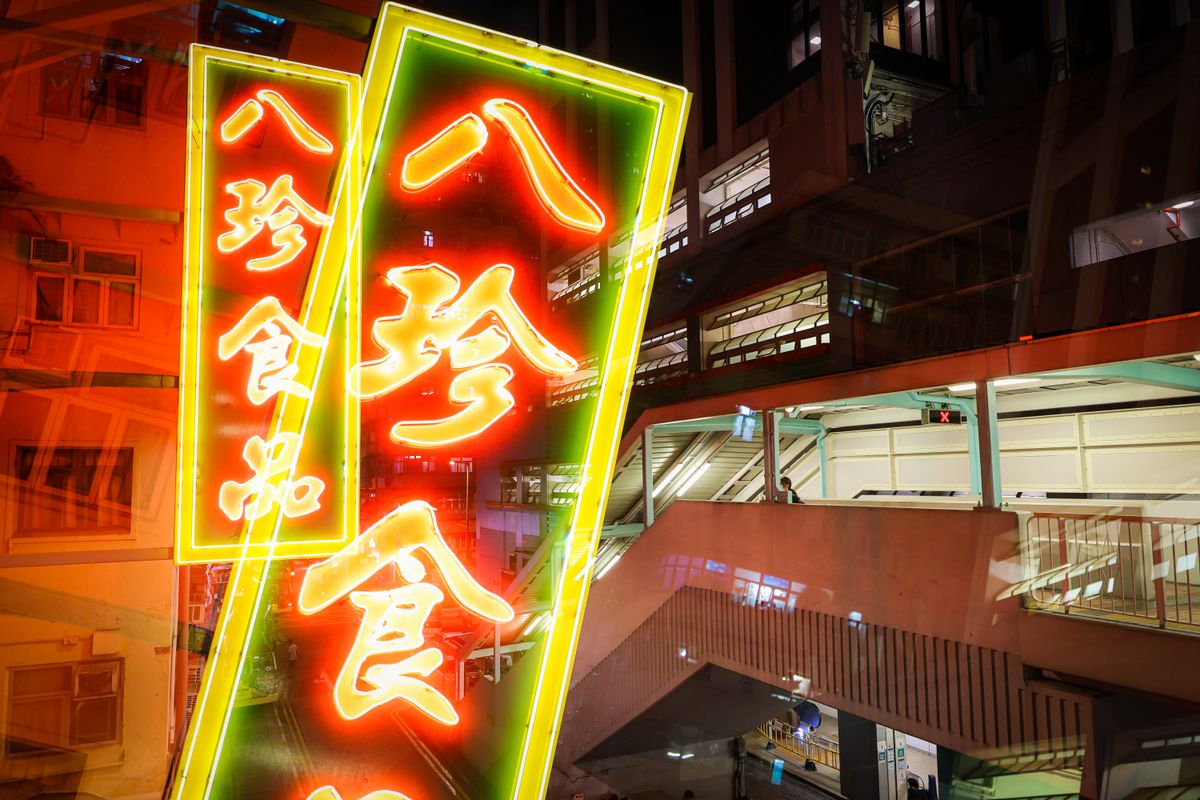
The 10 essential Cantonese time words
1. 而家
ji4 gaa1 — Jyutping romanisation
Meaning: Now / right now / at this moment.
Explanation: The single most-used Cantonese time word. Also written 依家 (ji1 gaa1) in casual texts. Mandarin says 現在 (xiànzài), but a Cantonese speaker will almost always reach for 而家 instead.
2. 尋日
cam4 jat6 — Jyutping romanisation
Meaning: Yesterday.
Explanation: Very often written informally as 琴日 (kam4 jat6) in casual writing — same word, different character. Mandarin uses 昨天; Cantonese refuses to touch that. 尋日 is the only word you need.
3. 聽日
ting1 jat6 — Jyutping romanisation
Meaning: Tomorrow.
Explanation: Nothing to do with the character for "listen" — 聽 here is a Cantonese-only reading that means the next day. Mandarin's 明天 (míngtiān) doesn't exist in spoken Cantonese.
4. 頭先
tau4 sin1 — Jyutping romanisation
Meaning: Just now / a moment ago / earlier today.
Explanation: The narrow window between "right now" and "a while back." 頭先 usually means something that happened minutes to hours ago, but still within today. Perfect for gossip that's still hot.
5. 一陣間
jat1 zan6 gaan1 — Jyutping romanisation
Meaning: In a moment / in a little while / soon.
Explanation: Often shortened to just 一陣 (jat1 zan6). Deeply elastic — anywhere from five minutes to "whenever I get around to it." A native speaker knows to double-check. 求其 ("whatever") culture leaks into 一陣間 culture.
Halfway through — and if you catch yourself saying 一陣間 to your mum when she calls for dinner, you might be ready for our 求其 Whatevs oversized tee. Time is a suggestion, not a rule.
6. 遲啲
ci4 di1 — Jyutping romanisation
Meaning: Later / a bit later.
Explanation: The classic soft-defer. "Later today," "later this week," "later in life" — 遲啲 covers all of them and the listener figures out which from context. The 啲 (di1) is a diminutive that softens the whole word.
7. 早啲
zou2 di1 — Jyutping romanisation
Meaning: Earlier / a bit earlier / sooner.
Explanation: The mirror of 遲啲. Also the second half of the classic Cantonese mum-line 早啲返屋企 ("come home earlier") — a phrase that follows every diaspora kid, no matter where in the world they've moved.
If your mum has ever said 早啲返屋企 to you across three time zones, we made a whole tee about it — the 早啲返屋企 Come Home Earlier oversized T-shirt is basically wearable guilt.
8. 成日
seng4 jat6 — Jyutping romanisation
Meaning: Always / constantly / all the time.
Explanation: Literally "whole day," but used to mean "always" in the exaggerated Cantonese sense. If your friend is 成日 late, they are always late. If someone is 成日食飯, they are always eating.
9. 時時
si4 si4 — Jyutping romanisation
Meaning: Often / frequently.
Explanation: The softer, gentler cousin of 成日. If 成日 is "always," 時時 is "often" — enough to be a pattern, not enough to be a complaint. Often paired with 都 (dou1, "also") as 時時都.
10. 得閒
dak1 haan4 — Jyutping romanisation
Meaning: To have free time / to be free.
Explanation: One of the most Cantonese phrases in the language. Lives inside the classic invitation 得閒飲茶 ("let's catch up over tea") — the way Cantonese people say "we should hang out" without ever pinning down a date. Warm, elastic, and slightly non-committal, which is exactly the point.
If any Cantonese phrase deserves its own tee, it's this one. The 得閒飲茶 Let's Catch Up sweatshirt takes the most Cantonese social ritual — vague plans over tea — and puts it on a warm winter layer.
Why Cantonese time is different
Mandarin time words tend to be precise and neat. Cantonese time words are the opposite: warm, vague, socially flexible. "Later" can mean anything; "soon" is a mood; "when I'm free" is a promise and a hedge at the same time. That's not sloppiness — it's a language that leaves room for people to figure out the details together.
Learn these 10 words and you'll notice the rhythm change. You'll defer without being rude, invite without over-committing, and complain about a friend's punctuality with proper diaspora authority. Everything else in Cantonese conversation happens in the spaces these words create.
📖 Related Articles
👉 Shop the Cantonese Slang collection
Modern streetwear for the global Cantonese community.