

Walk into any Cantonese household during Lunar New Year and you'll hear the same words bouncing between relatives like red packets flying across the dinner table: hou2 coi2, daai6 gat1, wong6, dim6. These aren't just New Year greetings — they're the words Hong Kongers reach for every day of the year, whenever something goes right, whenever someone needs a little push of good energy, whenever a deal needs sealing.
Volume 99 of our Cantonese Dictionary is dedicated to the vocabulary of luck, fortune, and good vibes — ten words that carry a thousand years of Cantonese belief that fortune favors the bold, the patient, and the ones who say the right thing at the right time. Grab a cup of tea, settle in, and learn the words that make Cantonese sound like a language of permanent optimism.

The 10 Cantonese Fortune Words
1. 好彩
hou2 coi2 — Jyutping romanisation
Meaning: Lucky; fortunate; thankfully.
Explanation: The workhorse of all Cantonese luck words. It can describe a person who's lucky, an outcome that turned out well, or be used as "thankfully/luckily" at the start of a sentence. Every Cantonese parent has muttered 好彩 after a near-miss on the MTR escalator at least a hundred times.
2. 行運
haang4 wan6 — Jyutping romanisation
Meaning: To be on a hot streak; to have a run of good luck.
Explanation: Literally "walking luck" — the image of fortune physically walking alongside you. Cantonese speakers believe luck moves in cycles, and when you're 行運, you ride it. People on a 行運 streak get told to buy a lottery ticket.
If you're the kind of person who powers through regardless of whether luck is walking with you, there's a whole philosophy for that too. We put it on a shirt: the 硬頸 Hard Neck sweatshirt — because sometimes you don't wait for 行運, you drag it along with you.
3. 旺
wong6 — Jyutping romanisation
Meaning: Thriving; prosperous; booming; busy with good energy.
Explanation: The character has a fire radical on the left for a reason — 旺 is the word for anything flourishing. A busy restaurant is 旺, a popular shop is 生意好旺 (business is booming), and even your love life can be described as 桃花旺 (peach-blossom luck is strong). It's why Mong Kok (旺角) was named "Prosperous Corner."
4. 發達
faat3 daat6 — Jyutping romanisation
Meaning: To strike it rich; to make it big; to prosper financially.
Explanation: Every Hong Konger's dream verb. 發達 is what you say about someone who just closed a huge deal, won the lottery, or finally got their start-up acquired. The character 發 by itself is so associated with wealth that the number 8 (baat3) is lucky because it rhymes with it.
5. 吉利
gat1 lei6 — Jyutping romanisation
Meaning: Auspicious; lucky; favorable.
Explanation: This is the formal, slightly ceremonial word for "lucky" — the one you use for colors, numbers, dates, and symbols. A red envelope is 吉利; the number 8 is 吉利; a wedding date chosen by a feng shui master is 吉利. It's why Hong Kongers call empty rental properties 吉舖 (gat1 pou3, "auspicious shops") — saying 空 (empty) is bad luck, so they flip it to 吉.

6. 利是
lei6 si6 — Jyutping romanisation
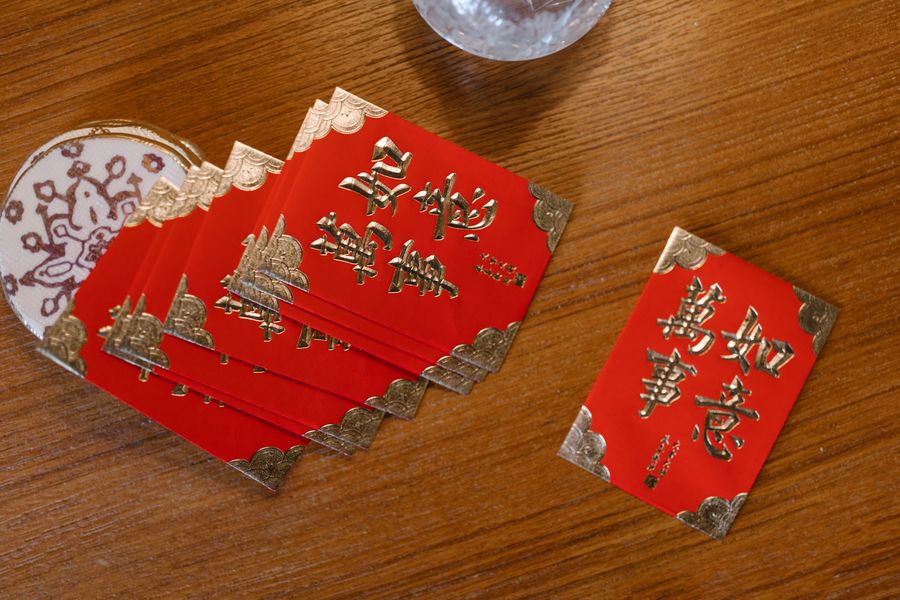
Meaning: Red packet; lucky money envelope. Also written 利市.
Explanation: The Cantonese version of what Mandarin speakers call hongbao. Hong Kongers rarely say 紅包 — the word is almost always 利是 or 利市. The literal meaning is "profit and good fortune," and the money inside is less important than the gesture: married people hand them out, kids and unmarried adults receive them. Pro tip: the amount is always an even number, and the notes should be crisp.
7. 大吉
daai6 gat1 — Jyutping romanisation
Meaning: Great fortune; huge luck; "big auspicious."
Explanation: The maximum-strength version of 吉利. You see it printed on red couplets stuck to doorways, especially the phrase 大吉大利 (daai6 gat1 daai6 lei6, "great fortune, great profit"). Older Cantonese also say 大吉利是 (daai6 gat1 lei6 si6) to immediately cancel out something unlucky someone just said — the equivalent of "knock on wood."
8. 掂
dim6 — Jyutping romanisation
Meaning: All good; sorted; handled; no problem.
Explanation: Pure Hong Kong Cantonese. 掂 is the sound of a problem being resolved — the deal closed, the exam passed, the taxi caught. If someone asks "搞掂未?" (gaau2 dim6 mei6, "all done?"), you answer "掂啦!" (dim6 laa1, "all sorted!"). It's the Hong Kong equivalent of a quiet nod and a thumbs-up.
That last one has a shirt too — the 準時收工 Clock Out On Time tee is for everyone who's handed in their deliverables and gets to say 搞掂 with a straight face.
9. 風水
fung1 seoi2 — Jyutping romanisation
Meaning: Feng shui; the geomantic arrangement of space to attract good energy.
Explanation: Literally "wind-water." Hong Kong's skyline is quite literally shaped by it — HSBC headquarters, Bank of China Tower, and countless luxury flats have been designed around 風水 principles. People check their house 風水 before moving, their office 風水 before signing a lease, and their desk 風水 before accepting a promotion. It's taken seriously by people who in every other way are hyper-rational.
10. 恭喜發財
gung1 hei2 faat3 coi4 — Jyutping romanisation
Meaning: "Congratulations and may you get rich." The all-purpose Lunar New Year greeting.
Explanation: The single most-said Cantonese phrase of the year. Walk into any shop, lift lobby, or family gathering between the first and fifteenth day of the lunar new year and you'll hear it a thousand times. Kids chant 恭喜發財,利是逗來 (gung1 hei2 faat3 coi4, lei6 si6 dau6 loi4) — "Congratulations and get rich, hand over the red packet" — in a cheeky singsong that has powered the lai see economy for generations.
The Deeper Logic of Cantonese Luck
What makes these words interesting isn't just that Cantonese speakers love talking about luck — it's that the language itself is built around auspicious wordplay. The whole system of Lunar New Year foods (魚 fish = 餘 abundance; 髮菜 fat choy seaweed = 發財 getting rich) depends on tonal puns. The reason you say 吉舖 instead of 空舖 for an empty shop is because 空 (hung1) sounds like "nothing" and nobody wants to invite that. If you want to go deeper into how everyday Hong Kong vocabulary bends toward optimism, our Volume 89 (chill, lazy, whatever words) is the exact opposite in spirit — proof that Cantonese contains the full emotional spectrum.
Fortune words also change how Cantonese speakers behave on New Year's Day: no sweeping the floor (you're sweeping luck out), no washing hair (you're washing luck out), no saying 死 or 窮 or 冇 (no, don't, broke) — even accidentally. Instead, you say 掂、旺、好彩、大吉 as often as you can get away with. If you want to wear the attitude year-round, the 鬼馬 Ghost Horse hoodie carries the mischievous luck energy that Hong Kongers associate with being clever enough to find fortune wherever it hides.
👕 Wear the phrase
- 硬頸 Hard Neck Sweatshirt — for the kind of person who makes their own luck
- 鬼馬 Ghost Horse Hoodie — mischief and fortune, in one piece
📖 Related Articles
👉 Shop the Cantonese Slang collection
Modern streetwear for the global Cantonese community.