

If you have ever stood on a Cantonese street at Lunar New Year, you know the sound before you see anything. The percussion comes first — a bass drum laid down like a heartbeat, cymbals snapping on the offbeat, a brass gong punching through the top. Then the crowd parts. A pair of eyes blinks, a jaw cracks open, a fur-and-sequins head rears up on two human legs, and three storeys of Cantonese tradition come dancing down the street. This is 舞獅 — Cantonese lion dance — and no other Cantonese ritual packs this much kung fu, noise, folk belief and theatre into a single performance.
For the diaspora, lion dance is often the one Cantonese tradition that survives everything. In Vancouver, San Francisco, Toronto, Sydney and London, the Lunar New Year lion still turns up outside Cantonese restaurants and shophouses to bless the year ahead. Here is where it came from, how it works, and why the Southern lion is one of the most Cantonese things in the world.
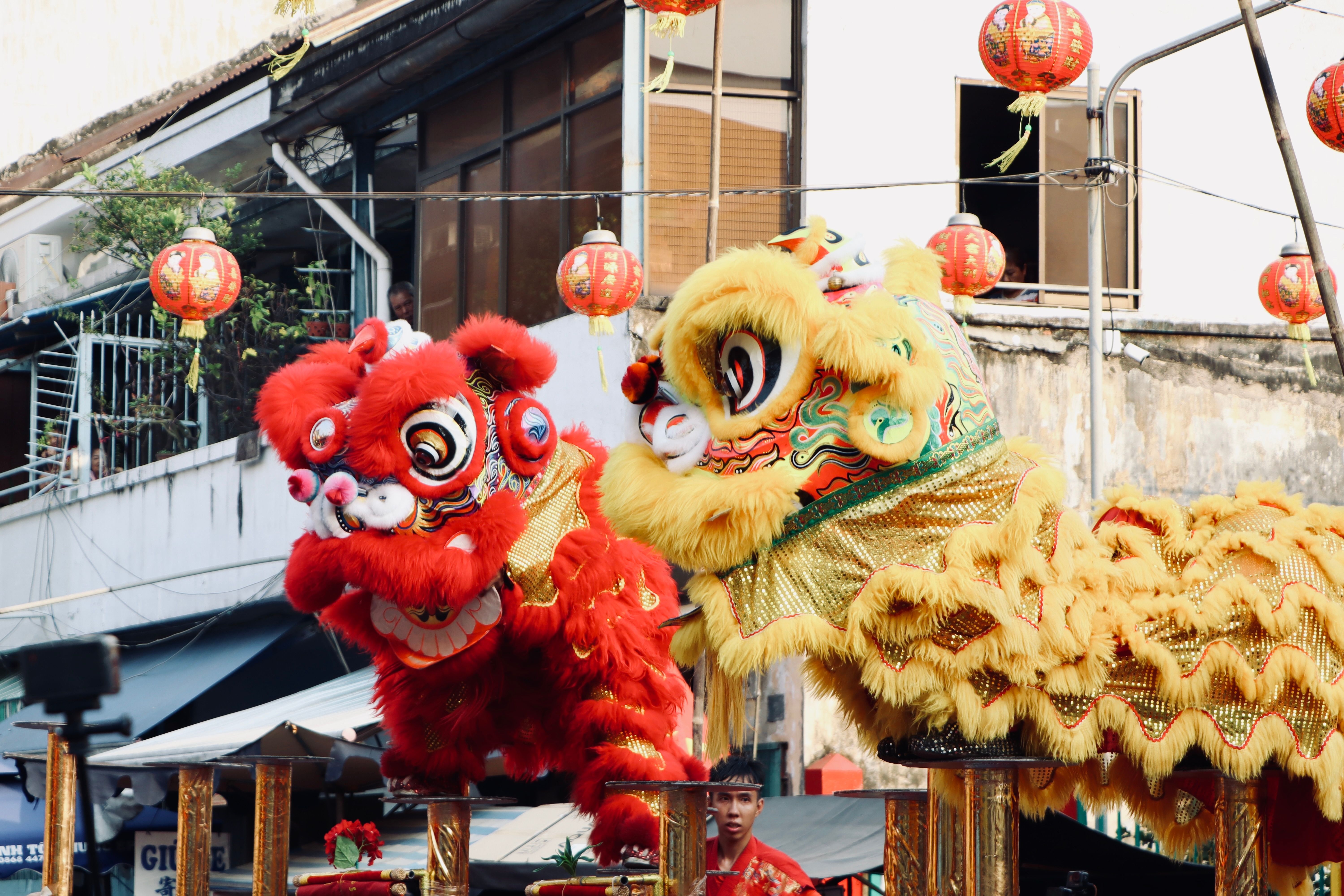
Southern lion versus Northern lion
The first thing to understand is that there is more than one kind of Chinese lion dance, and the Cantonese one — the Southern lion (南獅) — is its own distinct tradition. The Northern lion, which developed earlier, is a two-performer costume that looks a lot more like an actual lion, with shaggy orange-brown fur and acrobatic routines closer to a Beijing opera animal piece. The Southern lion is the one most of us picture when we hear the words: a huge expressive head with pop-up eyes and jaw, enormous blinking lashes, mirrors and sequins on the forehead, and a long trailing body shared between a head performer and a tail performer. According to cultural historians, the Southern lion developed in Guangdong province, most likely during the Ming dynasty, as a southern adaptation of the earlier Northern form.
Inside the Southern style, there are two main sub-schools, both named after Guangdong towns. Fo Shan style (佛山) is older and more martial — bristle-covered, with sharp angular features and a strong link to kung fu schools. Hok Shan style (鶴山), founded by Feng Gengzhang, is newer and more theatrical, consciously designed to mimic the natural movements of a real animal — specifically a cat — with a more refined mouth and more expressive lip movement. The Fo Shan lion is the warrior. The Hok Shan lion is the dancer.
What the dance is actually doing
The core performance is called 採青 (coi2 ceng1) — "plucking the greens." A bundle of fresh lettuce is tied up with a red envelope of lucky money and hung somewhere difficult: from a shopfront, a tall pole, a doorway above head height, or in the modern competition version from the top of a tower of steel pillars. The lion has to approach, size up the challenge, and then "pluck" the lettuce — grabbing it in its mouth, chewing, and spitting the leaves out toward the gathered crowd as a blessing. The red packet, needless to say, stays with the troupe.
The wordplay is Cantonese through and through. 採 (coi2 — to pluck) rhymes with 財 (coi4 — fortune). So "plucking the greens" is also, phonetically, "plucking fortune." Every shop opening, every wedding, every Lunar New Year parade in Chinatown ends with the lion delivering fortune back into the crowd. If you have ever stood close enough to a lion dance to feel the drum shake your ribcage, you know this is less a performance and more a civic act.

The kung fu underneath
The reason Southern lion dance is so tightly bound to Cantonese identity is that it did not grow up in a theatre. It grew up in a kung fu school. For most of the 19th and 20th centuries, lion dance troupes in Guangdong were run by martial arts schools, and the lion was literally practice: the head performer trained in deep horse stances, waist power and shoulder strength, and the tail performer trained in low-centred mobility and leg conditioning. A troupe's lion was the public face of its kung fu. If a rival school's lion met yours in the street, there were rules of etiquette — bows, salutes, deference by seniority — and if the rules were broken, there were sometimes fights that gave Hong Kong cinema most of its best storylines for the next hundred years.
If you want to carry that Cantonese cinema energy with you, our 賭神 God of Gamblers hoodie and 廣東仔 CANTONESE GUY oversized tee are the modern diaspora's way of carrying the heritage into the street.
The modern competition lion
In 1984, Malaysia launched the Genting World Lion Dance Championship, which has run biennially ever since. It changed what a lion could do. Competitive high-pole lion dance (舞獅樁陣, better known as "jong") puts the lion on top of a field of welded steel pillars, some three metres off the ground, and asks the two performers to leap, land and balance in sync without ever showing a human foot below the fur. The modern competition lion typically pairs a Southern-style head with a slightly shorter, more agile tail. Teams from Malaysia, Singapore, Hong Kong, Macau, Guangdong and the diaspora now train full-time for it. If you have seen a viral video of lions leaping across pillars in slow motion, that is the Malaysian jong tradition, and it is one of the clearest places you can watch Cantonese tradition being pushed into something new.
Our piece on the Golden Age of Hong Kong cinema covers the kung fu films that put Southern lion imagery onto screens worldwide, and the Dragon Kite oversized tee borrows another classic Cantonese motif in the same visual family.
The three Cantonese words to know
舞獅
mou5 si1 — Jyutping romanisation
Meaning: Lion dance.
Explanation: Literally "to dance the lion." Used both for the performance itself and for the whole discipline. If someone invites you to their 舞獅團 (lion dance troupe), they are inviting you to train, not just to watch.
採青
coi2 ceng1 — Jyutping romanisation
Meaning: "Plucking the greens" — the climactic moment of the lion dance when the lion grabs and spits out the lettuce.
Explanation: The wordplay is the point: 採 (pluck) is a near-homophone of 財 (wealth), so the gesture doubles as scattering fortune onto the crowd. If a shop invites a lion troupe to perform at its opening, this is the moment the whole street waits for.
Why the lion still matters
Half of what any diaspora has to decide, every generation, is which rituals to keep. Lion dance is one of the ones Cantonese communities worldwide have consistently chosen to keep. It is loud, physical, labour-intensive, and useless as efficiency — and that is the point. It takes a whole troupe, a whole street, a whole year of training, and a whole lineage of Cantonese kung fu and folk belief to make three minutes of theatre happen in front of a lettuce. There is no scrolling through it. If you want to feel what Cantonese culture built, stand close to a Southern lion when the drum kicks in. For the modern street side of that same identity, our best seller collection is where this heritage lives on fabric.
📖 Related Articles
👉 Shop the Best Seller collection
Modern streetwear for the global Cantonese community.