

For most of the year, Cheung Chau is a sleepy fishing island — a 40-minute ferry hop from Central, famous mostly for cheap seafood, quiet beaches, and the kind of weekend pace Hong Kong Island forgot. Then, for one week in early May, around Buddha's birthday, the population quadruples. Bamboo scaffolding rises three stories tall. Thirty-foot towers get wrapped in thousands of white steamed buns. Children get strapped onto the ends of iron rods and paraded through the streets dressed as deities. And at midnight, climbers in harnesses race up the tower to grab the lucky buns at the top.
This is the Cheung Chau Bun Festival (包山節 / baau1 saan1 zit3), one of the strangest, oldest, most unmistakably Cantonese carnivals on earth. It's been running for roughly two centuries, was almost killed by a tower collapse in 1978, and came back in 2005 with harnesses and health permits. Here's the long, weird, wonderful story of how a plague on a fishing island became the most photographed festival in the Hong Kong calendar.

A Plague, A Temple, and a Promise to Pak Tai
The origin story is Cantonese to the bone. In the 18th century, Cheung Chau was devastated by a plague. The islanders had tried everything — herbal medicine, isolation, prayer — and were still watching neighbours die. Someone had the idea to carry the statue of the sea god Pak Tai (北帝 / bak1 dai3) through the narrow lanes of the village in procession, hoping he would frighten away the plague spirits. According to local tradition, the plague ended shortly after. The islanders made a vow: every year, forever, they would hold a festival of thanks.
That festival became the Da Jiu (打醮 / daa2 ziu3) — a Taoist ritual of thanksgiving and purification — anchored at Pak Tai Temple at the north end of the island. For roughly a week during the festival, the entire island goes strictly vegetarian. Not a slice of char siu, not a scoop of fish paste. McDonald's on Cheung Chau famously removes meat from its menu for the festival period and sells mushroom burgers instead. It is one of the only moments in Hong Kong when every single stall on an island agrees on anything.
The Towers of Buns
The signature image of the festival is the baau1 saan1 — the "bun mountain." Three giant bamboo towers, each about three stories tall, are built in the plaza in front of Pak Tai Temple and completely covered in white round steamed buns called ping on buns (平安包 / ping4 on1 baau1 — literally "peace and safety buns"). Each bun is stamped with the Chinese character 平安 in red. Local bakeries make roughly 60,000 of them for the festival.
The buns themselves are modest — lotus paste or sesame paste in a soft steamed shell — but their symbolic weight is enormous. In Cantonese belief, eating one promises a year of health and protection. Being up on the tower is where the trouble starts, and where the drama lives.

The Piu Sik Parade: Children on Swords
On the final day of the festival, the island hosts the Piu Sik (飄色 / piu1 sik1) parade — the "floating colours" procession. Children between about four and seven years old are dressed as deities, folk heroes, or satirical versions of current political figures, then strapped onto hidden iron rods fixed to platforms carried by adults, so the kids appear to be floating in mid-air above the crowd. The illusion is helped by elaborate costumes: a child in red and gold robes seems to balance on the point of a sword or the tip of a paper fan.
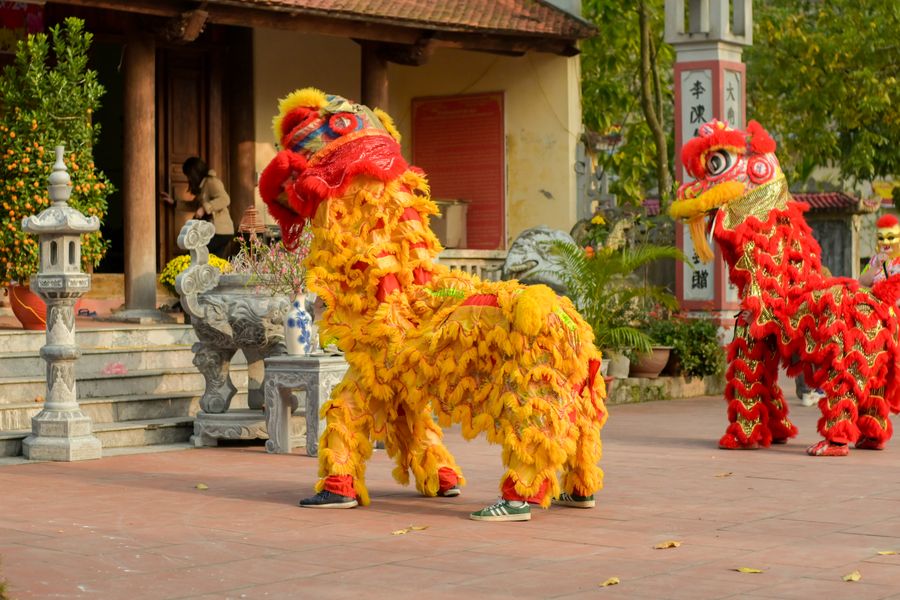
For families on Cheung Chau, being chosen to carry a Piu Sik child is a status honour — some lineages have carried the same platforms for generations. The parade winds through narrow village streets while lion dance teams and marching bands follow, and the whole island turns out, dressed up, cameras raised. If you've ever wondered what the old Cantonese wedding tea ceremony feels like multiplied by a thousand neighbours — this is it. If you're planning to join the day, a Cotton Tree Flower fanny pack is exactly the kind of light, hands-free gear that works for ten hours of walking narrow lanes.
1978: The Tower That Fell
For most of the 20th century, the finale of the festival was the Bun Scramble (搶包山 / coeng2 baau1 saan1). At midnight on the last night, hundreds of young men would scale the three bamboo towers barefoot, racing to grab as many ping on buns as possible. The higher the bun, the greater the luck for the climber's family — so the scramble started at the bottom and became a swarming climb up the sides of the tower.
In 1978, during one of these scrambles, one of the towers collapsed under the weight of the climbers. More than 100 people were injured. Colonial authorities banned the scramble immediately. For 27 years, the towers were still built — but they were decorative only, roped off, climbed by nobody.
2005: The Scramble Returns
On May 15, 2005, after years of lobbying by Cheung Chau residents who felt the heart of their festival had been removed, the scramble came back — rebuilt as a regulated sporting event. The tower is now a steel core wrapped in bamboo and plastic buns (not real ones — the real ones are distributed separately). Climbers wear harnesses and helmets. They qualify through pre-trials. The competition is timed: three minutes to climb, grab, and descend with as many buns as possible, with points weighted by height.
Purists grumbled. The old scramble was chaos, risk, prayer, and sweat. The new one is a sport. But most islanders came around — the modern version has pulled in a new generation of climbers, including women, who were historically excluded. In 2006, Kwong Chun-fai became the first "Bun King"; a year later, Wong Hoi-wah became the first "Bun Queen." The tower has grown in meaning: it's no longer only a religious act, but a very Cantonese story about rebuilding a tradition on top of its own near-collapse.
平安
ping4 on1 — Jyutping romanisation
Meaning: Peace and safety; wellbeing.
Explanation: The red character stamped on every bun on the tower. 平安 is the Cantonese catch-all for the thing you wish for the people you love — bigger than money, bigger than success. "May the household have ping on" is what grandmothers say before anything else. Keep an ear out for it; once you can spot it, you'll hear it everywhere.
If you're flying in from the diaspora specifically to catch the festival — Vancouver, SF, Melbourne, London — half the pleasure is sharing it with people from home. The 得閒飲茶 Let's Catch Up hoodie is exactly the shirt for that message: come home, let's eat, let's walk through the Piu Sik parade together.
Why Cheung Chau's Festival Matters More Than It Looks
In an era when most Hong Kong traditions are quietly disappearing — the old Cantonese opera stages, the hand-painted neon signs, the dai pai dong stalls — Cheung Chau's festival has done the opposite. It has grown. It attracts tens of thousands of visitors every year. Hong Kong's Chief Executive attends. It is recognised as part of China's intangible cultural heritage list and is now a signature of Hong Kong's tourism calendar.
The reason, you suspect, is that the festival is strange enough to be irreducible. You cannot flatten floating children on sword tips. You cannot gentrify a bun tower. You cannot smooth over the fact that the whole thing started because a plague wiped out a village and the survivors made a promise. For the Cantonese diaspora, that stubbornness is the point. Cheung Chau's Bun Festival endures because it refuses, politely but firmly, to be anything other than itself.
And if you've never been — this is the year. The ferry from Central runs every half hour. Dress light. Eat the vegetarian noodles. Buy a ping on bun. Catch the Piu Sik parade in the afternoon, the lion dances through the evening, and stay up for the midnight scramble. You will come home with 400 photos and a quiet understanding of why Hong Kong, for all its glass-tower modernity, is still a Cantonese fishing village at heart. For dressing the part all year round, the Cotton Tree Flower hoodie 木棉花 wears the kind of heritage motif that fits right in on the island.
📖 Related Articles
👉 Shop the Accessories collection
Modern streetwear for the global Cantonese community.