

Walk into a Hong Kong cha chaan teng at 8am on a Tuesday and listen. You'll hear a chaos of shouted orders that sounds, to the untrained ear, like a secret handshake society. "凍橋茶走冰!" "一個常餐,走色!" "咖啡茶,加底!" The waiter scribbles something on a tiny slip of paper that looks less like letters than hieroglyphs. The kitchen fires it back in two minutes. Nobody writes anything in English. Nobody slows down. This is cha chaan teng culture — one of the most efficient ordering systems in global food, and one of the most beautiful bits of living Cantonese.
A cha chaan teng (茶餐廳, caa4 caan1 teng1) literally means "tea restaurant." It emerged in post-WWII Hong Kong when the city's working class couldn't afford Western restaurants but still wanted a taste of what colonial Hong Kong was selling — milk tea, pork chop rice, baked spaghetti. In the 1950s and 60s, these affordable diners exploded across every neighbourhood. Today they're woven so deeply into Hong Kong family food culture that you can't claim Cantonese identity without one strong opinion about where to get the best milk tea.

Why the codes exist
Cha chaan teng codes aren't a gimmick. They're a tool. A busy diner serves 400 customers between 7am and 10am. Writing out "iced lemon tea without ice" for every order would collapse the entire system. So Cantonese waiters developed a shorthand so compact that a single character can carry a drink's entire personality — hot or cold, sweet or unsweet, with or without milk, extra noodles or less rice.
The system has two building blocks that unlock almost everything else: 走 (zau2, "walk") means leave something out, and 加 (gaa1, "add") means put more in. Learn those two and you can bluff your way through 70% of a cha chaan teng menu.
The drink codes every Hong Konger knows
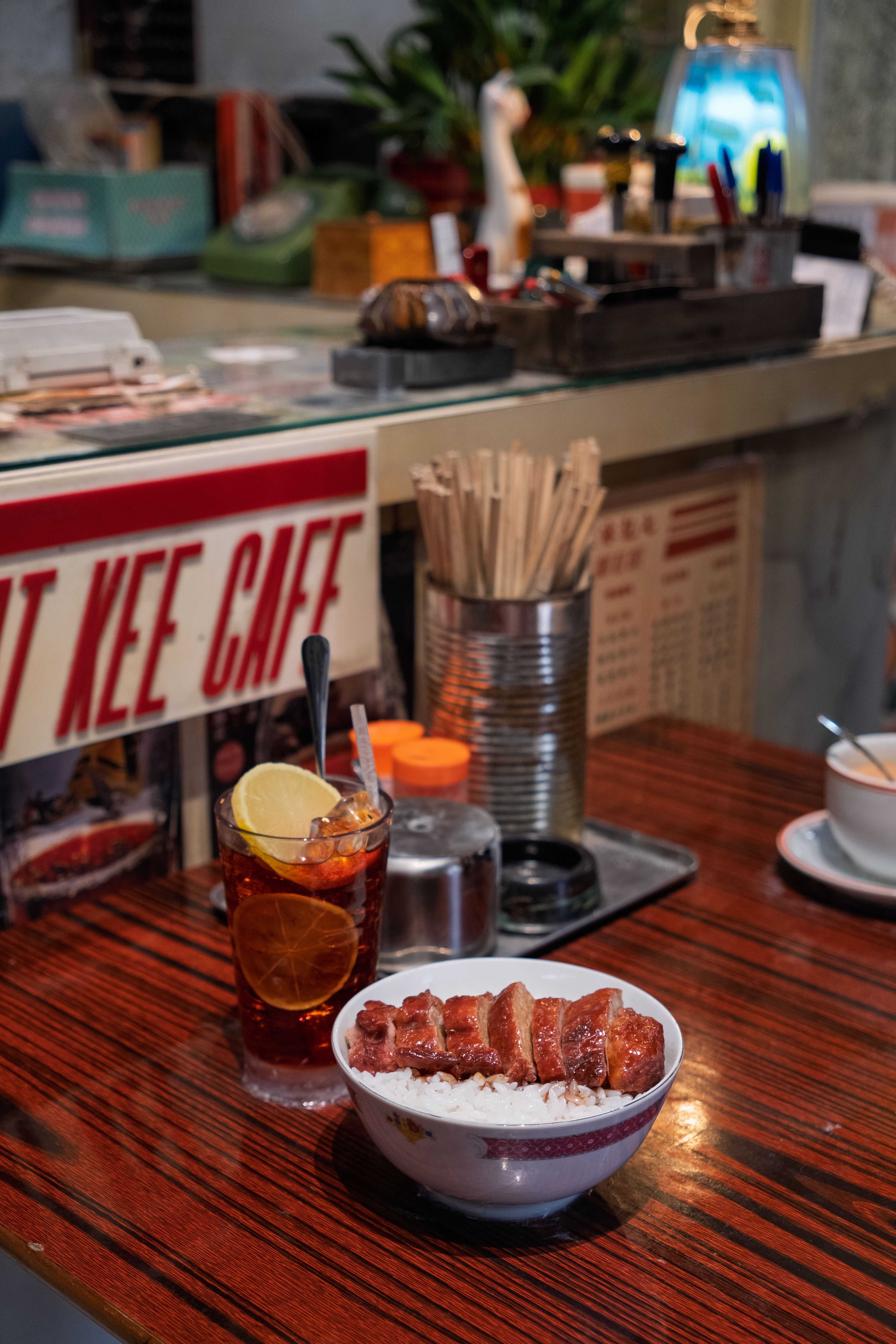
凍橋茶走冰 (dung3 ling4 caa4 zau2 bing1) — iced lemon tea without ice. Yes, iced tea without ice. The logic: ice dilutes the drink as it melts, so you ask for the drink to be made cold at the kitchen stage but served without cubes. Classic Hong Kong frugality meets flavour engineering.
飛砂走奶 (fei1 saa1 zau2 naai5) — "fly the sand, walk the milk." Black coffee with no sugar and no milk. 飛 (fly away) is a playful cousin of 走 (walk away) — both mean "leave it out" but 飛 is almost always used with sugar.
鸳鴦 (jyun1 joeng1) — the Hong Kong invention that fuses coffee and milk tea in one cup. Named after the mandarin duck, a bird that always appears in pairs. The drink was officially inscribed into Hong Kong's first Intangible Cultural Heritage Inventory in 2014, alongside milk tea, pineapple bun, and egg tart.
0T (ling4 T) — iced lemon tea. The 0 is read as "ling" in Cantonese, which sounds like 橋 (ling4, lemon). The T is just T, for tea. So "0T" literally spells out "lemon tea" using numbers and letters a waiter can scribble in one second.
All of these fit on a Hong Kong order slip the size of a receipt. A waiter writes "0T 走冰" and the kitchen knows exactly what to pour.
The food codes that save your lunch break
走青 (zau2 ceng1) — no spring onion. 青 (green) stands in for all green garnishes — scallions, coriander, chopped greens. If you hate the taste of raw onion in your congee, this is the magic word.
加底 (gaa1 dai2) — more rice/noodles underneath. Literally "add bottom." Useful when you're starving and the standard portion won't cut it.
扣底 / 走底 (kau3 dai2 / zau2 dai2) — less rice/noodles. The anti-加底. Perfect for a light lunch or when you're trying to leave room for a bowl of double-skin milk after.
反 (faan2) — the hieroglyph on your receipt that means "plain rice." Waiters write this one character and the kitchen plates a bowl of white rice. One of the most compressed pieces of Cantonese shorthand in existence.
行街 (haang4 gaai1) — takeaway. Literally "walk the street." If you want your pork chop rice in a box, you say "行街" and the aunty packs it up. There's no English equivalent that captures the mental picture — eating while strolling through Mong Kok at night.
👕 Wear the ritual
- 得閒飲茶 Let's Catch Up sweatshirt — the phrase every Cantonese person uses to mean "let's meet at a cha chaan teng or yum cha spot."
- 飲湯 Yum Tung oversized tee — because every proper cha chaan teng meal ends with a bowl of soup.
The unspoken etiquette
The code system has rules of politeness nobody writes down. You call the waiter 阿姐 (aa3 ze1, "big sister") or 靈仔 (leng3 zai2, "handsome young man") depending on their age. You order fast or you lose your spot. You never ask for the menu to be explained — you point and improvise. You pay at the counter on your way out, not at the table.
And the ultimate cha chaan teng rule: you never, ever stay longer than it takes to eat. The booth behind you has a queue of打工仔 waiting. 搵食 waits for no one.
Why these codes matter beyond ordering lunch
Cha chaan teng codes are proof that Cantonese is a living, working language — not a museum piece. They evolved on restaurant floors, under pressure, among people with no time to be elegant. They're pragmatic, playful, and deeply local. If you grew up in Hong Kong, you learned them the way you learned to cross the road. If you grew up in the diaspora, learning them is a kind of homecoming.
Next time you're in Kowloon at 7am, order "凍鸳鴦走冰加底" and watch the waiter nod without blinking. You've just spoken fluent Hong Kong.
📖 Related Articles
👉 Shop the Mami Says collection
Modern streetwear for the global Cantonese community.