

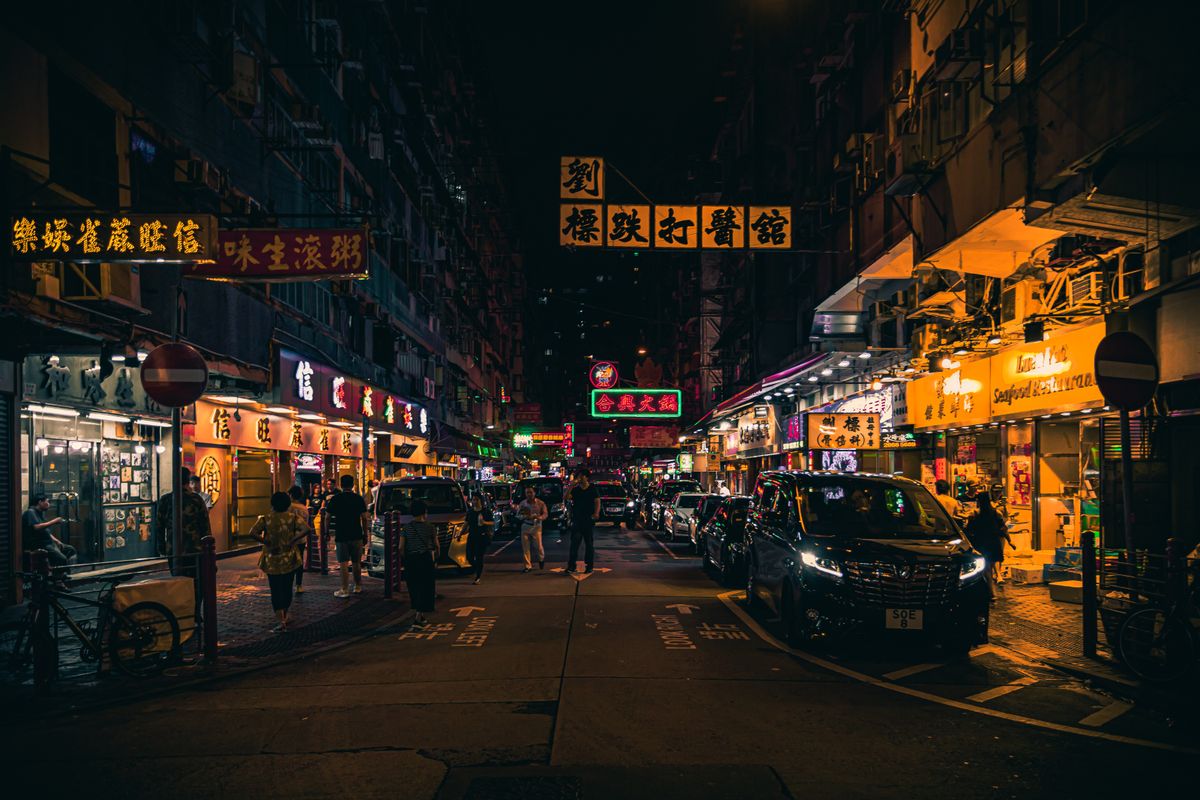
There is a specific quality to the air of a Hong Kong night market. It carries the smoke from a charcoal grill, the steam from a pot of fish balls simmering in curry, the fatty sweetness of roasting chestnuts, and beneath all of that, the human warmth of a few hundred people crowded into a street that was never designed for this many bodies and this much life. Hong Kong's night markets are not tourist attractions, though tourists inevitably find them. They are how the city eats — on its feet, in the open air, surrounded by noise and neon and the particular pleasure of food that asks nothing of you except that you eat it while it is hot.
Temple Street: The Original
Temple Street Night Market in Jordan, Kowloon, is the most famous of Hong Kong's night markets — and one of the most famous night markets in Asia. Named after the Tin Hau Temple (天後庙) that anchors the middle of the street, Temple Street comes alive each evening as stalls are assembled from folding tables and poles, and the narrow road is transformed into a dense corridor of vendors selling everything from electronics and counterfeit watches to jade jewellery and second-hand books.
But at the street food end of Temple Street, the atmosphere is something different again. Here, open-air restaurants set out plastic stools and folding tables on the pavement. Crabs and prawns are displayed live in tanks; you choose what you want and it arrives fried, steamed, or cooked in black bean sauce within minutes. Dai pai dongs (大牌檔) — licensed open-air food stalls that were once common throughout Hong Kong but have gradually disappeared over decades of urban redevelopment — survive here, cooking the same dishes they have served for generations: typhoon shelter crab (避風山蜘蒂), oyster omelette (貔仙4袓), and clay pot dishes that arrive still bubbling at the table.
Mong Kok: The Most Hong Kong Place on Earth
If Temple Street is famous, Mong Kok (望角) is legendary. One of the most densely populated urban districts in the world, Mong Kok concentrates an almost impossible amount of activity into a few square kilometres: markets for goldfish, birds, flowers, and ladies' fashion all occupy dedicated streets within blocks of each other. And threading through all of it, at all hours, is food.
The street food of Mong Kok is Hong Kong street food at its most concentrated. Egg waffles (鷥蛋仙4, gai1 daan2 zai2) — the grid-patterned, ball-shaped waffles that have been copied by food trucks worldwide but are best eaten fresh from Mong Kok — are made to order in long-handled moulds held over gas flames. Stinky tofu (臭豆腐, cau3 dau6 fu6), fermented and pungent and deeply savoury, is sold from mobile carts whose location you can identify from two streets away. Grilled squid, curry fish balls, taro balls, and tang yuan compete for your attention at every intersection.
The Dai Pai Dong: A Disappearing Institution
No discussion of Hong Kong street food is complete without acknowledging the dai pai dong — the open-air cooked food stall that was once as ubiquitous in Hong Kong as the double-decker tram. The name comes from the large licence plates (大牌, daai6 paai4) originally issued by the government to licensed street food operators, many of whom were dependants of civil servants who died in service. At their peak in the 1950s and 1960s, there were over 3,000 dai pai dongs across Hong Kong.
The government gradually stopped issuing new licences and prohibited the transfer of existing ones, meaning that as operators aged or died, their stalls closed. Today, fewer than 30 traditional dai pai dongs remain — most of them clustered in a handful of streets in Sheung Wan, Sham Shui Po, and around the Graham Street Market in Central. Their survival is precarious, but each one that endures is a living connection to the post-war Hong Kong that built the city's food culture from the ground up, with gas flames and folding tables and the absolute conviction that a great meal should never cost more than a working person can afford.
What Street Food Tells Us About Cantonese Culture
The night market is not simply a place to eat cheaply. It is an expression of Cantonese values: the belief that good food should be democratic, that the pleasure of eating is a communal rather than private experience, and that the best meals are often made in the open air by people who have been perfecting a single dish for decades. The dai pai dong master who has been making the same wok-fried clams in black bean sauce for forty years is as much a cultural custodian as any museum curator.
This democratisation of culinary excellence is at the core of what makes Cantonese food culture distinctive. As we wrote in our exploration of wok hei and the philosophy of Cantonese cooking, the fire of a Cantonese kitchen is not reserved for the wealthy. It is the fire of the street corner, the market stall, the night market cart — available to everyone, demanding nothing but appetite and willingness to stand at the side of the road and eat.
Finding the Night Market Spirit Wherever You Are
For the Cantonese diaspora, the night market is one of the most keenly missed sensory experiences of home. No restaurant, however good, fully replicates the specific pleasure of eating on a plastic stool at the edge of a crowded, smoke-filled, neon-lit street. But diaspora communities have found ways to approximate and honour it: the summer night markets of Richmond, BC; the Lunar New Year markets in Cabramatta, Sydney; the Chinatown street fairs of San Francisco and New York. Each of these is an attempt to recreate, in a new geography, the essential Cantonese conviction that the best place to eat is outside, in public, with other people, and as late into the night as possible.
The night market is not a nostalgia trip. It is a living cultural form — one that the Cantonese have been practicing for generations and that travels with them wherever they go. Like the Cantonese diaspora itself, it adapts, persists, and continues to feed the community that carries it forward.
📖 Related Articles
👉 Shop Cantonese Guy — Modern Streetwear for the Global Cantonese Community