

Around 9:25 on the night of 24 December 1953, somebody in a squatter shack in the Shek Kip Mei hillside of Kowloon knocked over a kerosene lamp. By 11 o'clock the fire had jumped lanes and was consuming the whole settlement. By the time it was finally put down at 2:30 the next morning — Christmas Day — a hillside of 2,580 shacks was gone and roughly 53,000 people were sitting on the burned ground with the clothes they stood up in.
The colonial Hong Kong government had been planning, in a slow and theoretical way, to think about housing eventually. The Shek Kip Mei fire ended that. Within six weeks, the Governor's office had committed to building emergency resettlement blocks for every family on the site. Within fifteen months the first H-shaped seven-storey towers were occupied. Those H-blocks — concrete, communal, cramped and desperately welcome — are the moment Hong Kong public housing (公屋, gung1 uk1) was born. Half the city still lives in buildings that descend directly from them.

The Fire That Rewrote the Colony
In 1953 Hong Kong's population had just crossed two million, inflated by waves of refugees from the mainland after 1949. There was nowhere near enough housing. Hillside squatter settlements of corrugated iron, wood and tar paper covered the slopes of Shek Kip Mei, Kowloon Tong, Chai Wan and Tsz Wan Shan. These were not slums in the sense of neglected buildings; they were improvised cities built by the people who lived in them, with no plumbing, no fire breaks, and no public assistance.
The Shek Kip Mei fire — the single largest incident in a long chain of similar fires — turned "the housing problem" into "the housing emergency." Governor Sir Alexander Grantham personally walked the burned hillside the next morning. The decision to build was both humanitarian and tactical: these were refugees, and they were not going anywhere.
Mark I: The Seven-Storey H-Block
The first permanent resettlement estates — the "Mark I" blocks that went up through 1954 on the burned Shek Kip Mei site — were brutally functional. Seven storeys of reinforced concrete arranged in an H plan, with the two long wings holding the living units and the cross-bar in the middle holding communal toilets, communal showers and communal kitchens. One room per family, no interior plumbing, no private cooking facilities. A family of five got about 120 square feet.
By today's standards it reads as inhuman. In 1954 it was a miracle. A family that had been sleeping on burned ground in December had a lockable door, a concrete roof, and electric light by the following summer. The rent, when it came in, was a fraction of market rate; the queue to get in stretched down the hill.
From Mark I to the Hong Kong Housing Authority
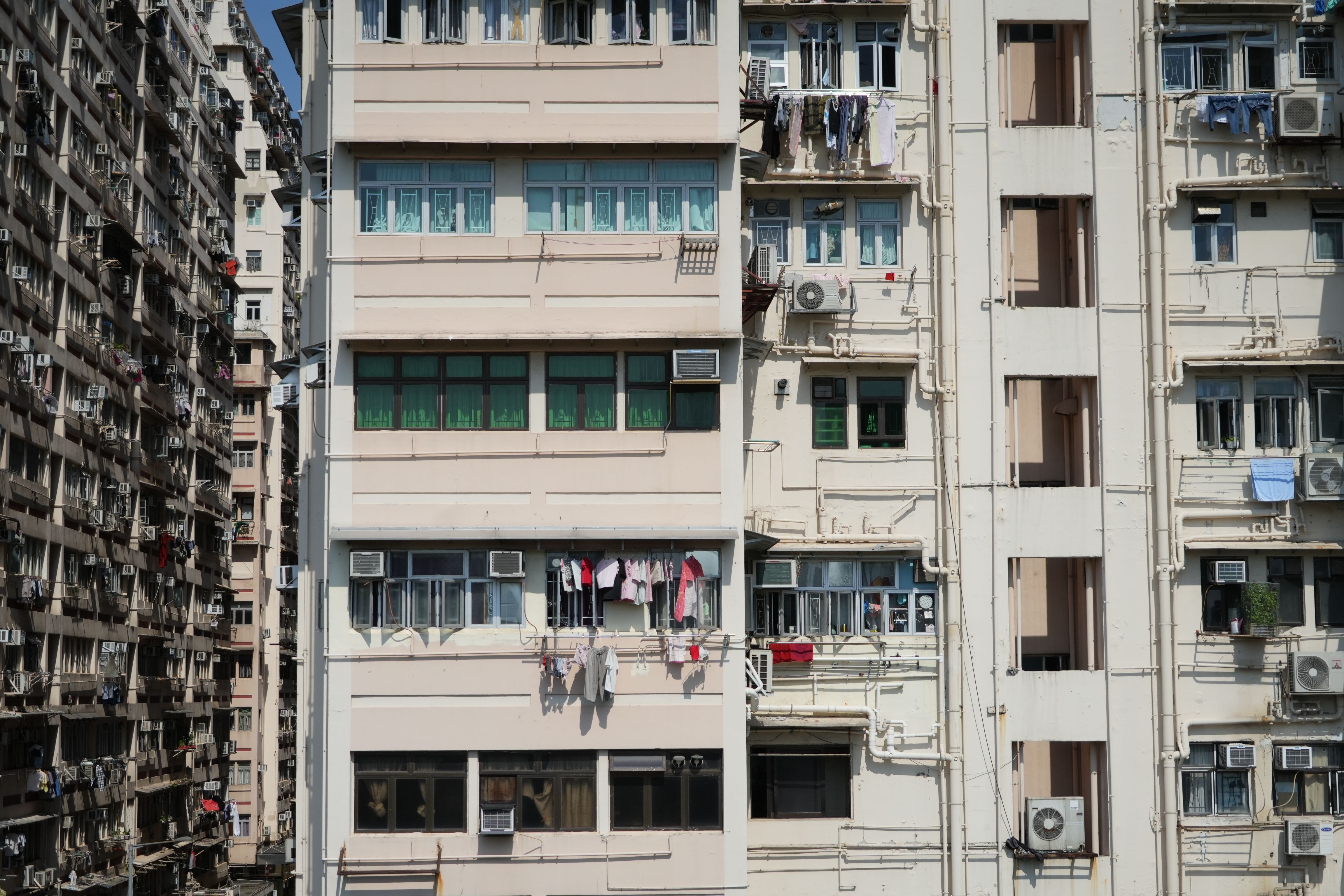
Through the 1950s and 1960s, successive "Mark" generations improved on the original: Mark II added private kitchens, Mark III got private toilets, Mark IV let in proper lifts. By 1973, Governor Sir Murray MacLehose folded the ad hoc resettlement machinery into a single Hong Kong Housing Authority and launched the Ten-Year Housing Programme — a commitment to rehouse 1.8 million people into self-contained flats by 1983. The architectural vocabulary shifted to the double-decker-style, double-tower "Twin Tower" and "Trident" blocks you still see from Choi Hung to Lam Tin.
Today, 44% of Hong Kong's population — more than three million people — live in some form of public housing, split between rental public housing (公屋) and subsidised Home Ownership Scheme flats (居屋). The Hong Kong Housing Authority manages one of the largest public housing portfolios on earth. Mei Ho House, the last standing H-block from the original 1954 Shek Kip Mei estate, has been preserved as a museum — a monument to the night a kerosene lamp changed a city.
🏢 The Design DNA Everyone Knows
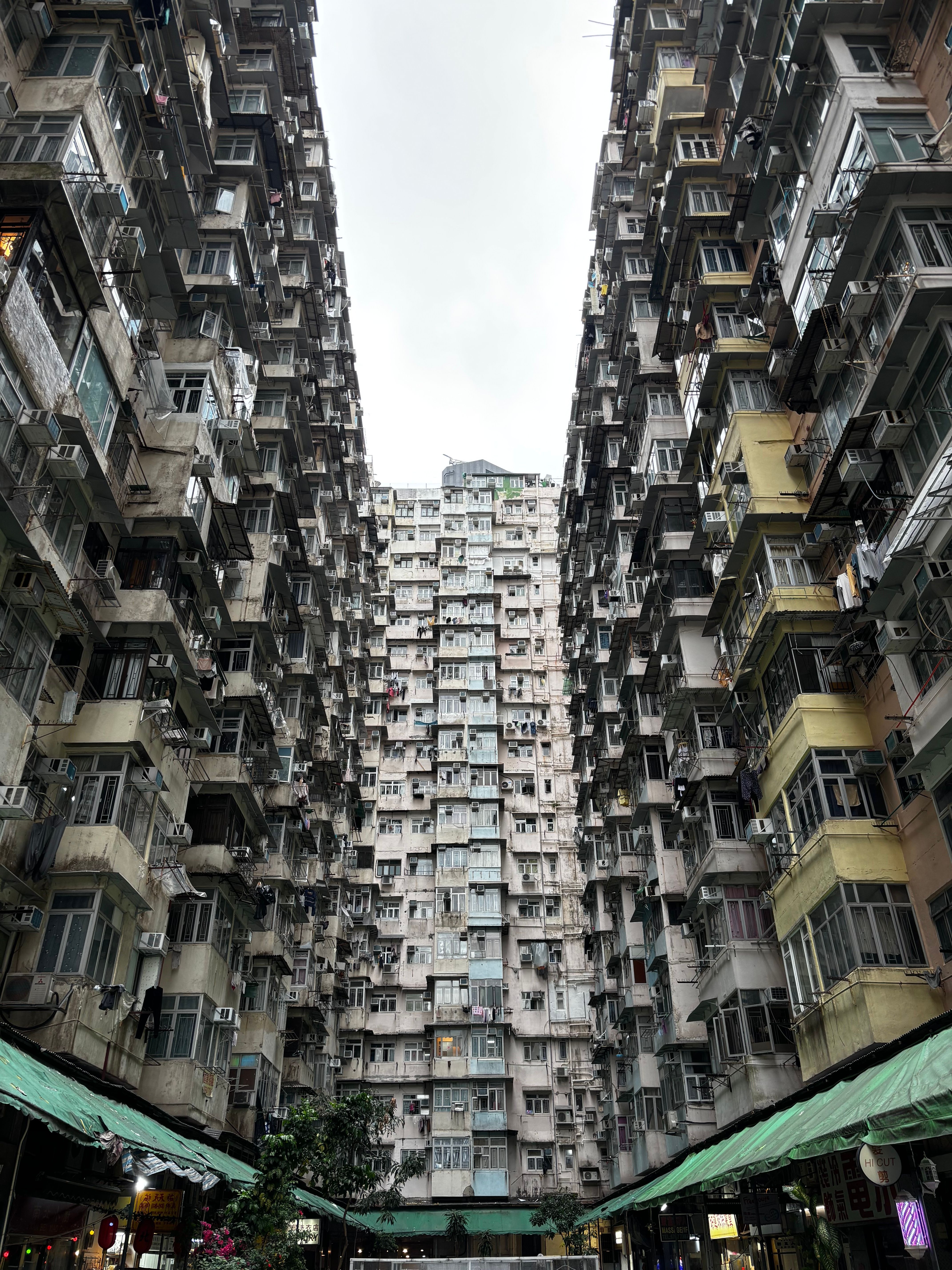
If you have ever seen a photograph of Choi Hung Estate's rainbow-coloured basketball court, Lok Wah's Y-block symmetry, or the tightly stacked pastel balconies of Shek Kip Mei, you have seen Hong Kong public housing in its mature form. Instagram knows these buildings because they are visually unlike anything else: brutalist, repetitive, unapologetically dense, and quietly beautiful at scale. Film directors from Wong Kar-wai to Fruit Chan have shot them because they understand that these estates are not the backdrop of Hong Kong life — they are Hong Kong life.
A Culture Built on 400 Square Feet
Growing up in gung1 uk1 created a specific Cantonese cultural vocabulary that outlasted the architecture. Communal corridors meant everybody knew everybody; aunties kept watch on each other's kids; the lift bank was the de facto meeting room of the floor. Public housing cooking — made in a tiny galley kitchen with one wok and a two-burner stove — produced the shortcut-genius cuisine that cha chaan teng culture later borrowed from.
Mum's advice in a gung1 uk1 flat is universal: wear more layers because the corridor is drafty, come home earlier because the lift breaks after 10pm, finish your rice because you don't know when you'll be back for dinner. The 著多件衫 Wear More Layers hoodie and the 早啲返屋企 Come Home Earlier oversized T-shirt are, more than anything else, the exact sentences a Hong Kong mum would shout from the gung1 uk1 kitchen as you ran out the door.
The Public Housing Word Every Hong Konger Knows
屋邨
uk1 cyun1 — Jyutping romanisation
Meaning: A housing estate; specifically, a public housing estate.
Explanation: 邨 is an older variant of 村 ("village"), and the Housing Authority deliberately chose it to signal that these were not just buildings but communities. "我住喺乜嘢屋邨" (what estate do you live in?) is one of the fastest ways two strangers from the same corner of Hong Kong can place each other — the estate name tells you where, when and how someone grew up.
Why Public Housing Explains Hong Kong
Most cities put their skyline in the central business district. Hong Kong puts its skyline in the housing estates of Kwai Chung, Sham Shui Po, Tin Shui Wai and Tseung Kwan O. The social contract of modern Hong Kong — that the government will build you a flat you can afford if you cannot afford one on the open market — was written in the Shek Kip Mei fire and signed off by Sir Murray MacLehose in 1972. It is the single piece of policy that most reliably defines what it means to live in this city.
It is also, if you grew up in it, the sound of children's slippers scuffing against polished concrete, the smell of your floor's communal kitchen at 6pm, the trellis gate of flat 2706 that your grandmother opened for the postman every morning, and the dai pai dong on the ground floor where the aunties congregated for breakfast. The buildings are concrete. The neighbourhood is Cantonese.
And when a Hong Konger in London or Toronto or Sydney says they miss "home," what they often really mean is the specific echo of the lift lobby in the estate they grew up in. The 廣東仔 CANTONESE GUY oversized T-shirt is the shortest possible way to carry that specific home with you.
📖 Related Articles
👉 Shop the Mami Says collection
Modern streetwear for the global Cantonese community.