

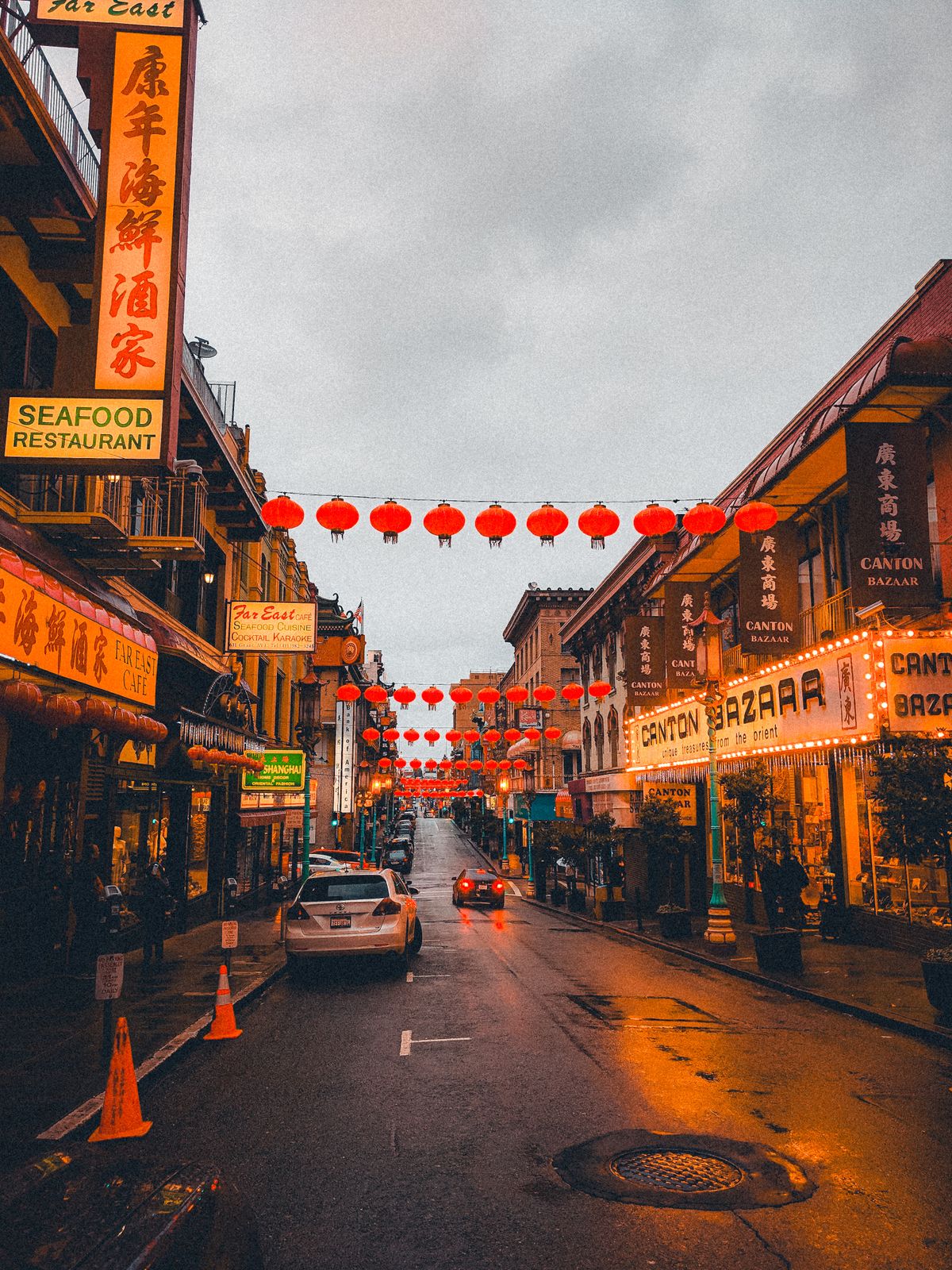
Almost everything you picture when you hear the words “San Francisco Chinatown” — the flared pagoda roofs, the dragon-wrapped lampposts, the golden temple filigree above Grant Avenue — didn't exist before 5:12 a.m. on 18 April 1906. That's when the 7.9-magnitude earthquake flattened the neighborhood, and a Cantonese businessman named Look Tin Eli looked at the rubble and made a decision that would define how the whole Western world imagined “Chinatown” for the next century. This is the story of the oldest Chinatown in North America — built by Cantonese gold-rush migrants in 1848, wiped out in 1906, and rebuilt by the same community as something the city had never seen before.
A Cantonese village of the Gold Rush
San Francisco Chinatown began the same year California's gold rush did. In 1848, gold was discovered at Sutter's Mill, and the news reached Guangdong within months via the Pearl River trade networks. The first Cantonese migrants arrived that year and set up on what were then Dupont Street (now Grant Avenue) and Stockton Street — the streets that still anchor the neighborhood today. They were almost entirely Cantonese, and specifically from three regions: Sze Yup (the four counties around Taishan), Sam Yup (the three counties around Guangzhou), and Zhongshan. They spoke Toisanese, Cantonese, and Zhongshanese variants of the Yue language, and they organised themselves the way Cantonese villages organise themselves everywhere — by home district.
The first district association, the Kong Chow Company, was formed in 1850. The Sam Yup Company followed in 1851. By 1862, six district associations had merged their boards into the Chinese Consolidated Benevolent Association — known everywhere in Cantonese America as the Chinese Six Companies (中華总會館) — which would remain the most powerful institution in Chinese America for the next hundred years. If you want the diaspora identity in a single sentence, it's stitched into our 廣東仔 CANTONESE GUY oversized tee — an entire people whose origin story keeps travelling.
Exclusion, opium panic, and the drumbeat toward 1906
By the 1870s, San Francisco Chinatown was tens of thousands of Cantonese men crammed into fifteen city blocks, and white San Francisco was in a full moral panic about it. The Chinese Exclusion Act of 1882 cut off almost all new immigration. Sensationalist newspapers ran endless features about opium dens, tongs, and “oriental vice” that were more fiction than reporting. Politicians openly campaigned on the idea that Chinatown should be seized and its residents pushed south of Market or out to Hunter's Point. On the morning of 17 April 1906, the future of the neighborhood already looked precarious. By dawn the next day, it looked impossible.
The earthquake, the fire, and the plan
The 1906 earthquake hit at 5:12 a.m. and the fires that followed burned for three days. Chinatown — mostly wood-framed Italianate buildings covered with signage — was completely destroyed. Within days, city government officials were openly saying the quiet part out loud: this was their chance to relocate the Chinese out of the city center for good. City Hall proposed moving Chinatown to Hunter's Point.
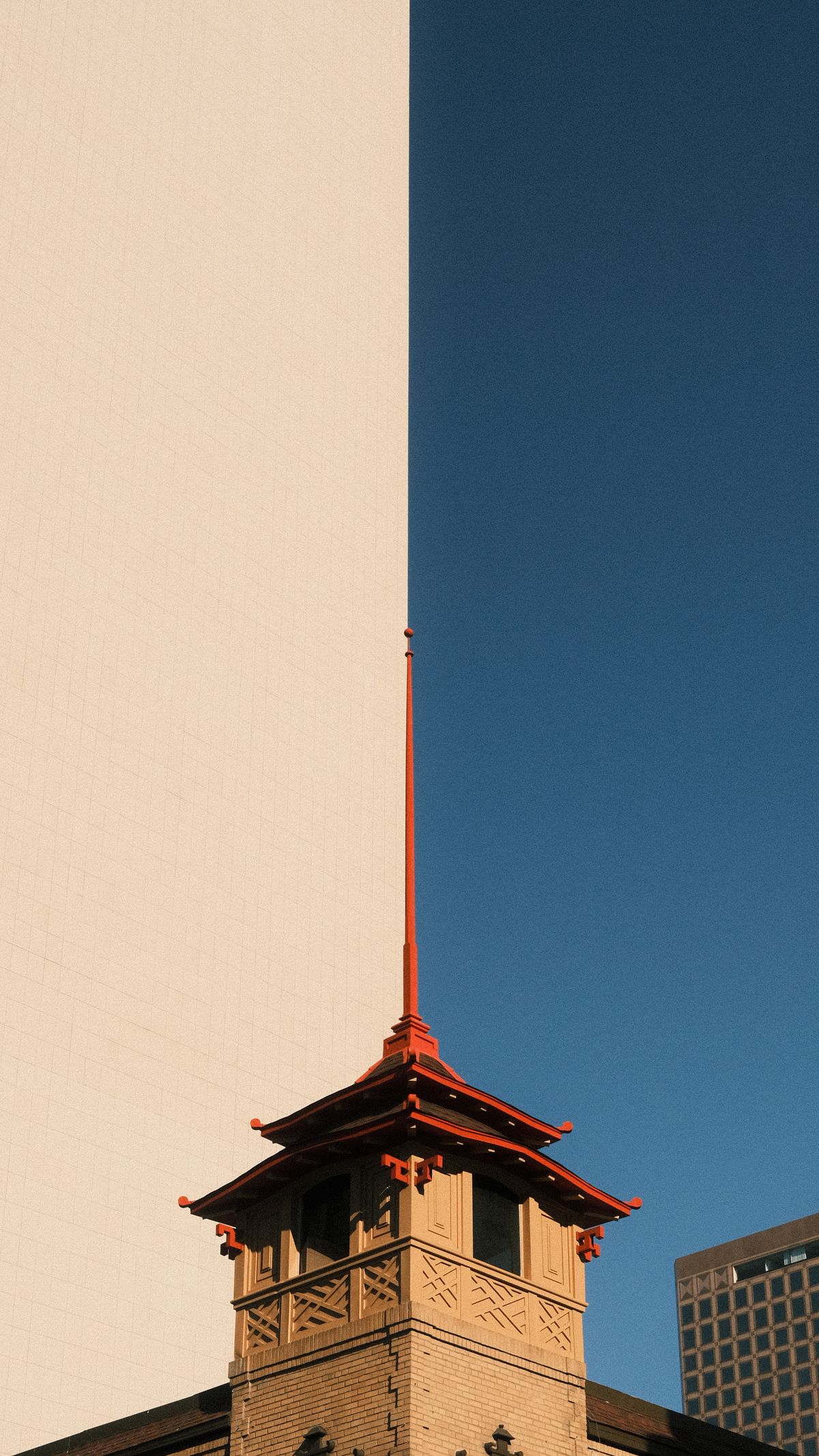
A Cantonese merchant named Look Tin Eli — born in Mendocino, educated in China, then back in San Francisco running the Sing Chong Bazaar — saw exactly what was coming. His counter-move was as strategic as anything in the neighborhood's history. If the city wanted them gone, he would rebuild Chinatown as something no other American city had — something so visually distinctive, so good for tourism revenue, that City Hall would not dare tear it down. He hired the American architectural firm of Ross & Burgren and asked them to design American-standard commercial buildings, but crowned with flared pagoda roofs, curled eaves, dragon motifs, coloured tile, and multi-storey verandas. Nothing in Guangdong actually looked like that. It was a deliberate, exaggerated, fantasy version of “China” designed for a Western audience.
Sing Chong, Sing Fat, and the birth of the pagoda skyline
The rebuild started with two anchor buildings on the corner of Grant Avenue and California Street: the Sing Chong Building and the Sing Fat Building, both completed by 1908. Both featured flared multi-tiered pagoda-style roofs, upturned eaves, and green tile detailing. They were, more than any single project, the birth of the aesthetic we now think of as generic “Chinatown” in every North American city that followed — New York, Vancouver, Toronto, Boston. Look Tin Eli's pitch worked. Chinatown stayed. City Hall got its tourism revenue. The neighborhood pulled the Chinese Six Companies, the herbal shops, the family associations, the temples, the newspapers, and the restaurants back onto the same fifteen blocks. Every Chinatown you have ever walked through in North America is, in some way, a descendant of what Look Tin Eli commissioned in 1906.
What SF Chinatown means to the Cantonese diaspora
Today, San Francisco Chinatown still runs on Cantonese — not Mandarin — in a way most American Chinatowns have long since stopped. Newer waves of migration have added Mandarin-speaking communities elsewhere in the Bay Area (Sunset District, then Cupertino and Fremont), but Grant Avenue and Stockton Street remain a Cantonese-speaking core. Family associations are still active. The Chinese Six Companies still sits at 843 Stockton Street. Herbal medicine shops still write prescriptions in classical Chinese. The Grand View restaurant and the Sam Wo cafe still take dim sum orders in Toisanese as often as Cantonese. And on the first day of Lunar New Year, the parade down Grant Avenue reliably draws half a million people — the largest Lunar New Year parade outside Asia.
For the global Cantonese community, SF Chinatown is a reminder that our diaspora didn't just arrive somewhere — we built something. We buried our people in Colma. We paid the head taxes. We survived the exclusion. We watched our neighborhood burn and we rebuilt it more visible, not less. That instinct — to show up more loudly the moment someone tells you to disappear — is exactly what our Black Logo T-shirt is built for. And the same instinct that put pagoda roofs on Grant Avenue in 1908 is the one our Cotton Tree Flower Printing Hoodie 木棉花 puts on your back today — a traditional motif carried forward proudly, without apology.
📖 Related Articles
👉 Shop the Best Seller collection
Modern streetwear for the global Cantonese community.