

In May 2000, a 37-year-old Hong Kong actor stood on the Cannes stage clutching a Best Actor trophy, smiled the same restrained, slightly apologetic smile he'd been smiling all his life, and said almost nothing. Half the audience didn't realise yet that this quiet Cantonese man — the one Wong Kar-wai had filmed in slow motion through smoke and rain for fifteen months — had just become the most internationally awarded Hong Kong actor of his entire generation.
His name is Tony Leung Chiu-wai (梁朝偉, Loeng4 Ciu4 Wai5), and he has spent four decades convincing the world that the most powerful thing a Cantonese actor can do is hold still and let his eyes do the talking.
The kid who almost never made it onto screen
Tony Leung was born in Hong Kong on 27 June 1962, the son of a gambling father who walked out when Tony was a child and a mother who raised him and his sister alone. He has said in interviews that this is why he became an actor: as a quiet boy, he started studying faces to understand the adults around him. The boy who couldn't read his father became the actor who could read anyone.
He met a kid named Stephen Chow at sixteen. They were both restless, both broke, both obsessed with kung fu films. Years later, in 1982, Stephen Chow introduced Tony Leung to TVB's legendary artist training class — and in the cruellest twist, the audition gods picked Tony and rejected Stephen. Tony graduated from the 11th cohort of TVB's training course in 1983. Stephen waited years before TVB would have him.
Hong Kong's "Small Tiger" of TVB
Once inside TVB, Tony Leung was tagged as one of the "Five Tiger Generals" (五虎將) — a young heartthrob unit that also included Andy Lau, Kent Tong, Felix Wong and Michael Miu. He was nicknamed "Small Tiger." It was a marketing label, but it also turned out to be accurate: he was the quiet, dangerous one, the one whose anger you could feel without him ever raising his voice.
🎬 The Wong Kar-wai marriage that took 15 months
Wong Kar-wai filmed In the Mood for Love over fifteen punishing months with almost no script. Tony Leung had to live inside his character — a polite, heartbroken newspaper editor — for over a year, without ever being told exactly what scene they were shooting. He has said in interviews that he sometimes didn't know if the film would ever be finished. When it premiered at Cannes in 2000, it didn't just finish; it became one of the most acclaimed films ever made in Asia.
🎬 The secret whispered into a hole at Angkor Wat
The closing scene of In the Mood for Love shows Tony Leung's character whispering his unspoken love into a hole in the wall of Cambodia's Angkor Wat temple, then sealing it with mud. Wong Kar-wai never told him what to whisper. He just rolled the camera, and Tony improvised the gesture in one take. To this day, no one but Tony knows what he actually said into that wall.
🎬 Flying to Paris alone to feed pigeons
A widely repeated Hong Kong tabloid story claims that after wrapping intense roles, Tony Leung sometimes flew to Paris alone — for one day — just to sit in a square and feed pigeons. He's mentioned versions of this in interviews. Whether it's literal or partly mythologised, it captures the way Hong Kong sees him: a man who needed silence to reset between performances, the opposite of a celebrity.
🎬 The Marvel role that almost didn't happen
When Marvel called in 2019 about playing Wenwu in Shang-Chi, Tony Leung was hesitant. He had never done a Hollywood blockbuster. He told the director he didn't want to play "the Asian villain." Marvel rewrote the part as a heartbroken father — and the resulting performance, much of it in Mandarin, became the most quietly devastating thing in the entire film. Western critics suddenly discovered what Hong Kong audiences had known for forty years: when Tony Leung looks into the camera, you stop breathing.
Seven films with Wong Kar-wai, and a generation of imitators
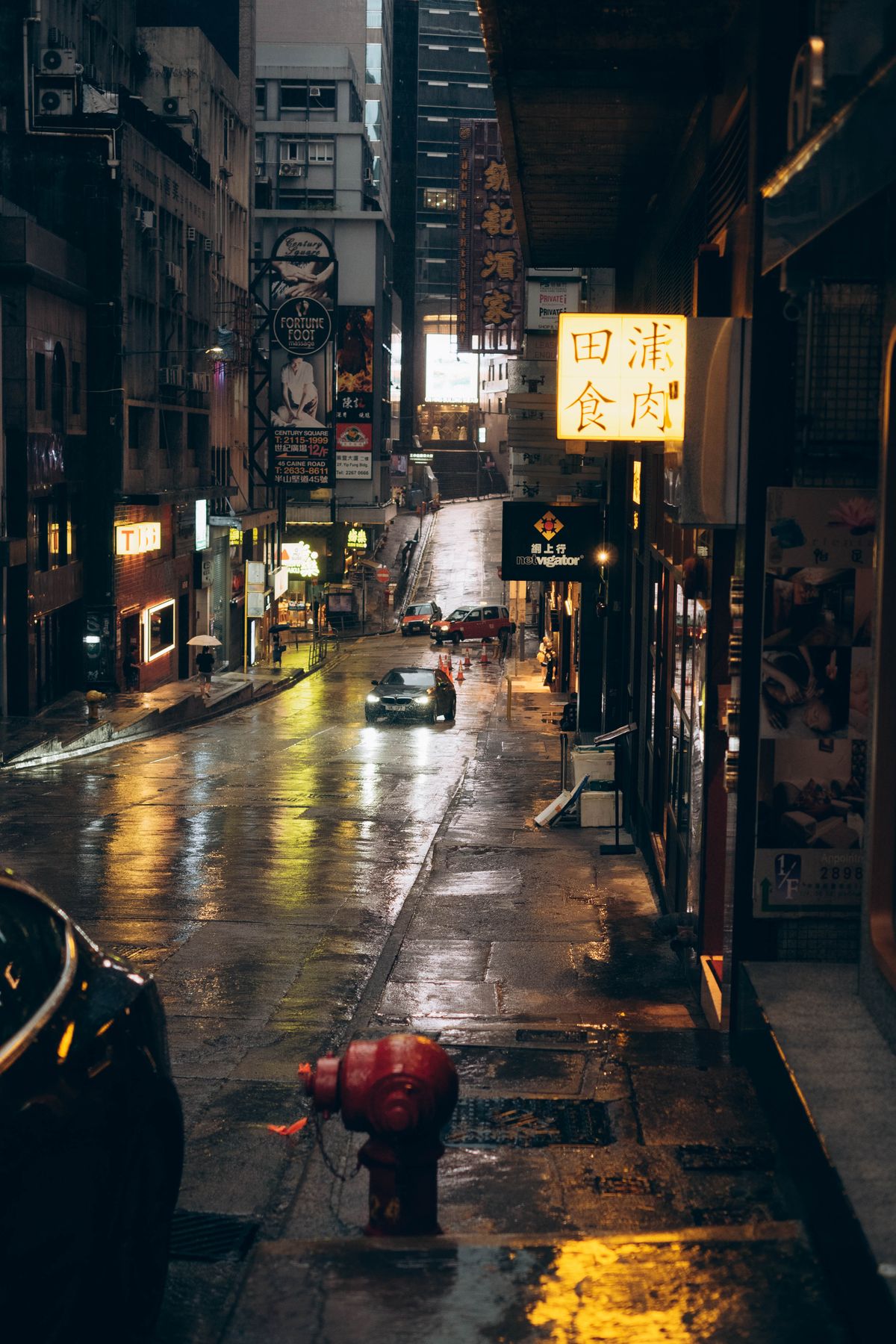
Tony Leung has made seven films with Wong Kar-wai: Days of Being Wild (1990), Chungking Express (1994), Ashes of Time (1994), Happy Together (1997), In the Mood for Love (2000), 2046 (2004), and The Grandmaster (2013). No actor-director partnership in Asian cinema has shaped global film aesthetics more. Every moody, neon-soaked, slow-motion Cantonese music video, every diaspora short film about longing, every art-house ad — they all borrow from what Tony and Wong built together.
If you want to understand the world Tony Leung helped create, start with our piece on Wong Kar-wai, the Cantonese auteur, and then read about the broader movement in the Hong Kong New Wave.
A Cantonese phrase that captures Tony Leung's whole career
含蓄
ham4 cuk1 — Jyutping romanisation
Meaning: Restrained, understated, not putting everything on display.
Explanation: 含蓄 is one of the highest compliments in Cantonese culture, especially in art. It implies that the most powerful expression is the one that holds back. Cantonese aunties have used this word to describe Tony Leung's acting for forty years — and it's also why grannies say a quiet grandchild has good 修養 (cultivation). It's the cultural opposite of "loud."
Why Tony Leung still matters to the Cantonese world
For the global Cantonese diaspora, Tony Leung is something more than a movie star. He's proof that Cantonese restraint — that 含蓄 inheritance, the impulse to hold back rather than perform — can travel the world without ever needing to shout. While Hollywood was teaching its actors to scream, Hong Kong gave us a man who could carry a whole film with one tilt of the head and one cigarette in the rain.
For Cantonese kids growing up far from Hong Kong — in Vancouver, in San Francisco, in London — Tony Leung is a permission slip. You don't have to be loud to be seen. You don't have to translate yourself for anyone. You just have to look at the world the way he does in In the Mood for Love: with deep, patient attention, and a love that doesn't need to explain itself.
📖 Related Articles
👉 Shop Cantonese Guy — Modern Streetwear for the Global Cantonese Community