

In the late 1950s, a teenage Bruce Lee was getting into too many street fights in Kowloon. His parents, worried he'd end up in serious trouble, marched him to a small Wing Chun school in Hong Kong to learn discipline. The teacher was a thin, soft-spoken man from Foshan named Ip Man (葉問). The teenager he met that day would go on to detonate the global image of Asian masculinity. The art Ip Man taught him would shape Hong Kong cinema for half a century — and lay the foundation for nearly every kung fu film, video game, and martial arts dojo that followed.
This is Wing Chun (詠春, wing6 ceon1) — the Cantonese-rooted martial art that quietly conquered the world.
A southern Chinese martial art with a women's origin myth
Wing Chun was born in the Pearl River Delta — Guangdong territory — during the Qing dynasty, sometime in the 17th or 18th century. The traditional origin story, told for generations in Cantonese kwoon (martial schools), credits a Buddhist nun named Ng Mui (五枚師太) who fled the destruction of the southern Shaolin temple. According to the legend, she watched a fight between a crane and a snake and built a new combat system out of what she saw: short, vertical, precise, economical.
She passed the system on to a young woman named Yim Wing-chun (嚴詠春), a tofu seller being pressured into a forced marriage. Yim Wing-chun used the new style to beat her would-be groom in a public fight, kept her freedom, and the art quietly took her name. Whether Ng Mui or Yim Wing-chun ever historically existed is debated by martial-arts historians, but the legend itself is real Cantonese inheritance — a martial art with a woman's name and a refusal-to-marry story at its heart.
Why Wing Chun looks nothing like other kung fu
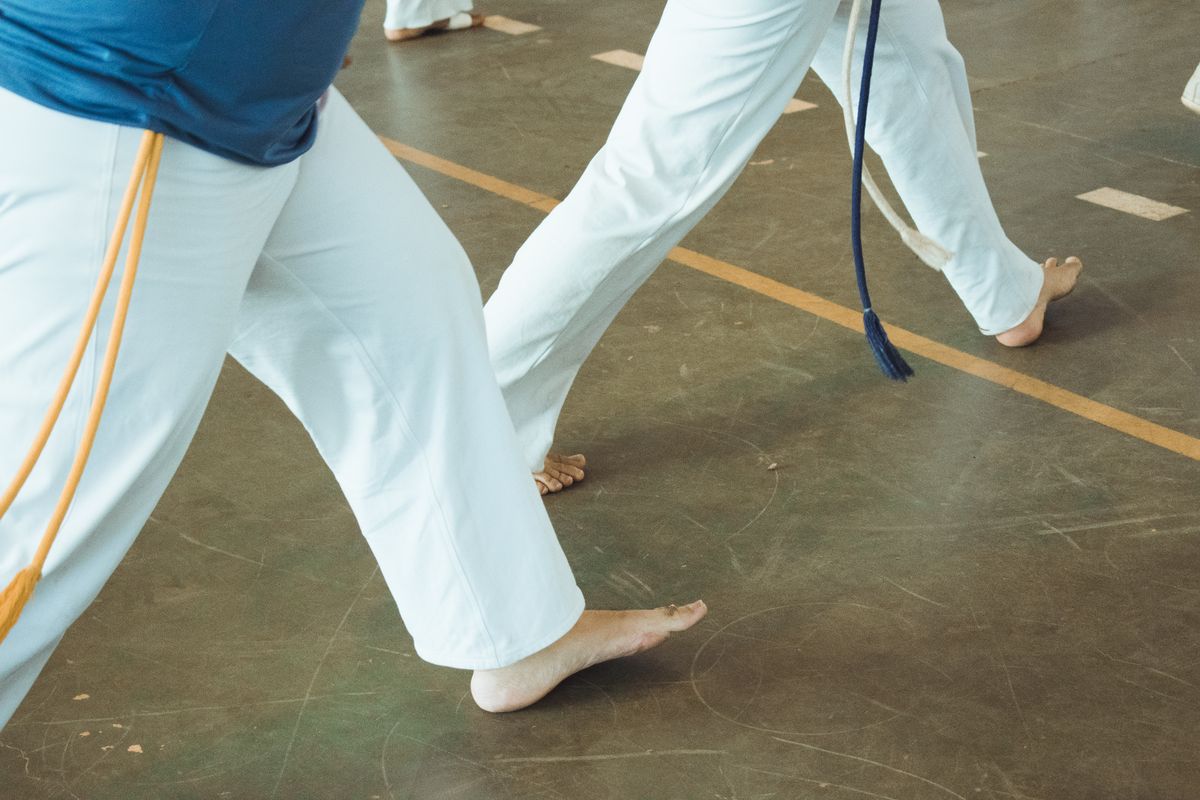
Compared to other Chinese martial arts, Wing Chun looks startlingly modest. There are no spinning kicks, no acrobatic leaps, no roaring stances. The fighter stays compact, the elbows in, the spine straight. Most strikes are aimed at the centreline of the opponent's body — throat, chest, solar plexus. Punches are thrown vertically with the knuckles aligned. Kicks rarely go above the waist.
Wing Chun's whole philosophy can be summed up in three words: economy of motion. The shortest distance between you and the opponent is a straight line, and Wing Chun finds it. It was designed for tight Cantonese alleys, narrow doorways, and the inside of crowded teahouses — places where there's no room to dance, only to end the fight.
🥋 The three forms every Wing Chun student learns
Wing Chun is built around three open-hand forms: 小念頭 (Siu Nim Tau, "Little Idea") teaches the centreline, structure, and economy. 尋橋 (Chum Kiu, "Seeking the Bridge") teaches movement and how to close distance. 標指 (Biu Tze, "Thrusting Fingers") teaches the emergency techniques — what to do when your structure breaks. Many traditional sifus say a student needs at least ten years of patient practice just to understand the first form.
🥋 The wooden dummy that became a cinema icon
The 木人樁 (muk6 jan4 zong1, "wooden man dummy") is the most famous training tool in Cantonese martial arts. It's a wooden post with three arms and one leg, set into a frame so it absorbs strikes. Students drill 108 set techniques against it, conditioning their forearms and refining their angles. The wooden dummy became globally famous through the Ip Man film series, but in Hong Kong it's been part of garage Wing Chun schools for over a century.
Ip Man: the man who took Wing Chun global
Ip Man (葉問, Jip6 Man6) was born in Foshan, Guangdong, on 1 October 1893. He started learning Wing Chun around age 13 from a senior student named Chan Wah-shun. As a teenager he moved to Hong Kong, where he reportedly continued his training under Leung Bik, the son of an earlier Wing Chun master. For most of his early life, Ip Man wasn't a professional teacher — he was a police officer, a refugee, a survivor.
In 1949, with the Communist victory in China, Ip Man fled to Hong Kong with almost nothing. He started teaching Wing Chun to make a living. Over the next 22 years, until his death in 1972, he quietly trained generations of Hongkongers in tiny rooftop schools. Many of his students went on to spread Wing Chun around the world: Wong Shun Leung, Leung Sheung, Ho Kam-ming, and a slim teenager named Lee Jun-fan — the world would come to know him as Bruce Lee.
🥋 The Bruce Lee connection that changed cinema forever
Bruce Lee studied directly under Ip Man between roughly 1955 and 1957 in Hong Kong. He later moved to the US, evolved Wing Chun's principles into his own system called Jeet Kune Do (截拳道), and brought Cantonese martial arts to a global audience through films like Enter the Dragon. Without Ip Man's quiet rooftop kwoon, there is no Bruce Lee, no Jackie Chan style, no half a century of kung fu cinema, no Mortal Kombat, no UFC obsession with stance work. Cantonese Hong Kong gave the world its martial vocabulary.
🥋 The Ip Man films that started a global revival
The Ip Man film series, starring Donnie Yen and directed by Wilson Yip, launched in 2008 and became one of the most successful Cantonese-language film franchises ever. Wing Chun schools around the world reported sudden waves of new students — kids, parents, retired adults — all wanting to learn what Donnie Yen was doing on screen. The art that almost disappeared in the 20th century has, partly thanks to Cantonese cinema, become one of the most practised martial arts in the world.
A Cantonese phrase every Wing Chun student knows
黰手
ci1 sau2 — Jyutping romanisation
Meaning: "Sticky hands" — the signature Wing Chun training exercise where two partners keep their forearms in contact at all times.
Explanation: 黰手 is how Wing Chun trains feel rather than sight. Partners attach their forearms and try to read the other's intention through pressure, balance, and direction — never letting go. It's the heart of the system. In Cantonese conversation, 黰 means "to stick," and Wing Chun students will say "黰返手先" — let's stick hands first — as casually as Western martial artists say "let's spar."
Why Wing Chun still matters to Cantonese identity
Wing Chun isn't just a martial art. It's one of the clearest examples of how Cantonese culture took a regional southern Chinese tradition, sharpened it inside Hong Kong's tight tenement rooftops, and exported it as a global standard. Every time a Hollywood actor practices stance work, every time a child in São Paulo or Lagos puts on a Wing Chun uniform, every time a viewer watches Donnie Yen deliver the line "我要打十個," they're touching something that came directly out of the Cantonese-speaking world.
For the global Cantonese diaspora, Wing Chun is a quiet kind of pride. It's a reminder that Cantonese identity has never just been about food, music, or language — it's also about a particular kind of efficiency, precision, and refusal to waste motion. To understand the cinematic side of that inheritance, read our pieces on Bruce Lee's Cantonese roots and the Hong Kong New Wave. The roots run deep, and they all lead back to that tiny rooftop kwoon in Kowloon.
📖 Related Articles
- Bruce Lee (李小龍): The Cantonese Kid Who Became Cinema's First Global Asian Icon
- Bruce Lee: Hong Kong's Greatest Cultural Export and His Deep Cantonese Roots
- The Hong Kong New Wave: How Cantonese Cinema Conquered the World in the 1980s
- Jackie Chan: The Cantonese Stuntman Who Made Hollywood Take Asian Action Seriously
👉 Shop Cantonese Guy — Modern Streetwear for the Global Cantonese Community