

In 1848, three Cantonese people — one man and two women — stepped off a ship in San Francisco. Two years later, there were 20,000 more. They called the city Gam Saan (金山) — Gold Mountain — and they left everything they knew in Guangdong to reach it. The neighborhood they built is still there. San Francisco Chinatown, centered on Grant Avenue and Stockton Street, is the oldest Chinatown in North America, and it is, to this day, a Cantonese-speaking place.
Its herbal medicine shops still label their drawers in Cantonese. Its old-timers still play mahjong in the tea houses. And the language you overhear on the sidewalks isn't Mandarin — it's the same rhythm of Taishanese and Cantonese that arrived on the first ships almost 180 years ago.
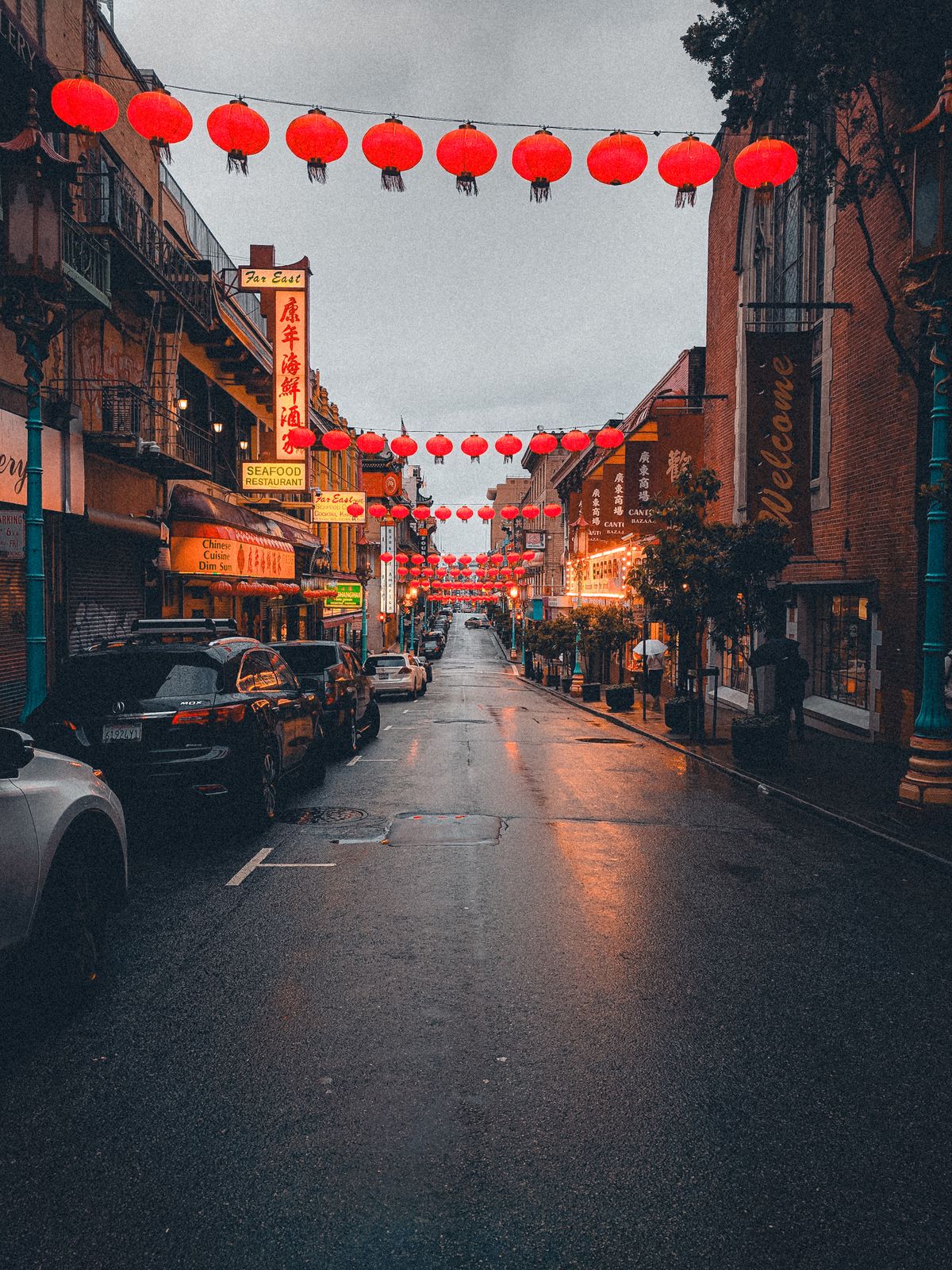
Gold Mountain, 1848: The First Cantonese Arrivals
When James W. Marshall found gold at Sutter's Mill in January 1848, word travelled fast — across the Pacific, along the Cantonese trade routes that already linked Guangdong to Southeast Asia and Hawaii. In Guangzhou (廣州), Hong Kong and the rural counties of the Pearl River Delta, families started calling California "Gam Saan" — Gold Mountain — and pooling money to send their sons across the ocean.
Most of them weren't miners by trade. They were farmers, fishermen and labourers from a specific corner of Guangdong: Taishan (台山), Zhongshan (中山), and the Sze Yup (四邑, "four counties") region. This is why San Francisco Chinatown to this day is a Taishanese-speaking place as much as a Cantonese one. Old-time Chinese America speaks Toisan (台山話), a sister dialect to Cantonese that developed in these coastal counties over centuries.
Building Grant Avenue From Scratch
The community that formed around what is now Grant Avenue (originally Dupont Street, 杜板衝 in Cantonese) was, from the start, a survival mechanism. Anti-Chinese laws, mob violence, and outright massacres in mining towns pushed Cantonese migrants back into the city. They clustered together on a few blocks, opened laundries, general stores, temples and clan associations, and built a self-governing neighborhood that could withstand what the outside world threw at it.
The great earthquake and fire of 1906 destroyed nearly all of it. San Francisco's white power brokers tried to seize the moment to push Chinatown out of downtown entirely. But Cantonese merchants, led by figures like Look Tin Eli and backed by the Qing consul-general, fought back — and rebuilt Chinatown right where it had been, but this time in a self-conscious "East meets West" architectural style, with sweeping tiled roofs and lanterns designed partly to attract tourists. That look is what you still see on Grant Avenue today.
The Chinese Exclusion Act and the Bachelor Society
In 1882, Congress passed the Chinese Exclusion Act, banning nearly all Chinese labour immigration. It was the first race-based immigration law in US history. For decades afterward, Chinatown was a "bachelor society" — men who had come to work but couldn't bring their wives or children. Angel Island in the Bay became the West Coast Ellis Island, but for Cantonese arrivals it was often a prison, where interrogators tried to catch "paper sons" — immigrants using purchased identities to bypass the exclusion laws.
The Exclusion Act wasn't fully repealed until 1943. Every Cantonese family whose story runs through San Francisco Chinatown has some ancestor who lived through that era — sending money back to a wife and children in Toisan, seeing them once every few years if at all.

The Food, the Language, the Backbone
Every classic Chinese-American food you can think of — chop suey, fortune cookies, egg foo young, dim sum in a bamboo steamer — traces back to a Cantonese cook in a place like San Francisco Chinatown, translating home flavours for whatever ingredients could be sourced. When Americans of any background talk about "Chinese food," they usually mean Cantonese food, filtered through diaspora improvisation.
You can still hear the older generation of shopkeepers on Stockton Street bargaining over bok choy in Toisan. You can still see the herbalist scales, the roast duck hanging in the window, the tea houses upstairs where the aunties are playing mahjong at 11am on a Tuesday. The rhythm is unbroken.
A Cantonese Phrase to Know
金山
gam1 saan1 — Jyutping romanisation
Meaning: "Gold Mountain" — the Cantonese nickname for San Francisco and, by extension, California and the American West.
Explanation: When Australian gold was later discovered, Cantonese speakers renamed San Francisco to Old Gold Mountain (舊金山) to distinguish it from Melbourne (New Gold Mountain, 新金山). Both names are still used by older Cantonese speakers today.
The Grandmother of Every Chinatown
San Francisco Chinatown is the ancestor of every Cantonese diaspora enclave in the Western world. Before Vancouver had its Chinatown, before New York had Mott Street, before Sydney had Dixon Street, San Francisco was already there — Cantonese kids running through the alleys, Toisan uncles laying out bok choy on Stockton, tea aunties playing mahjong upstairs on Grant.
For the global Cantonese community, this place is holy ground. It is the proof that Cantonese people can arrive somewhere with nothing, endure everything the world throws at them, and still be there, still speaking Cantonese, five generations later.
📖 Related Articles
👉 Shop Cantonese Guy — Modern Streetwear for the Global Cantonese Community