

Cantonese is a language that revolves around food. Hong Kongers do not just eat — they chase food. They crave it, hunt for it after midnight, judge each other by how much of it they can finish, and build whole friendships around the sentence let's go eat. This volume is for the hungry: ten Cantonese words every Hong Konger uses to talk about appetite, cravings, snacking and the universal truth that it is always, somehow, time to eat again.
If you grew up in a Cantonese home, half these words are what your mum shouted up the stairs, through the door, or across a yum cha hall. If you're learning the language, bookmark this one — these are the phrases that will make you sound like a real Hong Konger faster than any textbook sentence will.
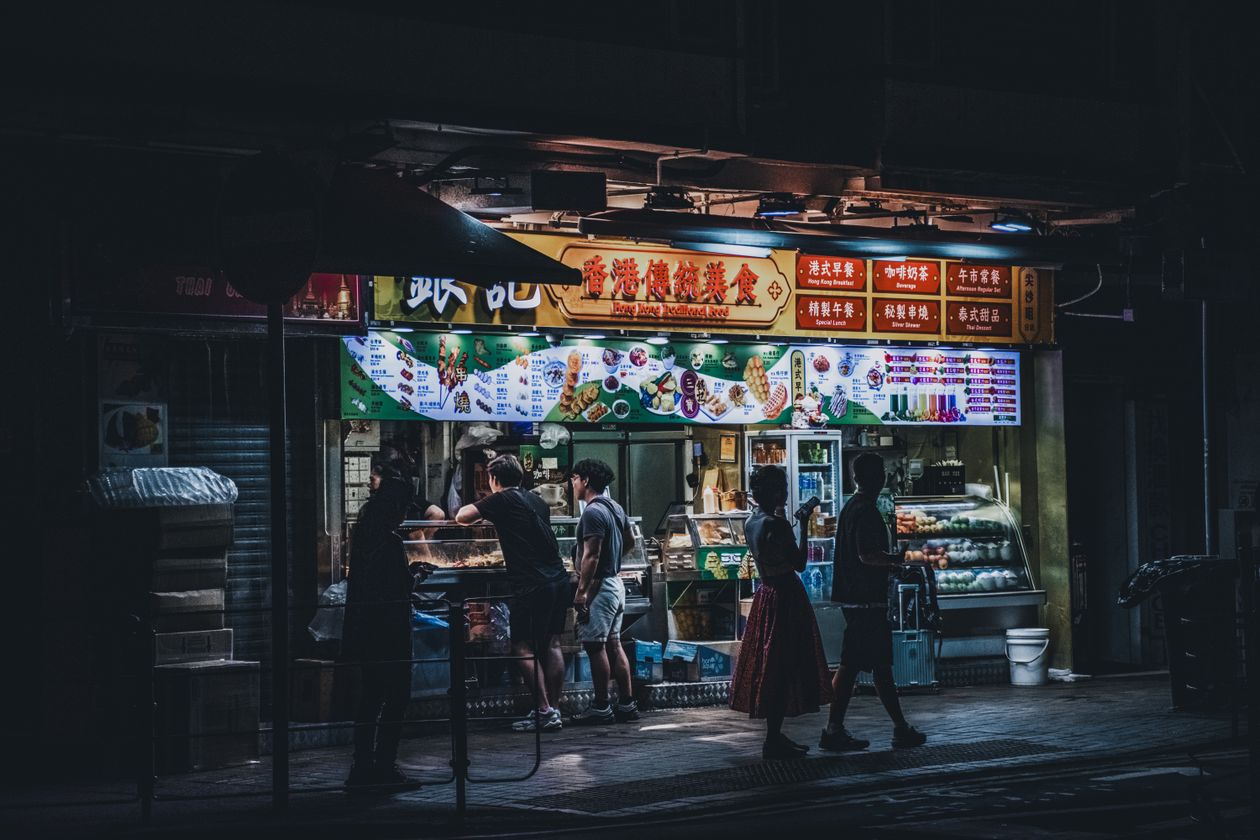
The 10 hungry Cantonese words every Hong Konger uses
1. 肚餓
tou5 ngo6 — Jyutping romanisation
Meaning: Hungry. Literally "belly-hungry".
Explanation: The default, everyday word for being hungry. Mandarin uses 餓 alone, but Cantonese almost always pairs it with 肚 (belly) — because Cantonese speakers like to locate the feeling in the body. You will hear this word thirty times a day in any Hong Kong office around 11:45am.
2. 餓鬼
ngo6 gwai2 — Jyutping romanisation
Meaning: Literally "hungry ghost" — a glutton, or someone who is always eating.
Explanation: Borrowed from the Buddhist concept of a hungry ghost (a spirit cursed with eternal appetite and a mouth too small to be satisfied). In everyday Cantonese it has lost its religious weight and just means someone who eats constantly. Used both as an insult and as affection — mothers call children 餓鬼 the way English speakers say "little piggy".
If you have ever been called a 餓鬼 by your mum and secretly agreed, you may enjoy wearing it — we made a 食飯 Dinner is Ready oversized tee for exactly that type of person.
3. 掃街
sou3 gaai1 — Jyutping romanisation
Meaning: Literally "sweep the street" — to eat your way through a neighbourhood's street food, stall by stall.
Explanation: One of the most Hong Kong words on the list. 掃街 means hopping between stalls — curry fish balls here, siu mai there, egg waffle on the way home — until you have cleared the strip. It implies more than one stop, and more than one snack. The energy of 掃街 is Mong Kok on a Friday night.
4. 消夜 / 宵夜
siu1 je2 — Jyutping romanisation
Meaning: Late-night meal, after-midnight snack.
Explanation: Not just a snack — a specific institution. 消夜 is the fourth meal of the Hong Kong day: congee at 1am after karaoke, roast pork at 11:30pm after a late shift, instant noodles at 2am after drinks. The city's 24-hour cha chaan tengs exist because of this word. If you've never had cheung fan at midnight you have not really lived in Hong Kong.
5. 嘴刁
zeoi2 diu1 — Jyutping romanisation
Meaning: Picky eater, with a demanding palate.
Explanation: Literally "mouth clamp/pick". Not entirely negative — a 嘴刁 person knows good food from mediocre food and will refuse the latter. Hong Kong's reputation for food snobbery is built on a city of 嘴刁 people. "She's really 嘴刁" can mean "she's annoying at restaurants" or "trust her recommendation", depending on tone.
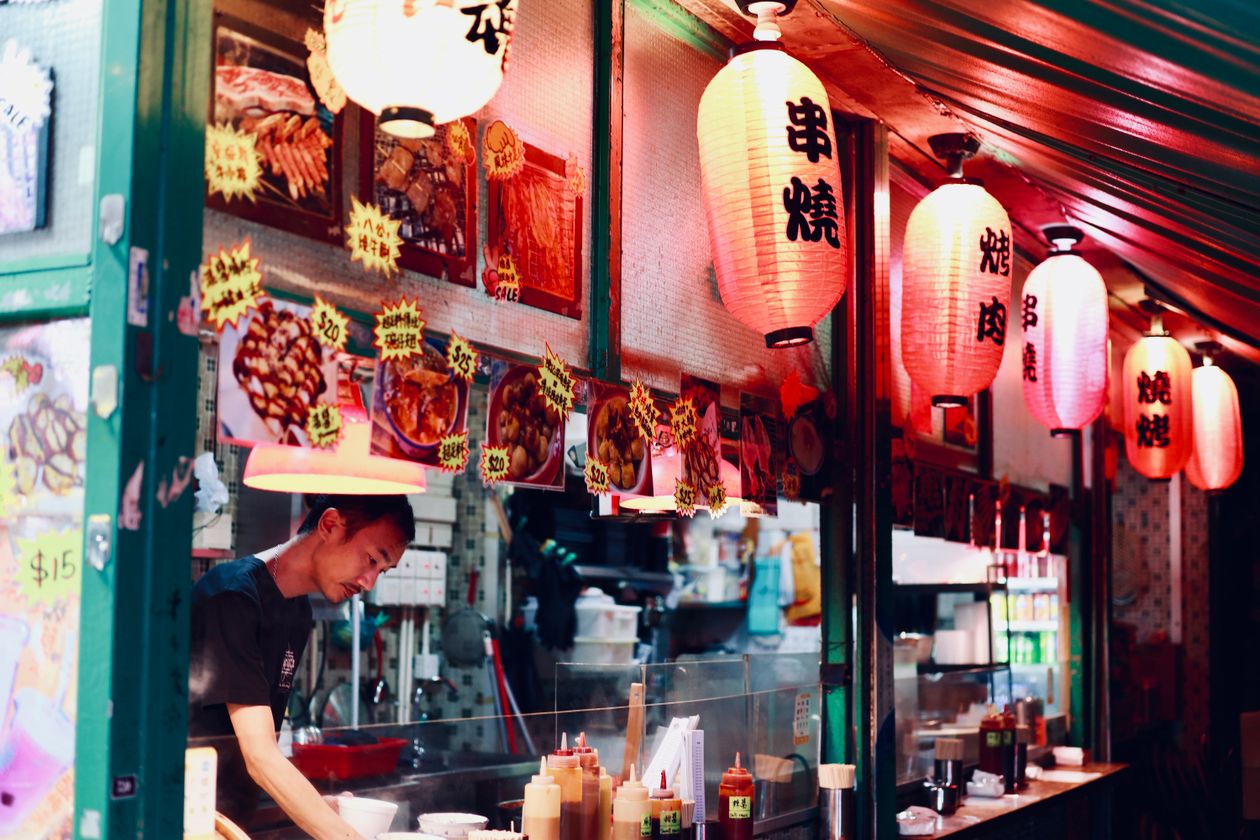
Five more hungry words to carry you from breakfast to midnight
6. 大食
daai6 sik6 — Jyutping romanisation
Meaning: A big eater, someone with a large appetite.
Explanation: Literally "big-eating". A compliment at a Cantonese family table — mums are proud when their kids are 大食 because it means they are growing well. The derivative 大食懶 (daai6 sik6 laan5) means "eats a lot and lazy", which is less flattering.
7. 口痕
hau2 han4 — Jyutping romanisation
Meaning: Literally "mouth itchy" — the specific feeling of wanting to snack even when you are not hungry.
Explanation: English does not really have this word. 口痕 is the state of restless-mouth that sends you to the pantry at 10pm looking for something to chew on. It also has a second meaning — being verbally mischievous, "mouthy" — but the food meaning is the everyday one.
8. 貪食
taam1 sik6 — Jyutping romanisation
Meaning: Gluttonous, greedy for food.
Explanation: More judgmental than 大食. 貪 means "greedy" or "coveting". A 貪食 person reaches for the last siu mai even when they are already full. Hong Kong aunties use this on children who hover around the kitchen while dinner is being plated.
If you grew up hearing your mum yell 食飯啦! up the stairs, you'll know the feeling behind this volume. We put the whole mum-sayings canon on one tee — 食飯 Dinner is Ready embroidered heavyweight tee — and it still gets stopped in Chinatowns on three continents.
9. 開飯
hoi1 faan6 — Jyutping romanisation
Meaning: Dinner is served; time to eat; mealtime starts now.
Explanation: Literally "open-rice". The shout every Cantonese kid grew up hearing from the kitchen. It also doubles as a metaphor — "開飯啦" said at work can mean "the fun starts now" or "here we go", a cheerful signal that something good is about to happen.
10. 歎
taan3 — Jyutping romanisation
Meaning: To enjoy slowly, to savour. (In this food context — the character also means "to sigh" in other uses.)
Explanation: One of the most Hong Kong verbs you can learn. You 歎 tea, you 歎 air-con, you 歎 a bowl of wonton noodles on a cold day. It carries a smug, lazy, deeply contented energy — the sound a Hong Konger makes after the first sip of silk-stocking milk tea. 歎世界 (taan3 sai3 gaai3) means "savour the world" and is a whole life philosophy.
If you take anything from this volume: 歎 is the opposite of 掃街. One is savouring, the other is sprinting. A full Cantonese life needs both — and if your weekend sounds more like 歎, we have a quieter mood piece for that: the Hea heavyweight tee for proper Cantonese chill, or 得閒飲茶 Let's Catch Up sweatshirt for the yum cha energy.
Why food is at the centre of Cantonese
No other Chinese language gives you this many ways to describe hunger, snacking and savouring. That is not a coincidence. Cantonese culture — from Guangzhou to Hong Kong to every diaspora Chinatown — organises itself around meals. When Cantonese people greet each other, we don't say "how are you". We say 食咗飯未呀? — "have you eaten yet?" The whole language is downstream of that question.
For more words that stitch together everyday Cantonese life, read our Vol. 123 on money slang, our Vol. 122 on workplace slang, and our Vol. 119 on family terms — the three volumes before this one, together, cover almost every daily situation a Hong Konger finds themselves in.
📖 Related Articles
👉 Shop the Mami Says collection
Modern streetwear for the global Cantonese community.