

Ask any Hong Konger what the weather is like today and you won't get a temperature — you'll get a whole mood. Cantonese has a rich, physical vocabulary for describing rain, heat, humidity, wind, and the emotional weight of a typhoon day. These aren't textbook words. They're the phrases you'll hear at the wet market at 7am, in a cha chaan teng before a rainstorm, or shouted across a rooftop when the T8 signal drops.
Here are 12 essential Cantonese weather and nature words every learner should know — with jyutping, cultural context, and real-life example sentences.
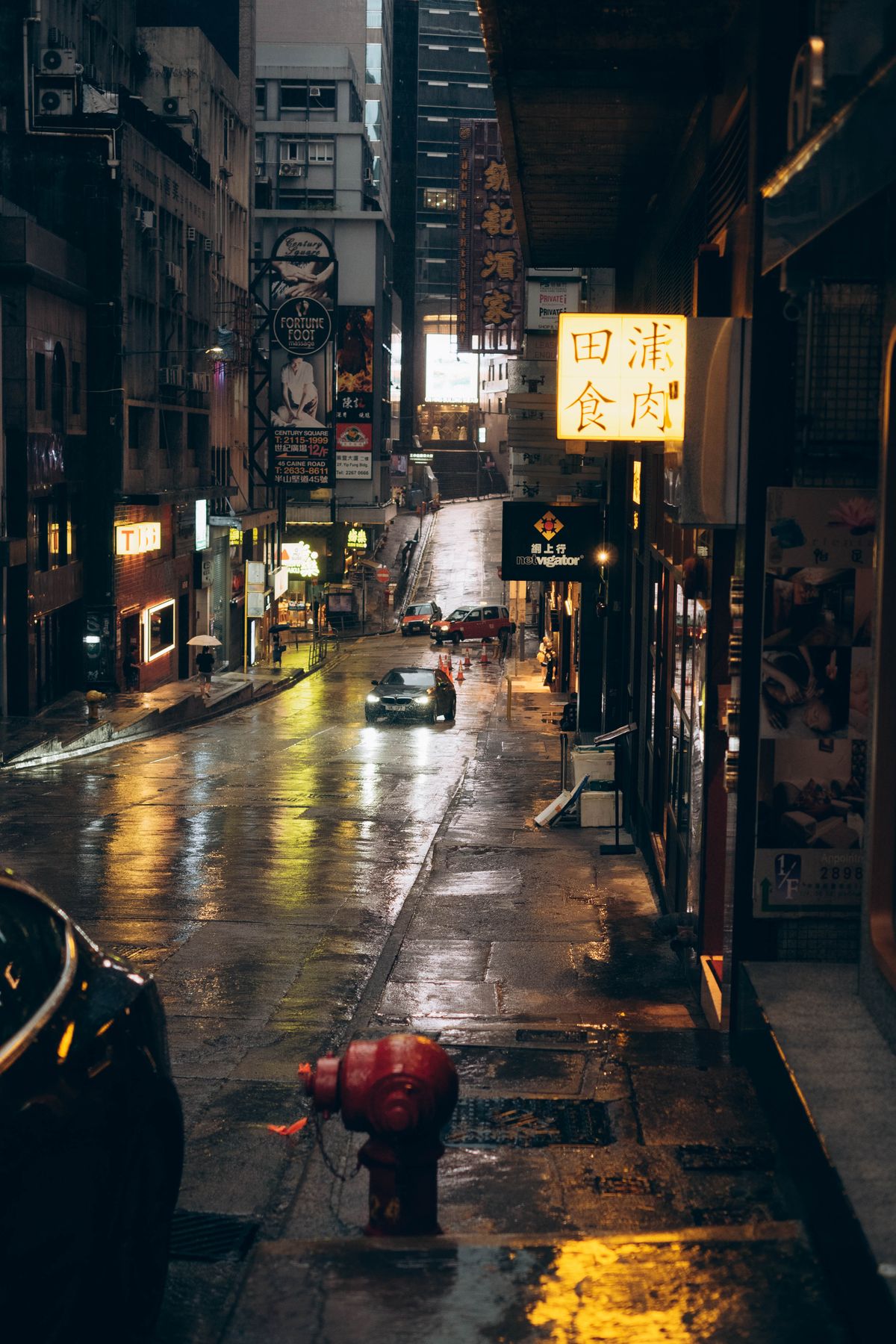
The Weather Words Hong Kong Actually Uses
1. 打風
daa2 fung1 — Jyutping romanisation
Meaning: A typhoon is coming / the city is getting hit by a typhoon.
Explanation: Literally 'hit wind.' This is the everyday phrase — nobody says 颱風 in normal conversation. When the observatory raises signals, everyone from taxi drivers to your grandmother uses 打風.
2. 落雨
lok6 jyu5 — Jyutping romanisation
Meaning: To rain / it's raining.
Explanation: Literally 'falling rain.' Cantonese pairs weather with the verb 落 (to fall) — you also get 落雪 (snow) and 落雹 (hail). It's a beautifully physical way to describe weather that Mandarin's 下雨 doesn't quite capture the same way.
3. 焗
guk6 — Jyutping romanisation
Meaning: Stuffy, oppressively humid, suffocatingly hot.
Explanation: One of the most Cantonese sensory words. It literally means 'to bake' or 'steam-cook in a covered pot,' and it's used to describe that trapped, airless summer heat you feel walking out of the MTR into Mong Kok in August. A single character doing the work of an entire English phrase.
4. 涼浸浸
loeng4 zam3 zam3 — Jyutping romanisation
Meaning: Refreshingly cool; that cool-to-the-touch feeling.
Explanation: A doubled adjective — very Cantonese. It describes not just cool weather but a cooling sensation, like walking into an air-conditioned room from the street or biting into cold tofu pudding. The repetition of 浸浸 makes the coolness feel immersive.
5. 好曬
hou2 saai3 — Jyutping romanisation
Meaning: Very sunny; the sun is scorching.
Explanation: 曬 means 'to sun-dry' or 'to be exposed to sun.' When Cantonese speakers say 好曬, they're not just noting brightness — they're warning you about UV and asking whether you brought an umbrella (for shade, not rain).

6. 掛波
gwaa3 bo1 — Jyutping romanisation
Meaning: Hoist the typhoon signal (informal).
Explanation: Literally 'hang the ball.' It's a holdover from the days when the Hong Kong Observatory raised physical wind-signal shapes above signal stations — including a ball — to warn ships of incoming typhoons. Locals still use 掛波 today when talking about the T3 or T8 signal.
7. 落雹
lok6 bok6 — Jyutping romanisation
Meaning: To hail; hailstones falling.
Explanation: Rare enough in Hong Kong that when it happens, everyone posts videos. 雹 refers specifically to the ice pellets. Because it's so unusual, older generations sometimes read it as an omen — a folk association still floating around the Cantonese-speaking world.
8. 大霧
daai6 mou6 — Jyutping romanisation
Meaning: Heavy fog.
Explanation: Late winter and early spring bring dense fog rolling in from the South China Sea, and Victoria Peak famously disappears into it. Hong Kong locals use 大霧 to describe those mornings when you can't see across the harbour.
9. 潮濕
ciu4 sap1 — Jyutping romanisation
Meaning: Humid; damp.
Explanation: The word every Hong Konger says in spring, when the walls sweat and dehumidifiers become sacred household objects. 潮濕 covers both the weather and that clammy feeling on your skin and inside your wardrobe.
10. 天光
tin1 gwong1 — Jyutping romanisation
Meaning: Daybreak; the sky brightens.
Explanation: Literally 'sky-light.' It describes the moment when night ends — a lovely, cinematic word that Hong Kongers use unselfconsciously in everyday speech. It also anchors expressions like 通頂到天光 (staying up all night until dawn).
11. 打雷
daa2 leoi4 — Jyutping romanisation
Meaning: Thunder; to thunder.
Explanation: Literally 'hit thunder' — the same 打 (to hit) that shows up in 打風. Hong Kong summer storms are dramatic, and grandmothers still tell children not to point at the sky when it thunders. The word carries a hint of that older, respectful awe of the elements.
12. 天陰
tin1 jam1 — Jyutping romanisation
Meaning: Overcast; cloudy sky.
Explanation: Literally 'sky yin' — the same 陰 from yin/yang, meaning shady or hidden. Cantonese speakers use it to describe both the weather and a mood: 天陰 days feel heavier, slower, more introspective. Hong Kong film noir was practically invented for 天陰 skies.
Why Cantonese Weather Words Hit Differently
Every one of these words is physical. 焗 is baking, 落雨 is falling, 打風 is being struck. Cantonese doesn't just describe weather — it locates you inside it. That's why speakers who move overseas often say English weather vocabulary feels flat by comparison. There's no English word that carries the exact sensation of 焗, no phrase that captures 涼浸浸 with the same skin-level immediacy.
Keep this vocabulary in your pocket for the next time you're in Hong Kong during a spring drizzle, a summer typhoon, or a rare snap of December cold. You'll sound less like a textbook — and more like someone who actually knows how the city feels.
📖 Related Articles
👉 Shop Cantonese Guy — Modern Streetwear for the Global Cantonese Community