

Cantonese doesn't just describe food — it choreographs it. There's a whole vocabulary for how something feels in your mouth, how a broth hits the back of your throat, why a dumpling skin snaps just right. This volume is 12 words every Guangdong grandmother, cha chaan teng auntie, and roast meat master knows by heart. If you can use them, you sound less like a tourist and more like someone who grew up eating.
The 12 Words
1. 鮮
sin1 — Jyutping romanisation
Meaning: Fresh, savoury, umami — that clean sea-and-broth taste.
Explanation: 鮮 is the Cantonese answer to umami. It's what a good chicken stock, a steamed grouper, or a bowl of wonton soup delivers. When someone says a dish is 鮮, they mean the ingredient is speaking for itself — no MSG required.
2. 香
hoeng1 — Jyutping romanisation
Meaning: Fragrant, aromatic — the smell that hits you before you even taste it.
Explanation: 香 covers everything from roast pork skin crackling out of a shopfront to sesame oil hitting a hot wok. It's the reason Hong Kong is called 香港 — literally "fragrant harbour." When something smells and tastes good together, it's 香.
3. 甘
gam1 — Jyutping romanisation
Meaning: A slow, mellow sweetness that arrives after the swallow.
Explanation: 甘 is the aftertaste your tongue notices when you drink good pu'er tea or bite into a slow-simmered old cucumber soup. It's not the up-front sugar of 甜 (tim4). It's the reward at the back of the throat.
4. 爽
song2 — Jyutping romanisation
Meaning: Crisp, refreshing, snappy — a texture that resists your teeth cleanly.
Explanation: 爽 is the texture of a good beef ball, a fresh cucumber, or a jellyfish salad. It's not crunchy, not hard — it has a bite that gives way and refreshes at the same time. Also used to describe cold drinks and clear soups.
5. 腍
nam4 — Jyutping romanisation
Meaning: Tender, soft, easily giving to a spoon or chopstick.
Explanation: 腍 is the highest praise for a braised beef brisket, a slow-cooked pork trotter, or a bowl of congee rice. It's the reason grandma tells you the brisket needs three more hours. Nothing is worse than tough meat — nothing better than 腍.
6. 脆
ceoi3 — Jyutping romanisation
Meaning: Crispy — the audible, delicate kind, like roast pork skin.
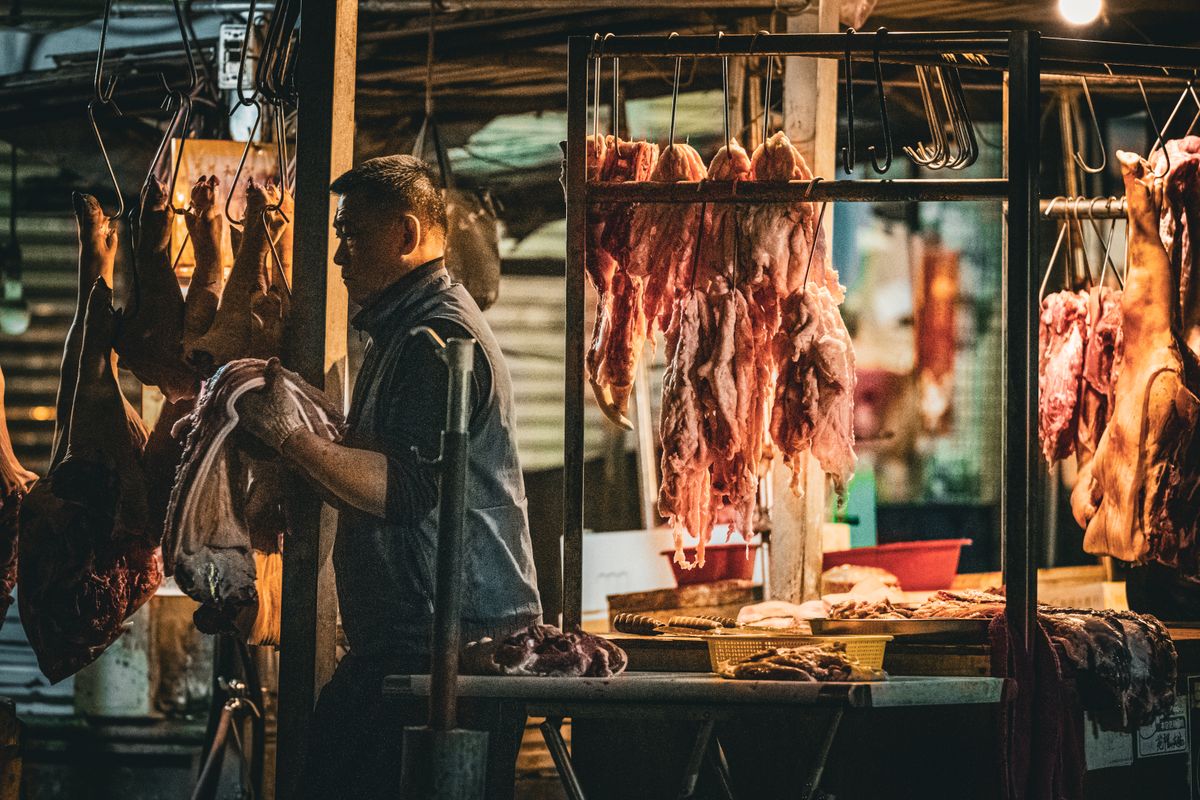
Explanation: 脆 is the sound and feel of Cantonese roast pork (燒肉) skin shattering under a chopstick, or the top of an egg tart snapping cleanly. If it doesn't crackle, it isn't 脆.
7. 滑
waat6 — Jyutping romanisation
Meaning: Smooth, silky — the texture of custard, tofu pudding, or steamed egg.
Explanation: 滑 describes anything that slides down your throat with no resistance. It's the crown of a well-made steamed egg, or the tofu pudding (豆腐花) sold from a bamboo bucket by an old auntie.
8. 韌
ngan6 (colloquial) / jan6 (literary) — Jyutping romanisation
Meaning: Chewy, tough, resilient — a texture that fights back a little.
Explanation: 韌 can be praise or complaint depending on the dish. Wonton skin should be 韌 (chewy in a good way). Overcooked squid is also 韌 (rubbery in a bad way). Context is everything.
9. 惹味
je5 mei6 — Jyutping romanisation
Meaning: Deeply flavourful, appetite-triggering — food that makes you want more.
Explanation: Literally "provoking the taste." 惹味 is what a plate of stir-fried salted fish and chicken does to a bowl of rice — it triggers hunger. Fermented, salty, garlicky dishes are usually 惹味.
10. 鑊氣
wok6 hei3 — Jyutping romanisation
Meaning: "Wok breath" — the smoky, seared flavour only a screaming-hot wok can create.
Explanation: 鑊氣 is the difference between fried rice at a dai pai dong and fried rice at a chain hotel. When flames leap into the wok and kiss the ingredients, that char you can taste is 鑊氣. Cantonese chefs will die on this hill.
11. 淡
taam5 — Jyutping romanisation
Meaning: Bland, light, under-seasoned.
Explanation: 淡 is what your uncle mutters when the soup needs more salt. It can be neutral (a light broth) or a mild diss (this dish has no soul). Add "冇味" (mou5 mei6 — tasteless) if you want to escalate.
12. 燶
nung1 — Jyutping romanisation
Meaning: Burnt, scorched — the bitter kind, not the good char.
Explanation: 燶 is the disaster word. Rice stuck to the bottom of the pot and turned black? 燶. Toast forgotten in the toaster? 燶. Not to be confused with the good 鑊氣 char — this is the bad one.
Why Cantonese Has So Many Food Words
Cantonese cuisine is built on a philosophy: let the ingredient speak. That means every texture, every temperature, every layer of aroma matters. So the language grew to match. A grandmother tasting a bowl of soup will use three of these words before the second spoonful. A wonton master will judge his own dough by whether it hits 韌 without crossing into rubbery. A dai pai dong chef lives and dies by 鑊氣.
Learn these 12 words and you can walk into any cha chaan teng, any siu mei shop, any grandma's kitchen — and describe what you're tasting like someone who belongs there.
📖 Related Articles
👉 Shop Cantonese Guy — Modern Streetwear for the Global Cantonese Community