

If you want to understand a Cantonese kitchen, listen to the verbs. Guangdong cooking is built around technique, and every technique has its own precise word — one that changes the way a piece of chicken, a leaf of choi sum, or a fish head is transformed into something eaten with reverence. Today we're breaking down 10 cooking verbs every Cantonese home cook knows by muscle memory.
This is Vol. 22 of our ongoing dictionary. If you missed the earlier volumes, our sensory and texture words and food market slang go beautifully with this list.

Why cooking verbs matter in Cantonese
In English, we say "cook" and add qualifiers — "slow-cook," "pan-fry," "steam over high heat." In Cantonese, each of these gets its own single character. The verb tells you everything: the heat, the vessel, the time, sometimes even the expected texture. Learn these ten and you can read almost any Cantonese menu or recipe.
10 essential Cantonese cooking verbs
1. 炒
caau2 — Jyutping romanisation
Meaning: To stir-fry over high heat in a wok.
Explanation: The workhorse verb of Cantonese cooking. 炒 is fast, loud and hot — it's the technique that produces 鑊氣 (wok hei), the smoky breath of the wok. Everything from choi sum to beef with black bean sauce is a 炒 dish.
2. 蒸
zing1 — Jyutping romanisation
Meaning: To steam.
Explanation: The verb Cantonese cooks reach for when the ingredient is already excellent and needs no interference. A whole fish, minced pork with salted egg, or dim sum — 蒸 is the technique that lets flavour speak for itself.
3. 炆
man1 — Jyutping romanisation
Meaning: To slow-braise / stew in a covered pot with sauce.
Explanation: Think beef brisket, oxtail, or radish falling apart in a dark, savoury sauce. 炆 dishes are patient work — low flame, closed lid, hours of surrender.
4. 焗
guk6 — Jyutping romanisation
Meaning: To bake / roast / cook in enclosed heat.
Explanation: The verb that covers everything from a HK-style baked pork chop rice (焗豬扒飯) to salt-baked chicken (鹽焗雞). 焗 traps heat and aroma inside a vessel — dish, dough, or salt crust.
5. 灼
coek3 — Jyutping romanisation
Meaning: To blanch quickly in boiling water.
Explanation: The technique behind poached prawns and blanched leafy greens with oyster sauce. 灼 is about speed and control — in and out just long enough to lock in colour and snap.
6. 煎
zin1 — Jyutping romanisation
Meaning: To pan-fry in a small amount of oil.
Explanation: The gentle cousin of 炒. 煎 is what you do to a piece of fish, a pork chop, or an egg — a wide, shallow pan and enough oil to crisp one side at a time.
7. 燉
dan6 — Jyutping romanisation
Meaning: To double-boil — steam a sealed pot inside a bath of water for hours.
Explanation: The technique behind restorative soups and desserts like double-boiled papaya with snow fungus. 燉 is famously gentle — nothing is agitated, and every flavour is drawn out with patience.
8. 煲
bou1 — Jyutping romanisation
Meaning: To simmer or slow-boil for a long time (also refers to the pot itself).
Explanation: The verb behind the sacred lo fo tong — old-fire soups simmered for three to five hours in a clay pot. To 煲 is to trust time.
9. 撈
lou1 — Jyutping romanisation
Meaning: To toss / mix ingredients together in sauce.
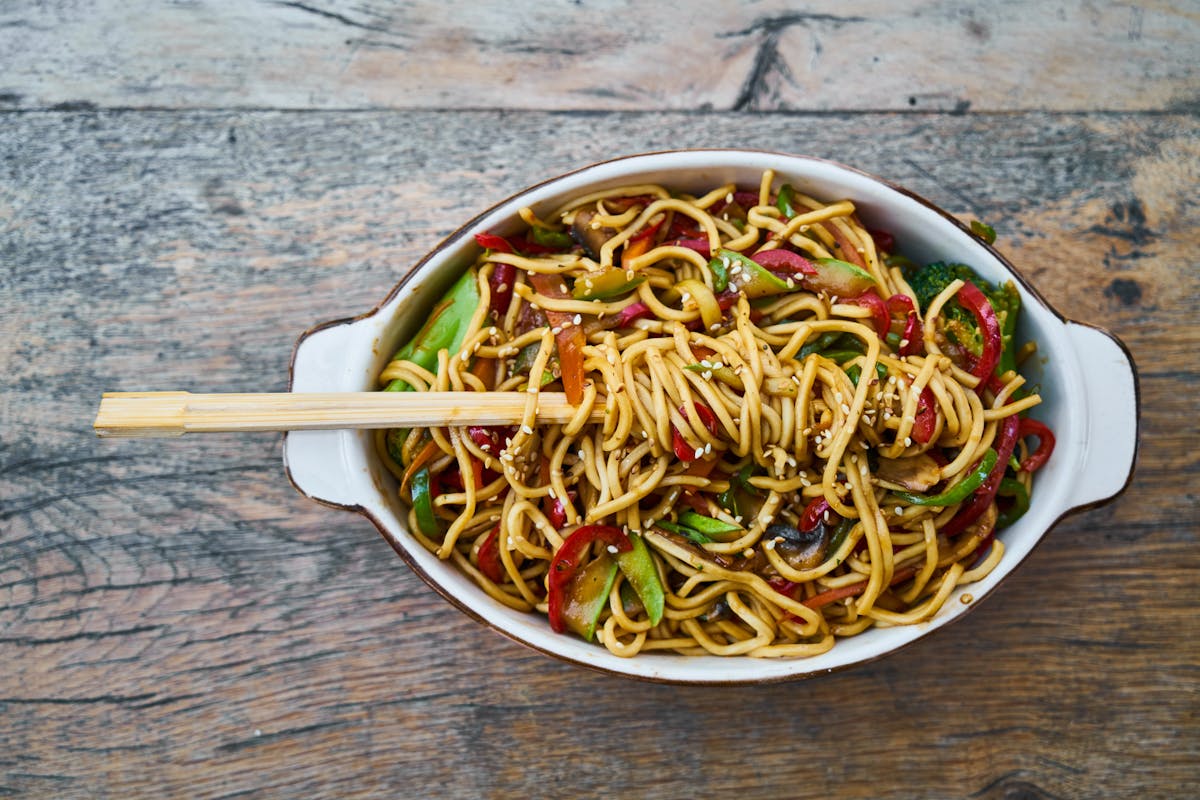
Explanation: The verb behind 撈麵 lou mein — noodles tossed dry in sauce rather than served in broth. It's what you do at the table when the dish arrives and you have to mix everything before eating.
10. 醃
jip3 — Jyutping romanisation
Meaning: To marinate or cure.
Explanation: Every serious Cantonese dish starts with a marinade. 醃 is how you build flavour before heat ever touches the meat — soy sauce, sugar, cornstarch, sesame oil, a little Shaoxing wine.
The pattern behind the verbs
Notice how every verb signals not just what you do, but how long, how hot, and in what vessel. Cantonese cooks don't need to explain a recipe in paragraphs — a single character does it. This economy of language is one reason Guangdong cuisine feels so precise. When you hear a grandmother say she 炆'd the brisket for two hours, you already know what her afternoon looked like.
Take the verbs home
Try slipping one into a real kitchen conversation this week. Ask a friend if the fish has been 蒸'd. Tell your mother you're going to 煲 a soup. Watch how quickly Cantonese food starts feeling less like a menu and more like a language.
📖 Related Articles
👉 Shop Cantonese Guy — Modern Streetwear for the Global Cantonese Community