

Walk down Temple Street in Yau Ma Tei on a cool October evening and the first thing that hits you isn't the smell — it's the sound. A low, continuous roar from a row of blue gas flames, and above them, the clink of hundreds of ceramic lids being lifted off hundreds of small pots at precisely the right moment. This is clay pot rice territory. 煲仔飯 (bou1 zai2 faan6), literally "little pot rice," one of the most quietly perfect dishes in the entire Cantonese canon.
Nothing in Cantonese food is more honest than a clay pot rice. It is rice, protein, soy sauce, and fire — nothing hidden, no sauces to disguise an iffy cut, no fancy knife work to compensate for anything. If the rice is wrong, the dish is wrong. If the fire is wrong, the dish is wrong. If the dark soy at the end is wrong, the dish is wrong. When it's right, it's one of the few meals that can genuinely make a tired Hong Konger sigh with satisfaction before they even sit down.

The Guangdong Dish That Fed the Delta
Clay pot rice is Cantonese in the oldest sense of the word — rooted in Guangdong province, built around the ingredients a Pearl River Delta household would have in the pantry at any given moment. Rice, soy sauce, a bit of preserved meat hanging from a hook, maybe some pickled vegetables, maybe a bit of egg if it was a good month. The clay pot itself — small, individual, about the size of a soup bowl — was cheap, held heat for ages, and could be set directly on charcoal.
That last part matters. For most of its history, this was a one-person meal cooked over one flame. A diner would order, and the cook would start their specific pot from scratch — rinse the rice, add water, cover, set it over fire, time it exactly. Nothing could be prepped in advance; the rice had to be cooked fresh or the texture would be off. That slowness is part of why clay pot rice became a sit-down ritual rather than a grab-and-go snack. You order, you wait 25 minutes, you watch the city go by, and when it arrives you lift the lid to a cloud of steam that is unmistakably the smell of home.
The Four Sacred Toppings
Any Cantonese cook will defend their favourite combination like a religion, but in Hong Kong you'll see four classics on nearly every clay pot menu:
🥓 1. Lap Mei (臘味)
The autumn and winter staple. Lap cheung (臘腸 / Chinese sausage) and lap yuk (臘肉 / preserved pork belly), sometimes with waxed duck (臘鴨), sliced thin and laid on top of the rice halfway through cooking so their rendered fat drips down and flavours every grain. This is the version your Cantonese grandmother would make when the weather turned cold. It's also the version that gets the most devoted following; a 叉燒 Char Siu oversized tee is a close cousin in spirit — both are variations on the Cantonese obsession with slow-cured, salted-sweet pork.
🥩 2. Minced Beef with Raw Egg (窩蛋牛肉)
Hand-minced beef seasoned with ginger, white pepper, soy, cornstarch, and a splash of oil, formed into a loose patty on top of the rice. A whole raw egg is cracked into the centre at the moment of serving — the heat of the rice and the pot cooks the white and barely warms the yolk. You stir everything together at the table. This is the version most popular with construction workers, taxi drivers, and students on exam week: fast fuel, cheap, satisfying.
🐔 3. Chicken with Shiitake Mushrooms (北菇滑雞)
Marinated chicken thigh or free-range chicken (走地雞 / zau2 dei6 gai1) layered with soaked dried shiitake mushrooms, ginger, and spring onion. The chicken's juices seep into the rice; the mushrooms give the whole pot a deep, savoury depth. This is the version your mother orders for you when you're coming down with a cold.
🐟 4. Salted Fish and Chicken (鹹魚雞粒)
A love-it-or-hate-it classic. Diced salted fish (traditionally mui heung-style 梅香鹹魚) and small cubes of chicken, cooked together in the pot. The salted fish is pungent — people on the other side of the restaurant will know what you ordered — but the funk mellows into something almost umami-sweet when it meets the rice. If you can learn to love salted fish, you've unlocked an entire category of Cantonese cuisine.

The Crust Is Half the Point
The best bite in a clay pot rice is not the sausage. It's not the chicken. It's not the sauce. It's the 飯焦 (faan6 ziu1) — the crispy layer of golden-brown rice welded to the bottom of the pot by the final minute of fire. In other parts of China this is called 鍋巴 (wo1 baa1); in Cantonese kitchens it's faan ziu, and it is the single most sought-after piece of real estate on the entire pot.
Experienced eaters have a ritual. You eat down through the top layer, mixing the topping into the rice, until you reach the crust. Then you scrape — not stab, scrape — the bottom of the pot with the back of your spoon, lifting the crust up in big sheets. It should crackle. It should taste of toasted rice, caramelised soy, and smoke. If the crust is right, the whole dish was right. If the crust is burnt or soggy, the cook had an off night. One pot, one verdict.
The Sweet Soy Finish
The signature of Cantonese clay pot rice — the detail that separates it from, say, Chinese or Korean dolsot — is the dark sweet soy sauce (老抽 / lou5 cau1 — "old draw") poured over the rice at the moment of serving. It's a thick, syrupy, slightly sweet soy, usually mixed with a touch of sugar and sometimes a splash of oyster sauce. The best clay pot shops in Hong Kong make their own blend — a jealously guarded ratio that's often the actual thing a regular is loyal to, not the rice itself.
Older Cantonese sometimes warn that clay pot rice is 熱氣 (jit6 hei3) — "hot energy," heavy and warming — and best eaten in cooler months rather than in the muggy summer. If you want to lean into that worldview, our 熱氣 Yeet Hay heavyweight tee captures the whole Cantonese philosophy of hot-and-cold foods in a single word. For the dinner-is-ready side of the ritual, the 食飯 Dinner is Ready oversized tee is what you wear when you're the one calling the table.
Where to Eat It in Hong Kong
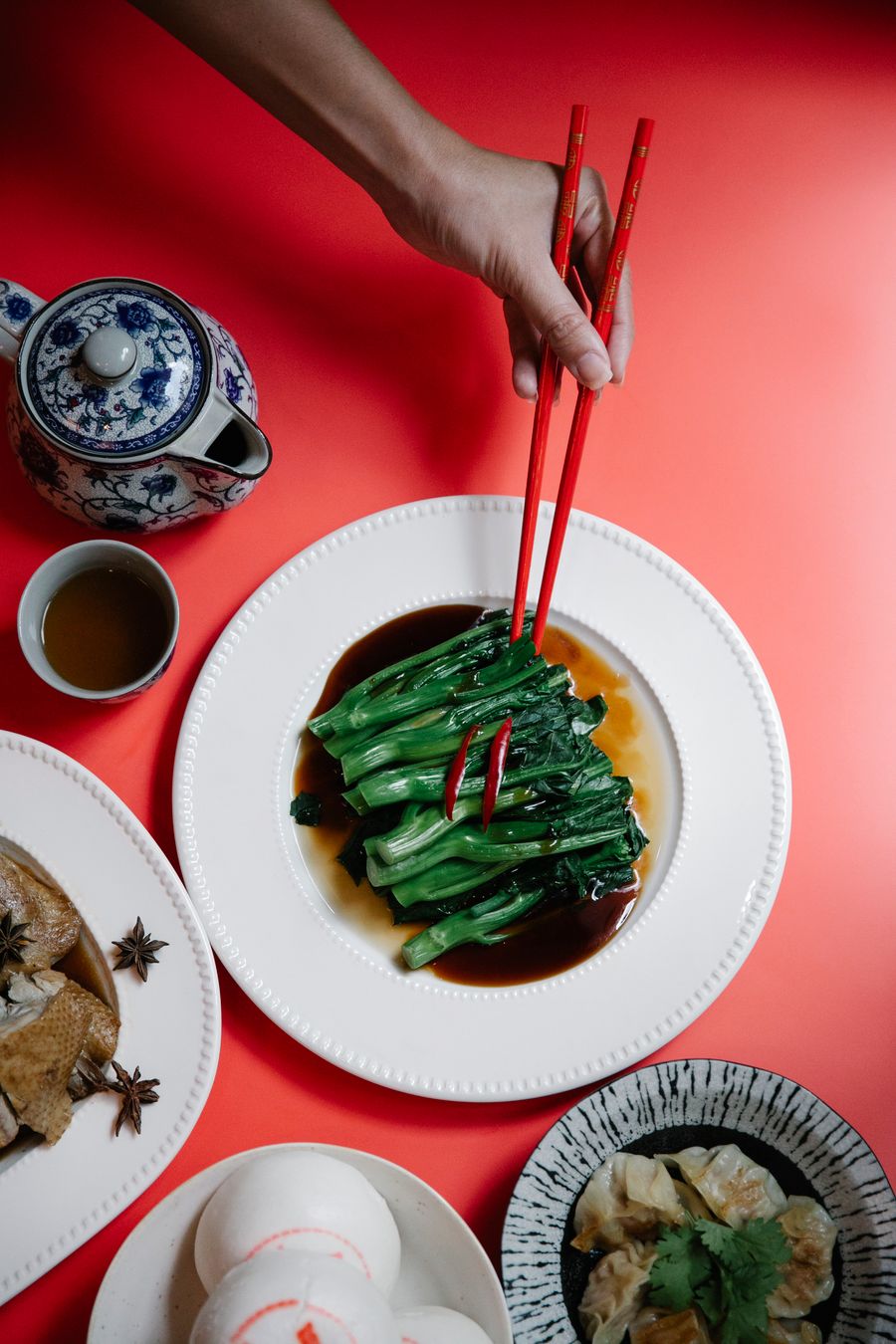
If you're in Hong Kong, the Temple Street / Yau Ma Tei and Mong Kok areas are where most locals head for a serious clay pot rice fix — they've long been clustered with dai pai dong and small restaurants dedicated to the dish. In Sai Ying Pun and Sheung Wan, a quieter old-guard scene survives; in Kowloon City and Sham Shui Po, smaller neighbourhood joints often do a better pot than the Instagram-famous places. Order the lap mei if it's cold, the beef and egg if you're broke and hungry, and share a plate of blanched choi sum with oyster sauce on the side so the whole table has something green.
A good shop will time your pot specifically. The server will say something like "等廿分鐘" (dang2 jaa6 fan1 zung1 — "wait 20 minutes") and mean it exactly. Don't rush. Drink some tea. Watch the cooks. The same slow-fire discipline that produces great char siu is at work on these clay pots, and part of the pleasure of the meal is watching the ritual.
The Cantonese Phrase That Captures the Dish
鑑氣
wok6 hei3 — Jyutping romanisation
Meaning: "Wok breath" — the aromatic, smoky quality a dish gets from being cooked over high flame in seasoned metal or earthenware.
Explanation: One of the hardest words to translate in Cantonese cooking. 鑑氣 is the smoky, slightly charred, deeply savoury quality that only comes from live fire — gas or charcoal — hitting food fast enough to blister the surface before the inside overcooks. A clay pot rice with proper wok hei smells of toasted rice, caramelised soy, and a tiny bit of smoke all at once. Reheated clay pot rice has none of it. That's why you eat it there, at the table, hot.
Why Clay Pot Rice Still Matters
In an era when Hong Kong's dai pai dong are being slowly cleared away like the neon signs, when rent is forcing out another generation of old food shops, when the next trendy opening is probably going to be another specialty coffee shop — clay pot rice is one of the quiet holdouts. It cannot be industrialised. It cannot be franchised at scale. It requires a cook standing over fire, timing one pot at a time, by eye. That slowness is the whole point.
For the Cantonese diaspora, clay pot rice is also a measuring stick. Any Hong Kong restaurant in Vancouver, San Francisco, London, or Sydney claiming authenticity will eventually be judged on their pot. If the crust is thin and burnt, the restaurant was never serious. If the crust lifts off in golden sheets and the lap cheung tastes like someone's grandmother made it, you've found the real thing. Keep that address. Guard it. Bring the next homesick person you meet.
📖 Related Articles
👉 Shop the Mami Says collection
Modern streetwear for the global Cantonese community.