

Before there was a Chinatown in New York, London, or Vancouver, there was the one in San Francisco. The oldest Chinatown in North America was built almost entirely by Cantonese hands — and more specifically, by villagers from the Pearl River Delta who crossed the Pacific chasing a place they called Gam Saan (金山), Gold Mountain. Their story is the story of how Cantonese language, food, and family structure put down deep roots on the other side of the world.
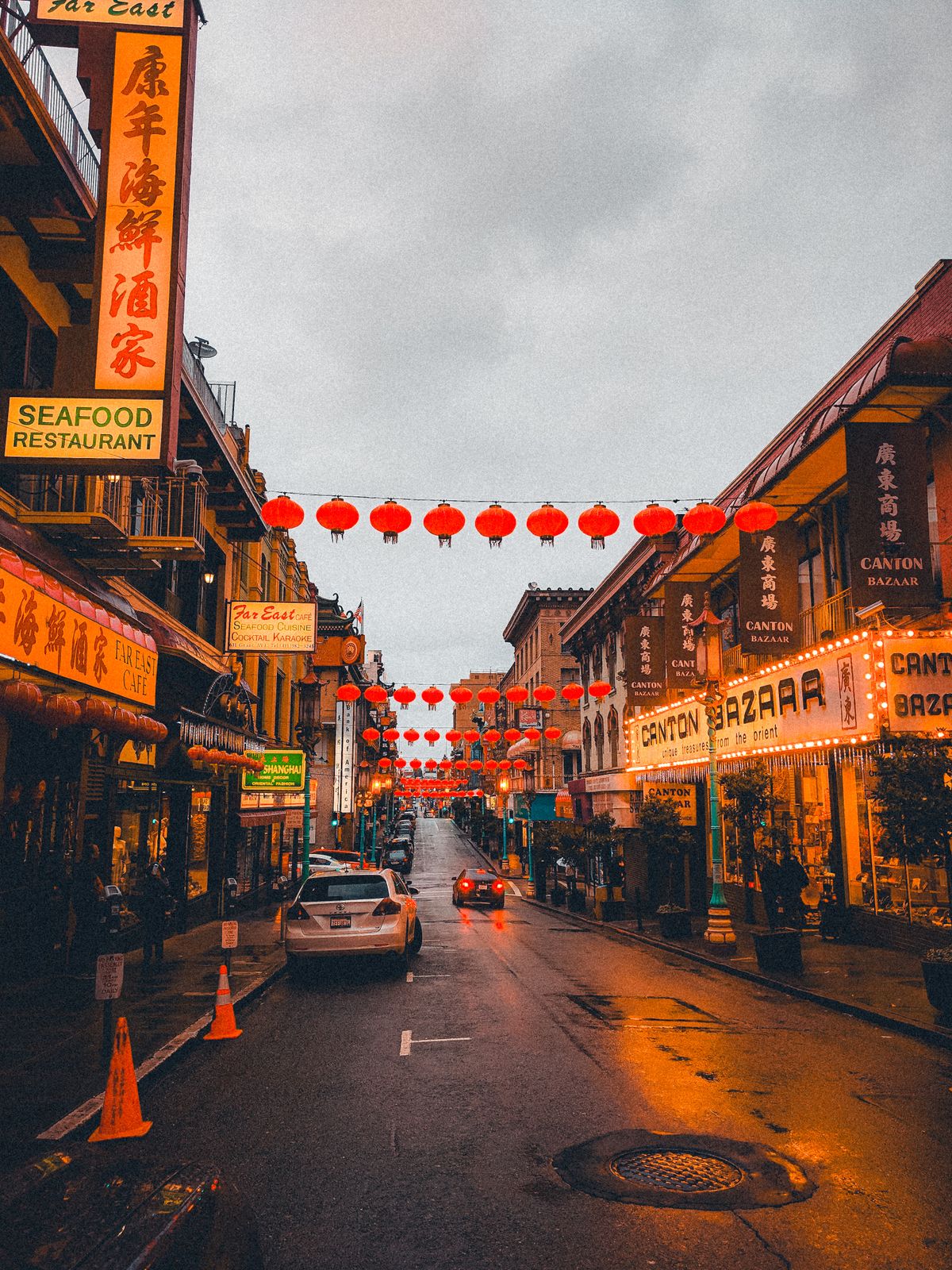
The first Gold Mountain
Chinese arrivals in San Francisco began around the mid-1840s, but it was the 1848 discovery of gold at Sutter's Mill that turned a trickle into a tide. News of the strike reached Guangdong at a brutal moment in Chinese history — the aftermath of the First Opium War, severe droughts, and political turmoil had pushed millions of young men in the Pearl River Delta to look outward for survival. The Cantonese name for the new world they were heading to was Gam Saan, Gold Mountain. The men who left were called Gam Saan haak, Gold Mountain guests.
By the 1850s, ships were landing in San Francisco Bay with hundreds of Cantonese passengers — most of them from the four counties known as Sze Yup (四邑), and especially from Taishan (台山). They came with little more than a contract and the address of a clan association. Within a few short years, Chinese shops, temples, and lodging houses had clustered along Sacramento Street, which the new arrivals called Tong Yan Gaai (唐人街), "Tang People Street." That name is still the everyday Cantonese word for Chinatown today.
A Cantonese city inside an American one
Unlike later Chinese immigrant communities, early San Francisco Chinatown was overwhelmingly Cantonese in a very specific way. The dialect on the street wasn't standard Guangzhou Cantonese — it was Taishanese (台山話), a related but distinct tongue spoken across the four counties. For decades, Taishanese was the lingua franca of Chinese America, and if your American-born great-grandparents spoke "Chinese," there is a strong chance it was actually Taishanese.
The community organised itself along Cantonese lines from the start. Family associations (kinship groups based on surnames) and district associations (based on home villages in Guangdong) handled everything from job placement to dispute resolution to shipping the bones of the deceased back to China for burial. By 1862, six of these district associations had banded together as the Chinese Six Companies (中華總會館) — for over a century, the most powerful institution in Chinese America.
Surviving the Exclusion era
San Francisco Chinatown's first half-century was lived under direct attack. The 1882 Chinese Exclusion Act made Chinese the first ethnic group in U.S. history banned by name from immigrating. It was renewed and tightened repeatedly until 1943, and combined with anti-miscegenation laws and discriminatory housing rules, it forced the Chinese community to compress into a few square blocks bounded by Broadway, Bush, Kearny, and Stockton Streets. Chinatown survived because it had to — every business, every herbalist, every tofu shop served a community that was legally locked out of the rest of the city.
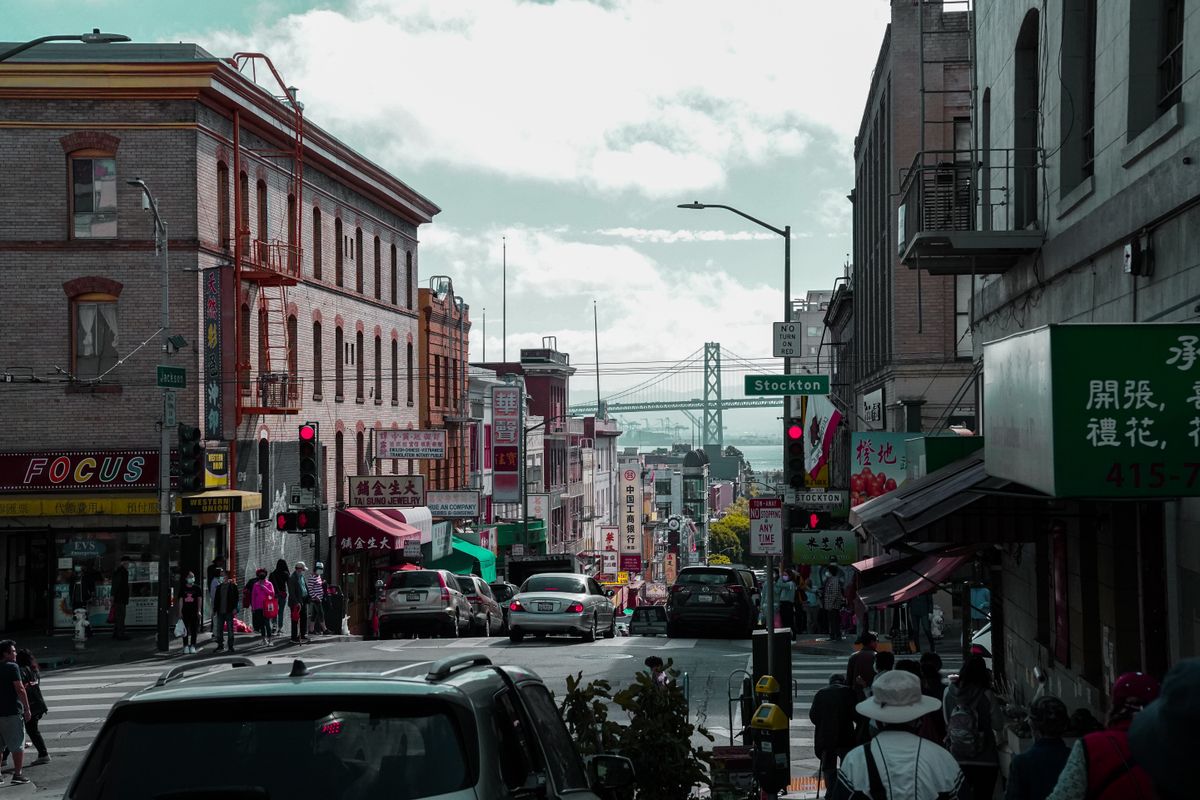
The 1906 fire and the Chinatown you see today
On April 18, 1906, the great San Francisco earthquake and the fires that followed destroyed nearly all of Chinatown. Roughly 14,000 residents were displaced. The city government immediately moved to seize the moment — pressuring the Chinese community to relocate to Hunters Point on the southern edge of San Francisco, so the prime real estate could be redeveloped by others.
A group of Chinese American merchants led by Look Tin Eli (陸潤卿), a California-born Chinese American businessman, refused. Their counter-proposal was brilliant and slightly cynical: rebuild Chinatown as a tourist destination. The new buildings would be brick, fire-resistant, and topped with theatrical Chinese architectural flourishes — pagoda roofs, curled eaves, dragon motifs — that would draw visitors from around the world. The look you associate with Grant Avenue today, with all its green-tiled rooftops and stone foo dogs, was an architectural performance designed to make the neighbourhood economically valuable enough that white San Francisco would let it stay. It worked.
Chinatown in the modern era
After the 1965 Immigration Act lifted national-origin quotas, new waves of arrivals from Hong Kong and Guangdong reshaped the neighbourhood. Cantonese is still the dominant language you'll hear on Stockton Street, in the produce markets, in the dim sum halls, and on the dragon-bordered streetlamps of Grant Avenue. Cantonese roast meat shops, herbalists, mahjong parlours, and family associations are still woven through the same blocks.
It's also a Chinatown that has fought to stay Cantonese. As Mandarin overtakes Cantonese in many overseas Chinese communities, San Francisco's Chinatown is one of the few in North America that still operates day-to-day in Cantonese — a continuity that has held for over 175 years.
Why this matters for the diaspora today
If you're Cantonese-American and your great-grandparents came through Angel Island, there's a good chance their first stop on land was a clan association on Waverly Place or Grant Avenue. Modern diaspora streetwear, food, and cultural identity owe an enormous debt to the small, stubborn community that refused to be relocated, refused to assimilate out of existence, and built a piece of Guangdong into the hills of California.
For more on the global Cantonese diaspora, see our piece on the Cantonese community that built Vancouver, our look at London's Chinatown, and our profile of Little Canton in Sydney.
📖 Related Articles
👉 Shop Cantonese Guy — Modern Streetwear for the Global Cantonese Community