

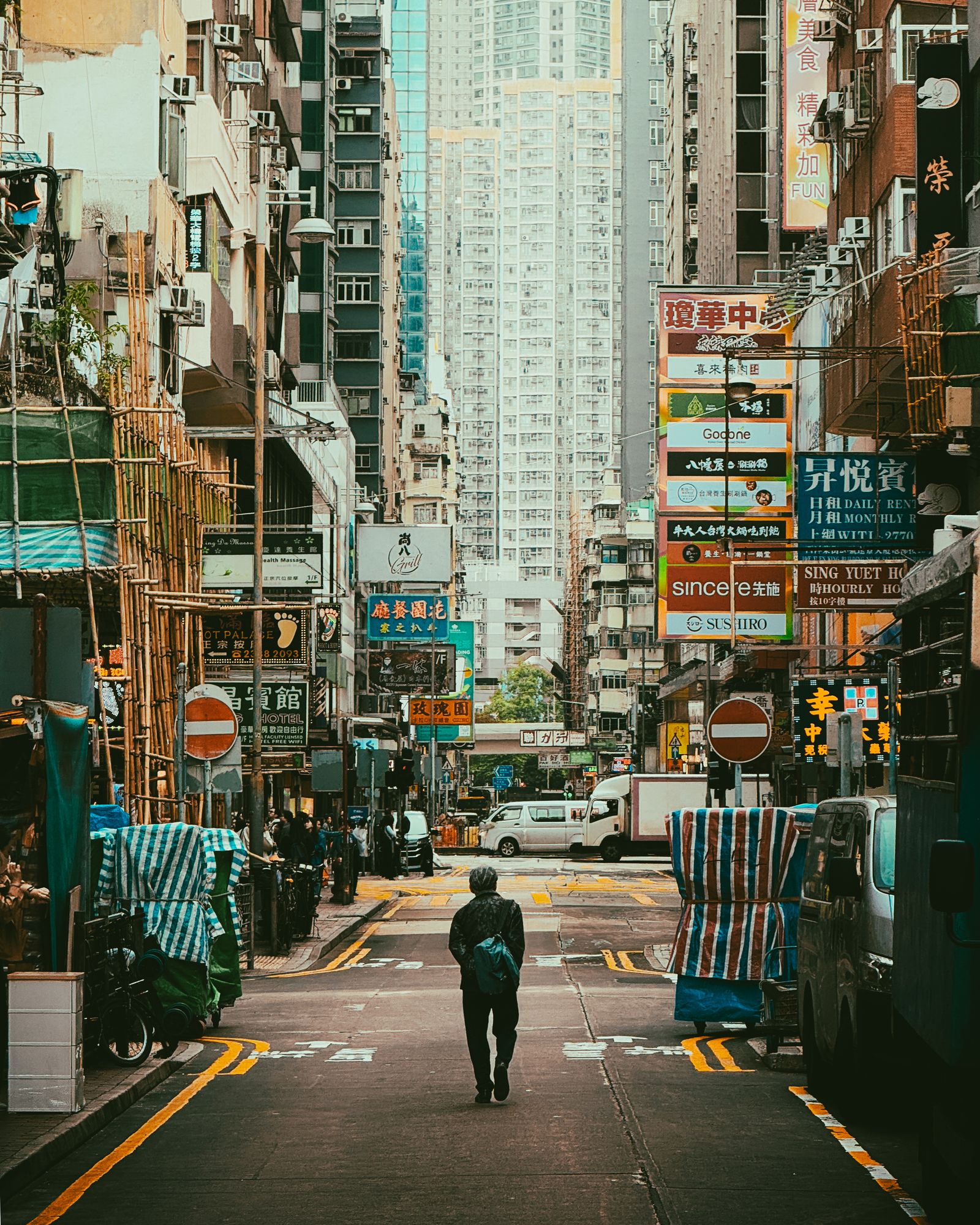
In 1994, if you stood on Nathan Road at nine o'clock at night and looked up, you saw a canyon of light. Layers and layers of red, gold, blue and white neon — restaurant names, pawnshop logos, mahjong parlour ideograms, cinema marquees — stacked twenty stories high on both sides of the road, throwing colour across the tram tracks and the wet pavement and the umbrellas below. It was, at that moment, one of the most recognisable urban skylines on Earth. Blade Runner cribbed from it. Wong Kar-wai painted with it. Every backpacker who visited Hong Kong photographed it.
Thirty years later, most of those signs are gone. The ones still glowing are on borrowed time. This is the story of Hong Kong's neon signs — nai4 hung4 dang1, the hand-bent Cantonese glass craft that once defined a city and is now down to fewer than a dozen surviving masters.
If Hong Kong's neon nights are what made you a Cantonese Guy in the first place, our best-seller collection is designed for exactly that generation — the one that grew up under the signs.
How a Neon Sign Actually Gets Made
A neon sign is not paint. It is a glass tube, bent by hand into the shape of a Chinese character or a Roman letter, then filled with either neon gas (which glows red-orange) or argon gas (which glows blue-white). Different phosphor coatings inside the tube produce the yellows, greens and pinks you saw on Nathan Road.
To bend a tube, a master craftsman heats a section over a small blue flame until the glass softens. Then, in one continuous motion, he bends it — blowing gently into the tube at the same time to stop the walls from collapsing. A Chinese character with 15 strokes might take an hour and thousands of tiny bends. A single mistake and the whole tube goes in the bin.

The Golden Age (1960s–1990s)
Neon reached Hong Kong in the 1930s but did not really take off until the postwar boom. By the 1950s and 1960s, workshops flourished across Kowloon and the New Territories, and by the 1970s and 1980s the craft had peaked. Signs got larger, more elaborate, and sometimes stretched across entire streets. In 1973, Guinness World Records recognised a massive National Panasonic sign in Hong Kong as the largest neon sign in the world at that time.
At the peak, tens of thousands of signs lit the city. Restaurants competed to have the loudest logo. Pawnshops used a specific shape — a bat holding a coin — so their signs could be spotted from three blocks away. Mahjong parlours favoured a particular red-and-green combination that told you the game was open all night.
🎥 Blade Runner and Wong Kar-wai Both Owe Hong Kong
Ridley Scott's production designers openly cited Hong Kong's neon-drenched streets as visual reference for Blade Runner (1982). A decade later, Wong Kar-wai's Chungking Express (1994) and Fallen Angels (1995) turned those same signs into a mood — the wet, smeared, colour-bleeding vocabulary of Hong Kong on film. Every music video shot in Mong Kok since then has borrowed from them both.
Why They're Disappearing
In 2010, the Hong Kong government introduced new signage safety regulations under the Buildings Department. Signs that stretched too far over the road, weighed too much, or had lapsed inspections had to come down. That, combined with the shift to cheaper LED replacements and the collapse of the old workshop apprenticeship system, gutted the industry.
Master craftsmen like Wu Chi-kai (胡志基) — who has been bending neon glass for nearly four decades — estimate that only around seven neon masters are still actively handcrafting in the city today. Many of the workshops that once trained apprentices have shut. Younger Cantonese people don't want to spend ten years learning to bend glass over a flame for what a sign shop can now do with a plastic LED strip in an afternoon.
Preservation: M+ Museum and the New Guardians
Since 2013, Hong Kong's M+ museum has been acquiring important neon signs from the streets before they are demolished. The signs of Sammy's Kitchen and the Kai Kee Mahjong parlour were among the first two neons to enter the M+ Collection. Groups like Tetra Neon Exchange work with owners to preserve signs privately, catalogue them, and occasionally exhibit them.
There is a small but growing counter-movement too. A handful of new-generation Cantonese designers have started commissioning custom neon signs — for cafes, for record shops, for personal projects — keeping the last few master craftsmen busy. It is not enough to save the industry, but it is enough to keep the flame lit.
The Cantonese Streetscape Is a Language
The reason neon matters, beyond aesthetics, is that it was a language. A pawnshop bat, a mahjong parlour green, a restaurant's specific font — these were readable signs of what the street was, who it was for, and what you could get there at 2am. They were the visual grammar of Cantonese urban life. Losing them is losing a way of reading the city.
If you want to keep that Hong Kong-under-neon energy on you when you leave home, the Cotton Tree Flower printing hoodie 木棉花 pulls from the same era — the Hong Kong of illuminated Chinese characters and cotton trees blooming over tramlines. Or wear the identity itself on our 廣東仔 Cantonese Guy oversized tee.
Where You Can Still See Them
Best remaining neighbourhoods for on-street neon: Jordan (Temple Street area), parts of Yau Ma Tei, and a handful of Kowloon side streets between Prince Edward and Mong Kok. The mahjong parlours of Sham Shui Po still keep their signs lit. Some old cha chaan tengs in Sheung Wan hold on to theirs out of stubbornness.
Take the photos now. In another decade, you'll be showing them to your kids the way our parents showed us photos of Kai Tak airport landings.
📖 Related Articles
👉 Shop the Best-Seller collection
Modern streetwear for the global Cantonese community.