

By the late 1980s, tens of thousands of people were living inside a rectangle of buildings barely bigger than four football pitches. Sunlight almost never reached the ground floor. Pipes and cables ran across balconies like nervous system diagrams. Dentists worked out of stairwells because they could not legally practise anywhere else in Hong Kong. And nearly every one of those residents spoke Cantonese as they went about the very ordinary business of raising kids, running noodle shops, and clocking into small factories — inside what the outside world had nicknamed The City of Darkness.
This is the story of 九龍寨城 (Kowloon Walled City) — for a time one of the most densely populated places on Earth, a jurisdictional black hole in Hong Kong, and one of the most quietly Cantonese neighbourhoods that ever existed.
A Qing dynasty fort that got left behind
The site has been fortified since at least the Song dynasty (960–1279), when it served as a small outpost overseeing the salt trade along the Kowloon coast. The Qing government upgraded the fort in the 19th century to keep an eye on the British — who by then were firmly established across the harbour on Hong Kong Island. When Britain signed the 1898 Convention for the Extension of Hong Kong Territory, taking a 99-year lease on the New Territories, one small clause left the walled city itself under Chinese jurisdiction.
That single clause created what would become the strangest legal enclave in modern Asia. The British never fully governed it. The Chinese central government could not reach it. And for nearly a century, the walled city floated in a jurisdictional no man's land.
After the war, the refugees arrived
After World War Two and the Chinese civil war, refugees poured into Hong Kong. Many gravitated to the walled city precisely because nobody could quite work out who was in charge. There were no rent controls, no building codes, and no formal law enforcement. What followed was one of the wildest experiments in improvised urbanism the modern world has seen.
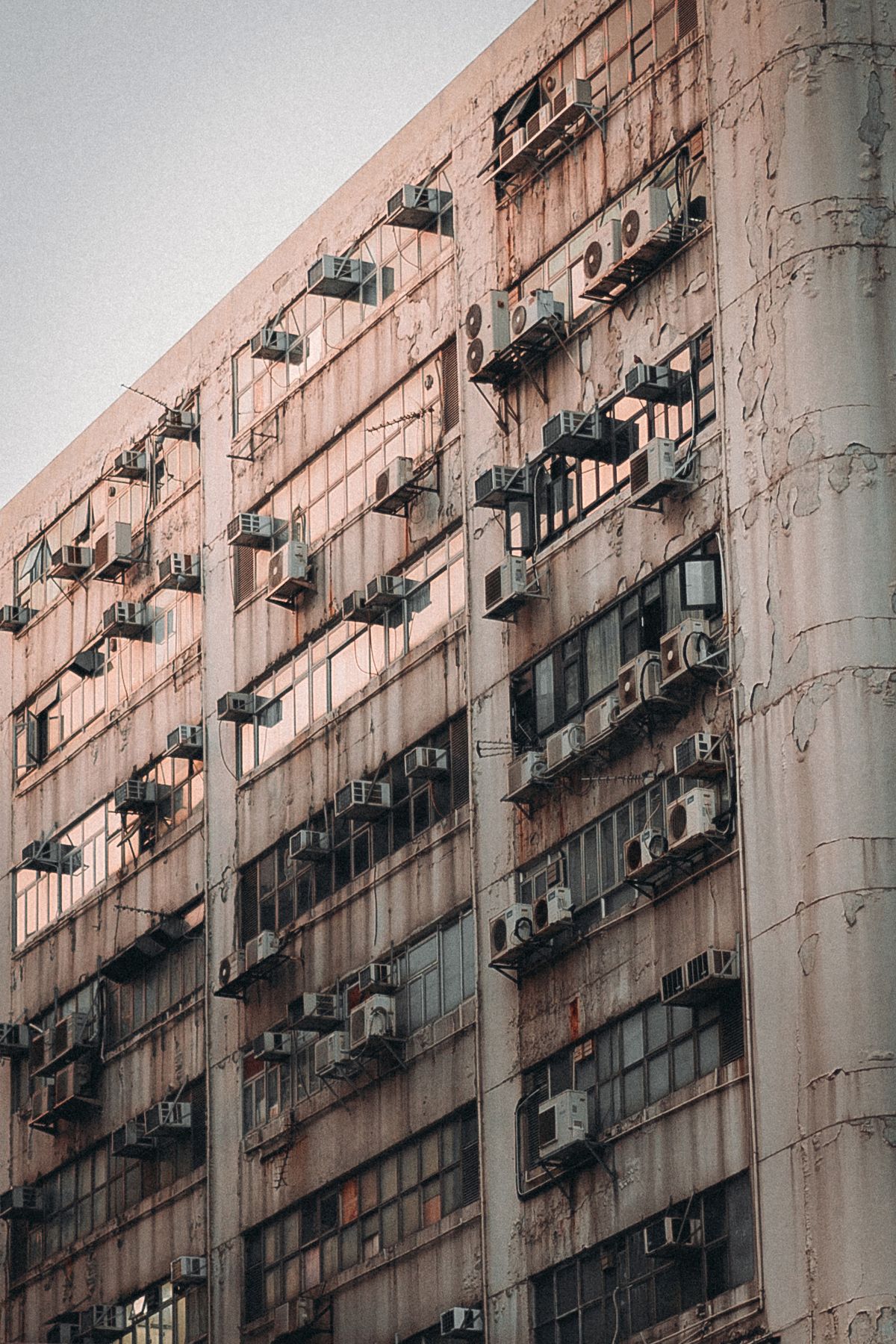
By the 1970s, taller buildings had been squeezed into every available square inch. Because of Kai Tak Airport's approach path just to the east, structures could not rise above roughly 14 storeys — so builders instead grew sideways and inward, stitching new floors and walkways onto existing towers until the whole thing became one continuous, breathing megastructure.
Life inside the City of Darkness
Yes, the Triads had a foothold. Yes, opium dens and unlicensed gambling parlours existed. But the caricature of the walled city as a purely lawless hellscape has always been unfair to the people who actually lived there. It was, by every account, mostly a working-class Cantonese neighbourhood — packed with factories making fish balls, plastic flowers, and rubber shoes; with families raising children in 250-square-foot flats; with mahjong parlours where uncles argued about horse racing.
The dentists became famous. Unlicensed by Hong Kong authorities but often trained on the mainland, they set up practices on the walled city's ground floor — offering good work at low prices. Locals from across Kowloon crossed into the enclave for cheap fillings and root canals. Above them, unregulated noodle shops served wonton noodles to factory workers coming off the night shift.
March 1993: the demolition begins
In 1987, with the 1997 handover approaching, Britain and China finally agreed the walled city had to go. Residents were compensated and relocated. Demolition began in March 1993 and was completed by April 1994. Photographers, urban planners, and filmmakers from around the world descended on the site in its final years, trying to document what was about to disappear. The photographer Greg Girard and the architect Ian Lambot's 1993 book City of Darkness became the definitive record.
In December 1995, Kowloon Walled City Park opened on the exact same footprint. The old Qing-era yamen — the administrative building that once housed the fort's officials — was carefully preserved, along with fragments of the southern gate and a few flagstones. Today it is one of the calmest, most beautifully landscaped public spaces in Kowloon.
Why the walled city still matters
Kowloon Walled City has become a cultural reference point far beyond Hong Kong. Cyberpunk cinema — from Blade Runner and its sequels onward — borrowed its aesthetic. Video games from Call of Duty: Black Ops to Shenmue II reconstructed pieces of it. Japanese arcades in Kawasaki built themed replicas. The visual grammar of dense, neon-lit, vertical Cantonese urbanism that streetwear brands and cyberpunk films still lean on today — that language was, in large part, drafted by the tens of thousands of people living on top of each other in one square block of Kowloon.
For the global Cantonese diaspora, the walled city stands as a stubborn reminder of what our grandparents and great-grandparents built when the system did not build for them: a community, a market, a school, a dentist's chair, all crammed into six-and-a-half acres, all held together by Cantonese ingenuity. That spirit still shows up today in every dai pai dong, every family-run bakery, and every corner shop from London Chinatown to San Francisco's Sunset District.
📖 Related Articles
👉 Shop Cantonese Guy — Modern Streetwear for the Global Cantonese Community