

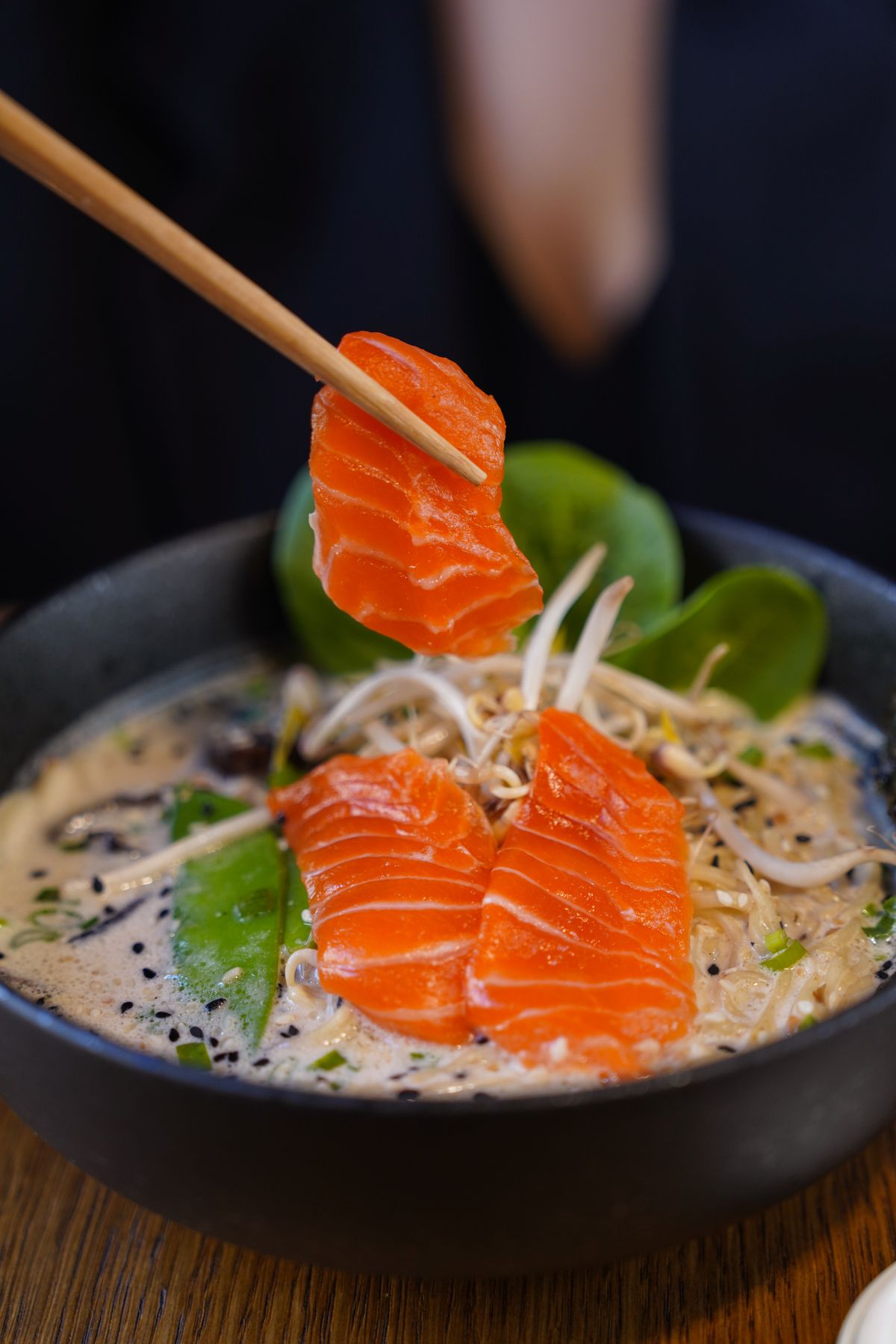
There is a very specific type of hunger that only wonton noodles can fix. It's around 10pm. You've had a long day. You duck into a narrow Hong Kong noodle shop that seats maybe fourteen people, you sit at a shared table, and within ninety seconds a small ceramic bowl slides in front of you: four plump prawn wontons floating on top, a nest of springy yellow noodles beneath, submerged in a thin, clear, golden broth that smells faintly of dried flounder. You ask for a spoonful of red vinegar. You slurp. Every problem you had at 9:59pm is now smaller.
This is 雲吞麵 — wonton noodles — arguably the most iconic single dish in Cantonese cuisine. And behind it sits a family story that starts in Guangzhou in the 1920s and never really stops.
From Guangzhou to Hong Kong: The Mak Family Dynasty
Wonton noodles came out of Guangzhou during the late Qing dynasty, but the version most Cantonese diaspora eat today owes its shape to one man: Mak Woon-chi (麥換池). Starting in the 1920s in Guangzhou, Mak is credited with inventing the "whole-egg noodle" — a dough of duck egg, chicken egg and flour, with no added water. At its peak his family ran eight wonton shops in Guangzhou. He is often called 雲吞麵大王, the King of Wonton Noodles.
In 1946, following the war, the family moved south. His son Mak On opened Mak's Noodle (麥奸記) in Central, Hong Kong, and the recipe migrated with them. Three generations later, Mak's Noodle is still there, and it still serves the noodles the way the grandfather taught: four wontons per bowl, bamboo-pressed noodles, kept high above the broth so they don't turn soggy.
The Bamboo Pole — A Craft That's Almost Extinct
The best wonton noodles in Hong Kong are still made with a traditional technique called 竞竹打麵 (ging1 zuk1 daa2 min6) — "bamboo-pole pressed noodles." A noodle master sits astride a huge bamboo pole anchored to a wooden table and bounces up and down on it, pressing the dough over and over. It takes strength, rhythm and years of practice. The result is a noodle with an unmistakable texture: bouncy, slightly chewy, with a faint alkaline snap that soft, machine-rolled noodles cannot fake.
Almost no one under 50 does this work anymore. In 2021, Hong Kong added bamboo-pole noodle-making to its intangible cultural heritage list — an official acknowledgement that the craft is disappearing. A handful of masters, mostly in their 60s and 70s, still press noodles the old way in tiny kitchens in Kowloon and Sheung Wan.
The Anatomy of a Real Bowl
A proper Cantonese wonton bowl — what old-timers call 細蓉 (sai3 jung2) or "small bowl" — is deliberately tiny. The idea is that the noodles cook in the boiling water, get lifted out, and are placed on top of the wontons, resting on a soup spoon at the bottom of the bowl. The noodles must never sit in broth for long, or they turn to mush. The bowl is small so you eat it fast.
The four wontons should be tiny, translucent, and about 70% whole shrimp, with just a whisper of pork for sweetness. The broth is clear and pale gold — made from pork bones, dried flounder (大地魚), shrimp shells, and often dried shrimp roe. The final touch: a few strands of yellow chives and, at some shops, a sprinkle of that same dried shrimp roe scattered across the top.
Order it right, and every element is engineered for the same thing: to be eaten in about eight minutes.
Where to Eat the Real Thing
Every Hong Konger has an opinion here, and each opinion is a small identity. The classics: Mak's Noodle in Central for the historical bowl (small, minimalist, expensive by wonton standards). Mak Man Kee in Jordan (a separate branch of the family, different lineage, equally serious). Tsim Chai Kee opposite for the counter-argument — huge shrimp wontons, generous portion, half the price. Ho Hung Kee in Causeway Bay held a Michelin star for years. Sang Kee in Sheung Wan is another quiet local favourite.
Outside Hong Kong, wonton noodle shops opened by Cantonese migrants dot every Chinatown from San Francisco to Vancouver to London — you can trace the diaspora on a map by looking for the bowls. In many families abroad, learning to fold a wonton is one of the first skills a Cantonese grandmother passes down.
A Word Every Wonton Fan Should Know
細蓉
sai3 jung2 — Jyutping romanisation
Meaning: "Small bowl" — the traditional order of wonton noodles.
Explanation: 蓉 is old Cantonese slang for a bowl of wonton noodles. When you walk into a proper wonton shop, you don't say "one bowl of wontons" — you say 「一個細蓉」. It's the shibboleth that tells the boss you know what you're doing.
Why It Matters
Wonton noodles are the working-class heart of Cantonese food. Not banquet food. Not tourist food. Ordinary food, perfected. A dish so obsessively refined that entire families have devoted three generations to a bowl that costs less than a coffee. That's very Cantonese — the belief that greatness lives in the small, humble thing you serve to a stranger at 10pm on a Tuesday.
While you're here, don't miss our stories on soy sauce chicken and the cheapest Michelin star, the cha chaan teng, and the underappreciated pineapple bun.
📖 Related Articles
👉 Shop Cantonese Guy — Modern Streetwear for the Global Cantonese Community