

There is no fruit inside a pineapple bun. Never has been. The name is a joke on its own face — the crumbly, cracked golden top just looks like a pineapple skin, and Cantonese speakers, being Cantonese speakers, decided that was reason enough. The bread underneath is soft, milky, warm, and completely fruit-free.
This is the 菠蘿包 (bo1 lo4 baau1), the most beloved bun in Hong Kong. It's on every cha chaan teng menu, in every neighbourhood bakery display, and in the hands of half the schoolkids leaving school at 3:30pm. In 2014 the Hong Kong government officially listed the technique for making it as intangible cultural heritage. This is the story of a bun with no pineapple that carries a whole city on its back.
A 1940s Hong Kong invention
The pineapple bun emerged in 1940s Hong Kong, when local bakers were absorbing Western-style pastries and remixing them for Cantonese palates. Nobody knows exactly who invented it. What's clear is that by mid-century, Hong Kong bakeries were producing them at industrial scale — some urban shops were reportedly turning out around 3,000 bo lo bao a day between the 1940s and 1960s. It was, and still is, the single best-selling item in most Cantonese bakeries.
The origin theories are wonderful. One story credits the Ng family, who were deported from Mexico and opened a café on Shanghai Street in 1946 — they're said to have adapted the Mexican concha, which also has a sweet cracked topping. Another traces it to Tai Tung Bakery, founded in 1943, which claims to have created what was originally called the "crispy-skin bun" (酥皮包). A third theory points across the sea to Japan's melon-pan, which shares a similar cracked-top structure. The most Cantonese answer is probably: all three, and none, and it doesn't really matter.
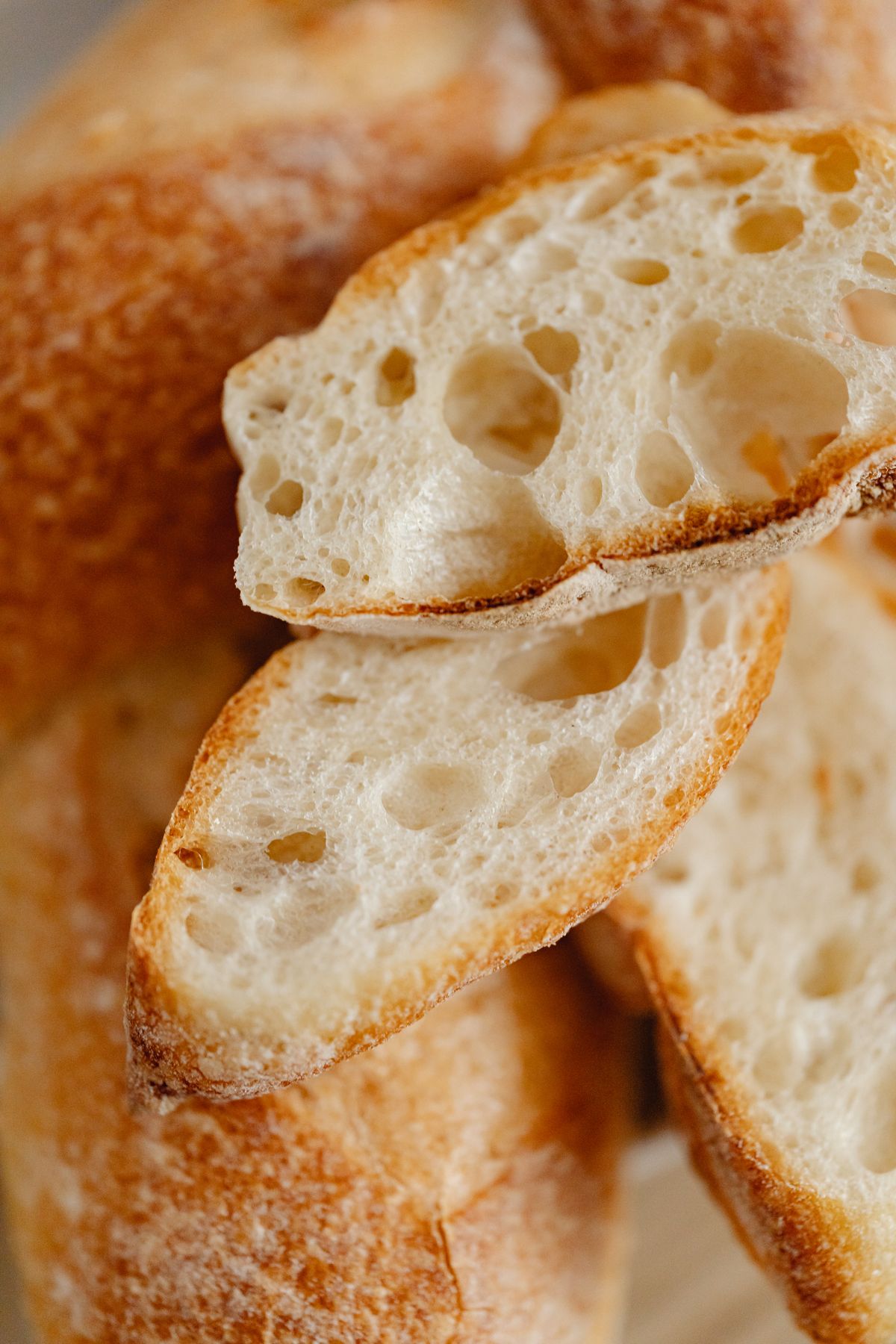
Anatomy of a perfect bo lo bao
The bun is two doughs collaborating. Underneath, a soft milky yeasted bread — pillowy, slightly sweet, in the same Chinese-bakery lineage as 奶黃包 (cream buns) and 雞尾包 (cocktail buns). On top, a completely different creature: a sugary lard-and-flour paste rich with egg yolks, brushed on before baking. In the oven the topping puffs, dries, and cracks into the tessellated pattern that gave the whole thing its fruit name.
A good bo lo bao is engineered for the first bite: the crust shatters like a thin sugar biscuit, then the warm milky bread underneath collapses in your mouth. It should feel almost weightless. Bakeries obsess over the ratio — too much topping and it goes cloying, too little and the crackle disappears.
The upgrade nobody saw coming: bo lo yau
In the 1960s, someone at a Hong Kong cha chaan teng — the details are lost — sliced a fresh, oven-hot pineapple bun in half and stuck a thick cold slab of salted butter inside. The butter, hitting the heat, half-melts. The salt sings against the sweet crumb. This is the 菠蘿油 (bo1 lo4 jau4), literally "pineapple oil," and it is one of the most gluttonous, most beloved things in the entire Cantonese food canon.
Kam Wah Cafe (金華) in Prince Edward is the most famous stop for it — the queue snakes down the street even on Tuesday mornings. Cha chaan teng ordering vocabulary for bo lo yau shows up in our Cantonese cha chaan teng slang dictionary — knowing how to order one like a local is a small badge of honour.
Why the government protected it
In 2014 Hong Kong added the traditional technique of making bo lo bao to its intangible cultural heritage inventory. The move was controversial to almost no one. In a city where old bakeries close every year and rents chase family businesses out of Kowloon, the bo lo bao is one of the last things every Hong Konger still shares. Rich or working class, born in Kowloon or in Toronto, everyone knows the smell of a fresh pineapple bun coming out of the oven at 8am.

The Hong Kong ritual
There is a specific choreography to a Hong Kong bo lo bao morning. You walk past the bakery. You see the freshly baked tray coming out. You point. Auntie tongs it into a thin paper bag. You pay a few dollars. You walk out. You eat it before you get to the MTR gate. The bag ends up in a bin and you spend the next hour pulling flakes of topping off your shirt. Repeat several times a week for your entire life.
It's what makes bo lo bao such a diaspora ache. Cantonese people in London, Melbourne, and Vancouver will drive an hour to a Chinese bakery just to eat one warm. It doesn't taste like home. It is home. The same way an egg tart is home, or a bowl of wonton noodles is home. Food you didn't have to be taught to love because it was always there.
Try one warm this week
If you're near a Chinese bakery, walk in at opening time. Ask for a bo lo bao — or if you're feeling brave, a bo lo yau with a slab of butter. Sit outside. Take one bite. Then tell us it isn't the best few dollars you've spent all month. The pineapple bun has no pineapple, no complexity, no pretensions. Just crumb, crust, warmth, and 80 years of Cantonese memory in a paper bag.
📖 Related Articles
👉 Shop Cantonese Guy — Modern Streetwear for the Global Cantonese Community