

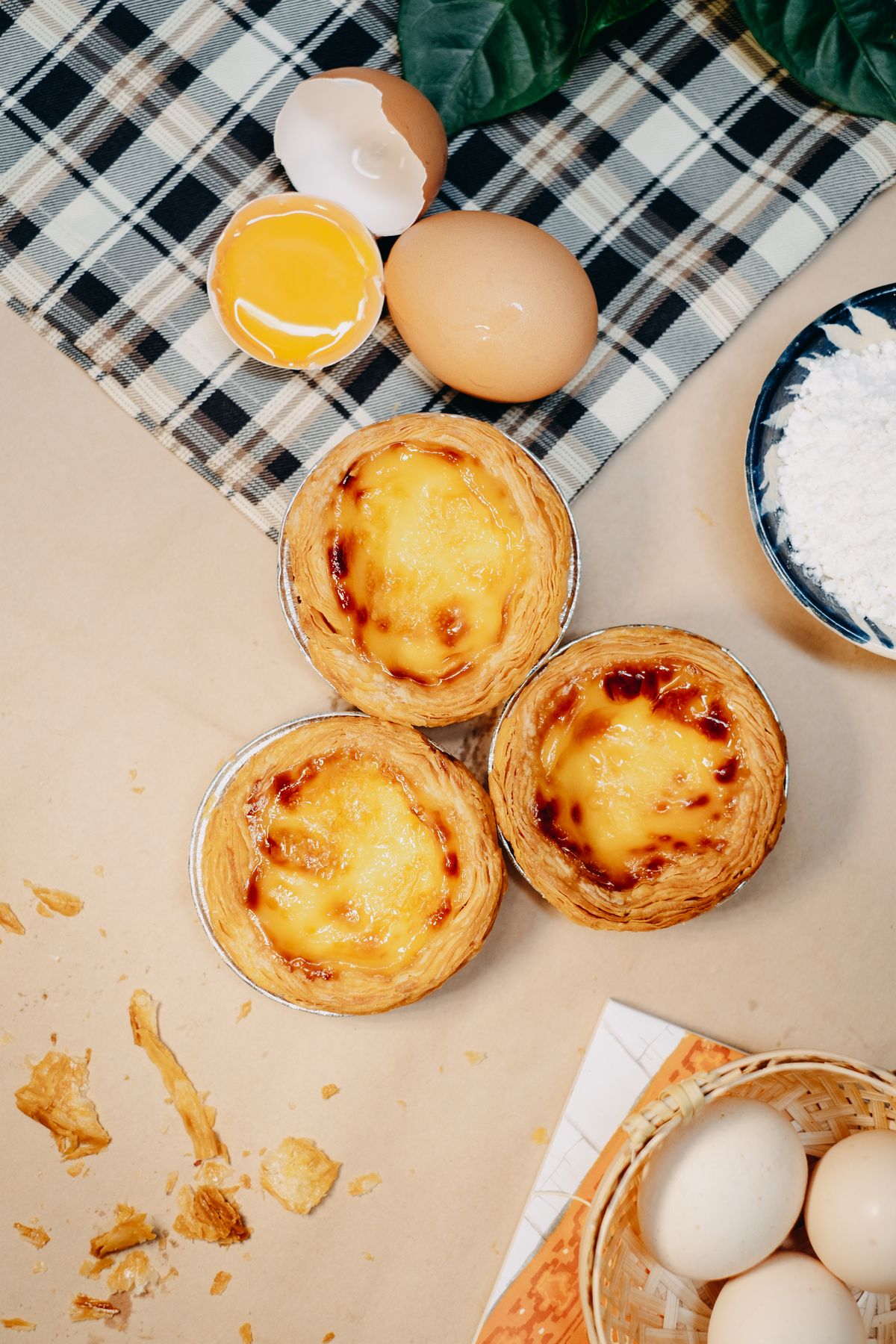
Warm from the oven, a Cantonese egg tart (蛋掻, daan6 taat1) fits in the palm of your hand. The crust shatters against your teeth in golden flakes. The custard trembles like it might slide right off the spoon. It is, without argument, one of the most perfect things Hong Kong ever put on a plate — and its origin story runs from a monastery in 18th-century Lisbon, through colonial Macau, all the way to a Central bakery where the last British governor of Hong Kong queued for his fix.
The Portuguese Ancestor
The egg tart's oldest ancestor is the pastel de nata — a small custard tart with a flaky pastry crust and caramelised top that Portuguese monks at the Jerónimos Monastery in Lisbon developed in the early 1800s. Legend has it the monastery used vast quantities of egg whites to starch their robes, leaving buckets of leftover yolks that had to go somewhere. The pastry that emerged became a Lisbon icon and, thanks to Portugal's colonial reach, spread wherever Portuguese sailors and settlers went.
Macau — a Portuguese colony from 1557 until 1999 — became one of those places. But the Macau version we know today is not a direct copy of the Lisbon original. It was invented much later, and by a British pharmacist.
The English Pharmacist Who Reinvented It in Macau
In 1979, an Englishman from Essex named Andrew Stow moved to Macau to work as an industrial pharmacist. He had visited Belém, tasted a pastel de nata, and been quietly obsessed ever since. In 1989 he opened Lord Stow's Bakery in Coloane village and started selling his own version — Portuguese pastry shell, English-style heavy custard from a family recipe, and the signature scorched, blistered top he baked in extremely hot ovens. Because he had no formal recipe to work from, the tart he ended up with was something new.
To distinguish it from the standard Cantonese daan6 taat1, he called it the "Portuguese Egg Tart" (葡式蛋掻, pou4 sik1 daan6 taat1). Today Lord Stow's makes roughly 13,000 tarts a day, and the Portuguese egg tart has become so identified with Macau that most tourists assume it has always been there. It hasn't. It's only about 35 years old.
Hong Kong's Own Dan Tat: A Different Story
The Hong Kong-style daan6 taat1 is a completely separate creation, and older. It arrived in Hong Kong in the 1940s and was itself a Cantonese reinterpretation — this time of the British custard tart. The British had colonial custard tarts served in high-end hotel dining rooms. Cantonese chefs, always ready to adapt a foreign idea into something more delicious, shrunk it, sweetened it, gave it a firmer wobble, and started baking it in cha chaan tengs and dim sum halls.
The result is what most people picture when they hear "Hong Kong egg tart": a glassy, deep-yellow custard that sits perfectly flat on top, cradled in either a soft cookie crust (餅乾皮) or a flakier puff pastry crust (酥皮). Every neighbourhood bakery had its own version. It became one of the essential accompaniments to cha chaan teng milk tea and one of the classic dim sum finishers at yum cha.
Chris Patten and the Tai Cheong Story
If any single bakery deserves to be called Hong Kong's egg-tart temple, it's Tai Cheong Bakery (泰昌餅家) on Lyndhurst Terrace in Central. Founded in 1954, Tai Cheong was already a neighbourhood favourite when its cookie-crust egg tart became legend under Master Au Yeung, the second-generation owner who refined the recipe using techniques he had picked up baking cakes in a hotel.
The bakery's real turning point came in the 1990s. Chris Patten, the last British governor of Hong Kong, started making frequent stops at Tai Cheong for its tarts — sometimes eating them fresh from the oven, sometimes carrying boxes back to Government House. He publicly declared them the best in Hong Kong, and that quote turned the tiny shop into a citywide pilgrimage site. Tai Cheong was even forced to close for a time in 2005 due to soaring rent, before reopening nearby to enormous public relief.
Today the Central shop still queues around the corner most afternoons. The tart itself is small, buttery, and — crucially — not too sweet, so you can eat two or three without noticing.
Cookie Crust vs Puff Pastry: The Hong Kong Debate
Ask a Hong Konger which egg tart is best and you'll get a battle. There are two camps:
Team Cookie Crust (餅乾皮). Denser, buttery, breaks like shortbread. Tai Cheong is the flagship. Fans say the crust is the whole point — the custard is just an excuse to enjoy the biscuit.
Team Puff Pastry (酥皮). Flaky, shatters into a hundred golden layers, gets messy fast. Chinese bakeries and dim sum halls tend to lean this way. Fans say the puff pastry is the more "authentic" Cantonese take because it hews closer to the British inspiration.
Neither side is wrong. What matters is that you eat it warm — both styles suffer badly once cool, and reheating one is a mild culinary sin.
Why Dan Tat Matters to the Cantonese Diaspora
Walk into any Chinese bakery in San Francisco, Sydney, Toronto, London, or Vancouver and the egg tart will be there. It travelled with the Cantonese diaspora because it is small, cheap, portable, and unmistakable. For thousands of Cantonese kids growing up abroad, biting into a still-warm daan6 taat1 is one of the fastest routes back to a grandmother's kitchen. It carries no ceremony, no chopsticks, no complicated ordering rules. It's a two-dollar sensory shortcut home.
The tart also captures something particularly Cantonese about Guangdong and Hong Kong cuisine: an unashamed willingness to borrow from anywhere — Portugal, Britain, Macau, colonial hotels — and to keep tinkering until the result is more delicious than any of its sources. Cha chaan teng food is built on that same instinct. So are pineapple buns, milk tea, and even the sweet-and-sour pork Cantonese chefs originally invented for foreign diners in Guangzhou.
📖 Related Articles
How to Eat One Like a Local
Order it fresh, ideally still hot enough that you can feel the heat through the paper. Hold it flat in your palm, take one bite from the edge to test how the crust behaves, then commit. Pair with a black cup of Hong Kong-style milk tea (奶茶, naai5 caa4) — the astringency of the tea balances the eggy sweetness so perfectly it's suspicious. Don't share unless you have to. Order a second one. You'll want it.
👉 Shop Cantonese Guy — Modern Streetwear for the Global Cantonese Community