

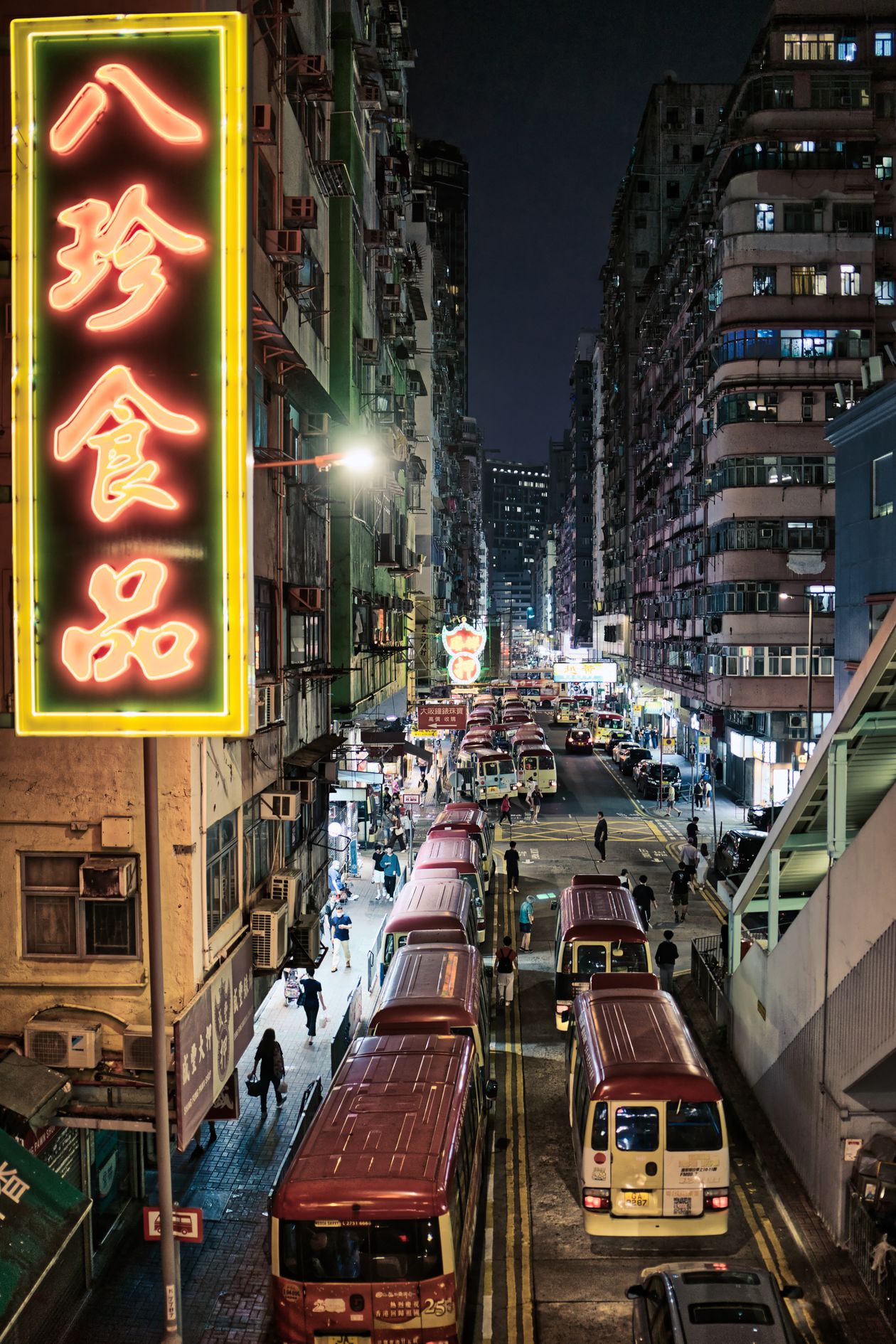
Flag one down on the roadside. Shout the stop at the driver — in Cantonese, with the right landmark name, before you miss it. Pay cash as you step off. No app. No fixed timetable. No seatbelts until recently. No air-con in half of them until the 1990s. The Hong Kong red minibus — 紅Van, hung4 Van — has been running the city at its own stubborn speed since the late 1960s, and it is one of the strangest, fastest, loudest institutions in Cantonese daily life.
Every Hong Konger has a 紅Van story. The 2am ride home from Lan Kwai Fong. The driver who did 110 km/h on a wet overpass. The old auntie who yelled her stop so loudly the whole van turned around. The 24-hour route to Yuen Long that saved you when the MTR had stopped running. Red minibuses are chaos on wheels, and they are a core piece of how Hong Kong actually works.
Born out of a 1967 bus strike
In 1967, during the Hong Kong leftist riots, workers at China Motor Bus and Kowloon Motor Bus went on strike. The two companies ran almost every franchised bus route in the city. Suddenly, Hong Kongers had no reliable way to get to work. Minibus operators — previously limited to the New Territories under a semi-informal "Pak Pai" network of 9-seater vans — stepped in to run urban routes. One early route carried people from the Jordan Road ferry pier up to Yuen Long, considered the first proper minibus route into the New Territories.
The government, watching this all happen in real time, had to make a decision: ban the illegal minibuses, or legalise them. In 1969, legislation legalised the service and roughly 5,000 licences were issued. The red roof — distinguishing them from the later green-roofed, fixed-route minibuses that would arrive in the 1970s — became the symbol of a very Hong Kong form of transport: fast, chaotic, lightly regulated, driver-owned.
Red van, green van — the difference that still confuses tourists
Both red and green minibuses look nearly identical from the outside. Same chassis, same 16- or 19-seat capacity, same compact body. The only visible difference is the colour of the roof. Everything else is different.
Green minibuses — 綠Van, luk6 Van — run fixed routes with government-regulated fares. They accept Octopus cards. They have numbered routes. They are, in effect, small buses with a slightly more intimate scale.
Red minibuses have no fixed routes. The government does not control their fares. Many run 24 hours. Many only run after midnight — when the MTR shuts and the 紅Van becomes the last way home to the suburbs. Drivers can set their own prices and often charge more during typhoons, rainstorms, or late nights. They mostly take cash, though some have started accepting Octopus in recent years. The whole system runs on tribal knowledge: locals know which 紅Van goes where, how much it costs, and where to catch it.
If you work hard, finish late, and catch the last 紅Van home, you probably already live the 準時收工 Clock Out On Time heavyweight tee energy — even if the reality is you clock out a lot later than on time.
The art of shouting your stop
Red minibuses do not have a stop button. There is no electronic announcement. The way you get off is you shout — in Cantonese — to the driver. The call-and-response goes something like this:
有落! (jau5 lok6) — "Getting off!"
巴士站有落唔該! (Baa1 si2 zaam6 jau5 lok6 m4 goi1!) — "Bus stop, please stop!"
紅綠燈前有落! (Hung4 luk6 dang1 cin4 jau5 lok6!) — "Stop before the traffic light!"
The driver may raise a hand to acknowledge. Or he may ignore you and you'll have to shout louder. Tourists trying this for the first time are usually hilariously under-prepared. Locals shout stops like they are ordering at a wet market — fast, loud, with no apology. If you learn one Cantonese sentence for Hong Kong public transport, learn 有落.
For more phrases every Hong Konger shouts without thinking, dip into our dictionary volumes — Vol. 123 on money slang and Vol. 120 on compliments are two solid starting points.

The speedometer legend
For decades, 紅Van drivers were paid per trip, not per hour. The incentive was simple: finish the route faster, make the next one, earn more. Red minibuses became famous — and feared — for driving fast. The urban legend of the 紅Van that overtook a Mercedes on the Lantau Link is not entirely a legend. It is partly a documented complaint pattern from Hong Kong's Transport Department archives.
In 2012 the government required all public minibuses to install a speed alarm set at 80 km/h and a digital speedometer that passengers can read from their seats. The alarm beeps continuously once the vehicle crosses 80. If you have ever been in a 紅Van at 2am and heard a constant, insistent beep as the driver merges onto the highway at Prince Edward Road, you have experienced one of Hong Kong's quietly most Cantonese sounds.
A piece of Cantonese that only lives inside the 紅Van
有落
jau5 lok6 — Jyutping romanisation
Meaning: Literally "have off" — passenger-speak for "I'm getting off here".
Explanation: The single most useful Cantonese phrase for Hong Kong public transport. On buses, trams, and especially red minibuses, this is how you tell the driver to stop. Shouted with the right volume and the right landmark attached, it is a tiny piece of local performance every Hong Konger does hundreds of times a year.
Why the 紅Van still matters
Hong Kong has one of the most efficient public transport systems in the world. The MTR runs underground to almost every neighbourhood. Double-decker buses blanket the island and Kowloon. The Star Ferry still carries people across the harbour. In that context, a chaotic, cash-only, driver-owned minibus with no fixed route sounds like something that shouldn't survive.
It does survive — because it fills gaps nothing else fills. The 2am run to Tseung Kwan O after the MTR has shut. The direct ride from Mong Kok to Sai Kung on a Sunday morning when the KMB would take 90 minutes with transfers. The old auntie's weekly trip from the wet market in Yuen Long back to her village. The 紅Van is Hong Kong at its most self-organising, most Cantonese, most whatever works. If you've ever lived on the island or in Kowloon and you've ever taken the last ride home, you know exactly what we mean.
For another slice of the city's living transport heritage, read our pieces on the 1904 Hong Kong trams Hong Kongers call 叮叮 and the 1888 Star Ferry across Victoria Harbour.
📖 Related Articles
👉 Shop the Best Seller collection
Modern streetwear for the global Cantonese community.