

Walk down any older street in Hong Kong, Guangzhou or Macau and you will eventually smell it: a slow, bitter, slightly earthy steam coming out of a copper urn behind a glass counter, pumping into the humid air. That smell is 涼茶 — "cooling tea" — and for the past two centuries it has been the Cantonese answer to just about everything that goes wrong in a subtropical body. Sore throat. Can't sleep. Hungover. Pimples. Stress. The remedy is the same: step inside, hand over a few dollars, drink the bitter cup in one go, chase it with the preserved plum they hand you after. Then back out onto the street.
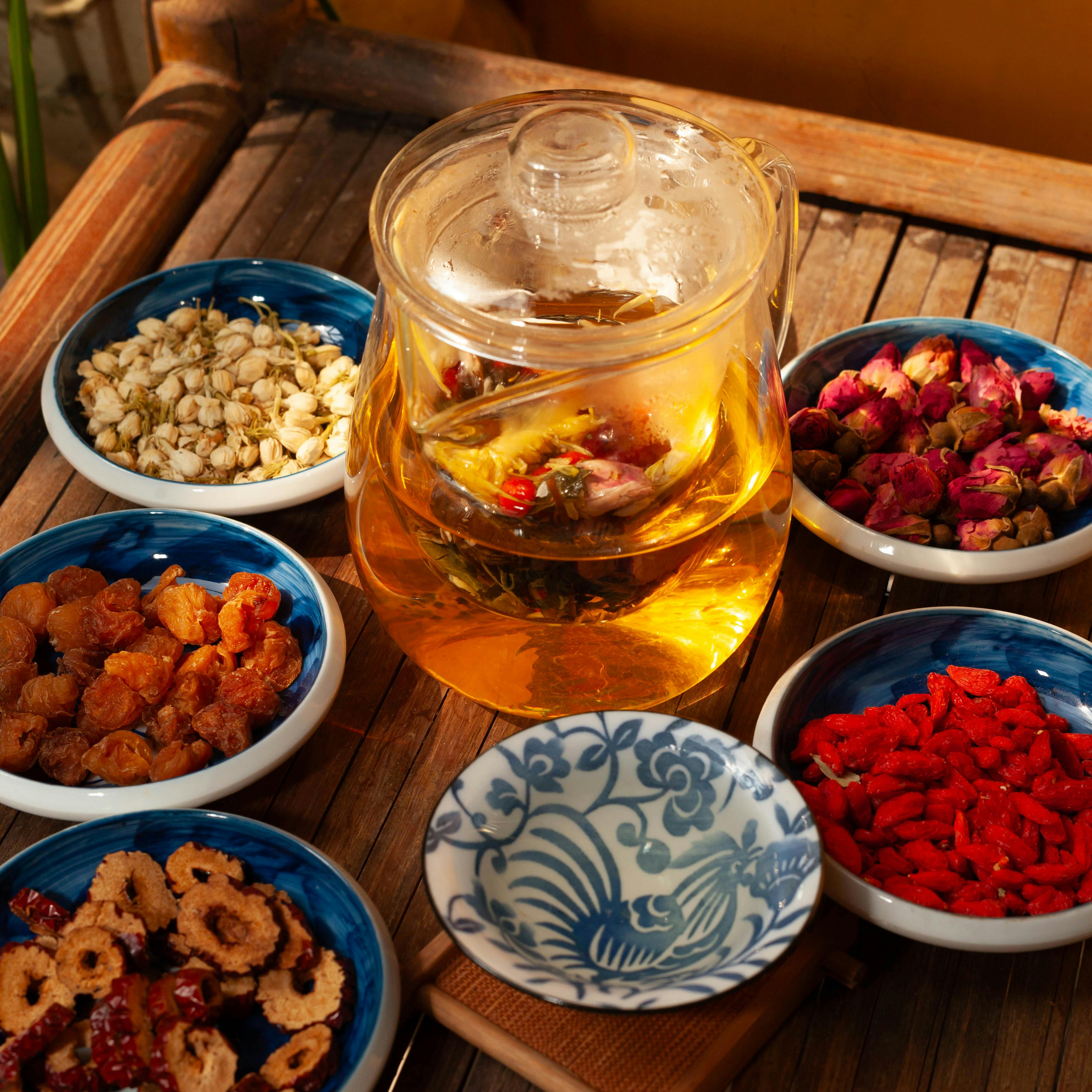
涼茶 is not tea in the Western sense. It is a family of herbal decoctions brewed from the twigs, barks, roots, flowers and leaves of the Lingnan countryside. It is one of the most Cantonese things in the world. And it is quietly disappearing from Hong Kong streets.

Where it comes from
The best-documented origin story runs through Guangdong in the Qing dynasty. In 1828, a herbalist named Wong Chat Bong (王澤邦) opened a stall in Guangdong brewing a bitter herbal concoction aimed at the heat-and-damp maladies of the southern climate. His brand, Wong Lo Kat (王老吉), is still a household name across Greater China today — and holds a Guinness World Record as the oldest Chinese herbal tea brand. But 涼茶 as a practice is older than any one brand. It is folk medicine built up over generations of Lingnan families cooking what grew around them, filed under what Traditional Chinese Medicine calls the balancing of 熱氣 (yeet hay — internal "heat") with cooling foods and drinks.
If you have ever heard your mum say "你咁多暗瘡係熱氣啊!" ("All those pimples — you're too heaty!"), you have met the operating system 涼茶 was built for. We wrote a whole piece on this cosmology, and if you want to signal that you believe in it, our 熱氣 Yeet Hay embroidered tee says it in two characters.
What is actually in the cup
Herbal tea shops in Hong Kong usually offer a handful of standards, and the names on the glass jars tell you what each one is for. The most famous is 廿四味 (yaa6 sei3 mei6) — "twenty-four flavours" — a brutally bitter brew traditionally made from 20 to 30 different medicinal herbs, drunk to clear general heat and dampness from the body. There is 五花茶 (ng5 faa1 caa4), five-flower tea, lighter and more floral, aimed at summer heat. 雞骨草 (gai1 gwat1 cou2), chicken bone grass tea, is drunk for the liver. 竹蔗茅根 (zuk1 ze3 maau4 gan1), sugar cane and imperatae root, is the sweet one — the children's gateway drug into 涼茶 culture. 羅漢果 (lo4 hon3 gwo2), monk fruit tea, is drunk for coughs and sore throats.
The bitter ones hit like a wall. Shop keepers hand you a shot glass of brown liquid, a small plate of preserved plum or sour prune to chase it with, and watch you knock it back. This is not a sipping drink. 涼茶 is medicine first, beverage a distant second.
The golden era: 1950s to 1970s Hong Kong
The shops exploded across Hong Kong in the post-war decades. In the 1950s and 60s, when air-conditioning was rare, Western medicine was expensive and most working-class families lived three to a room, 涼茶 shops became something like neighbourhood clinics plus living rooms. You would stop in on the way home from the factory, drink your 廿四味 standing up, and watch the TV mounted above the counter — one of the first places in the neighbourhood with a set. Herbal tea shops are credited by Hong Kong cultural historians as some of the first places ordinary people watched broadcast television in Hong Kong. For a generation, Hong Kong pop culture and 涼茶 happened in the same room.
If you want more on the Hong Kong of that era, our piece on Hong Kong trams covers another everyday institution the same working-class city built. The 得閒飲茶 Let's Catch Up hoodie borrows a phrase from the same age of casual neighbourhood meet-ups.
The quiet decline — and the comeback
The arrival of mass-market Western medicine, air-conditioning, cold convenience-store drinks, and expensive Hong Kong rents did to 涼茶 shops what they have done to a lot of family-run street trades. Many of the small independent shops closed through the 1990s and 2000s. The ones that survived often did so by scaling up into chains — Hung Fook Tong (鴻福堂) and Hoi Tin Tong (海天堂) are the two that most Hong Kongers now reach for, with their chilled bottles stacked in refrigerators across the city.
But in the last few years something has shifted. A new generation of Hong Kong bartenders and chefs has been pulling 涼茶 into modern cocktail menus. Cantonese cafés in Vancouver and the Bay Area have started brewing 廿四味 for homesick diaspora kids. And on a Guangzhou street at 35°C in August, the queue outside an old Wong Lo Kat storefront is still worth walking past.
A phrase to learn
飲啥涼茶
jam2 daam6 loeng4 caa4 — Jyutping romanisation
Meaning: "Have a sip of cooling tea."
Explanation: The pragmatic Cantonese prescription for anything inflamed, swollen, red or hot. Your mum will say it to you after you have been eating too much deep-fried food. Your popo will say it to you after an all-nighter. Nobody in the family will ask whether you want to.
Why it matters
涼茶 is one of the clearest surviving examples of what everyday Cantonese culture actually looks like once you strip away the dim sum and the neon signs. It is folk science. It is the Lingnan climate speaking through two centuries of trial and error. It is a kind of medical democracy — a few dollars gets anyone, factory worker or financier, the same brown cup and the same preserved plum chaser. If you grew up with a popo pressing a bowl of 竹蔗茅根 into your hands on a July afternoon, you already know everything 涼茶 is trying to teach: that the body is a weather system, and sometimes you just need to cool it down. For more Cantonese food thinking in the same spirit, our piece on turtle jelly covers the dessert end of the same cosmology, and the 飲湯 Yum Tung oversized tee celebrates the slow-brewed soup side of it.
📖 Related Articles
👉 Shop the Mami Says collection
Modern streetwear for the global Cantonese community.