

Walk down almost any old street in Hong Kong or Guangzhou and you will spot a particular kind of shop: a row of polished copper urns lining the counter, a wall plastered with handwritten paper menus, and a few small porcelain bowls of dark, bitter liquid waiting for customers. This is a 涼茶舖 (loeng4 caa4 pou3) — a herbal tea shop — and the drink it serves, called 涼茶 (loeng4 caa4), has been part of Cantonese life for the better part of two centuries.
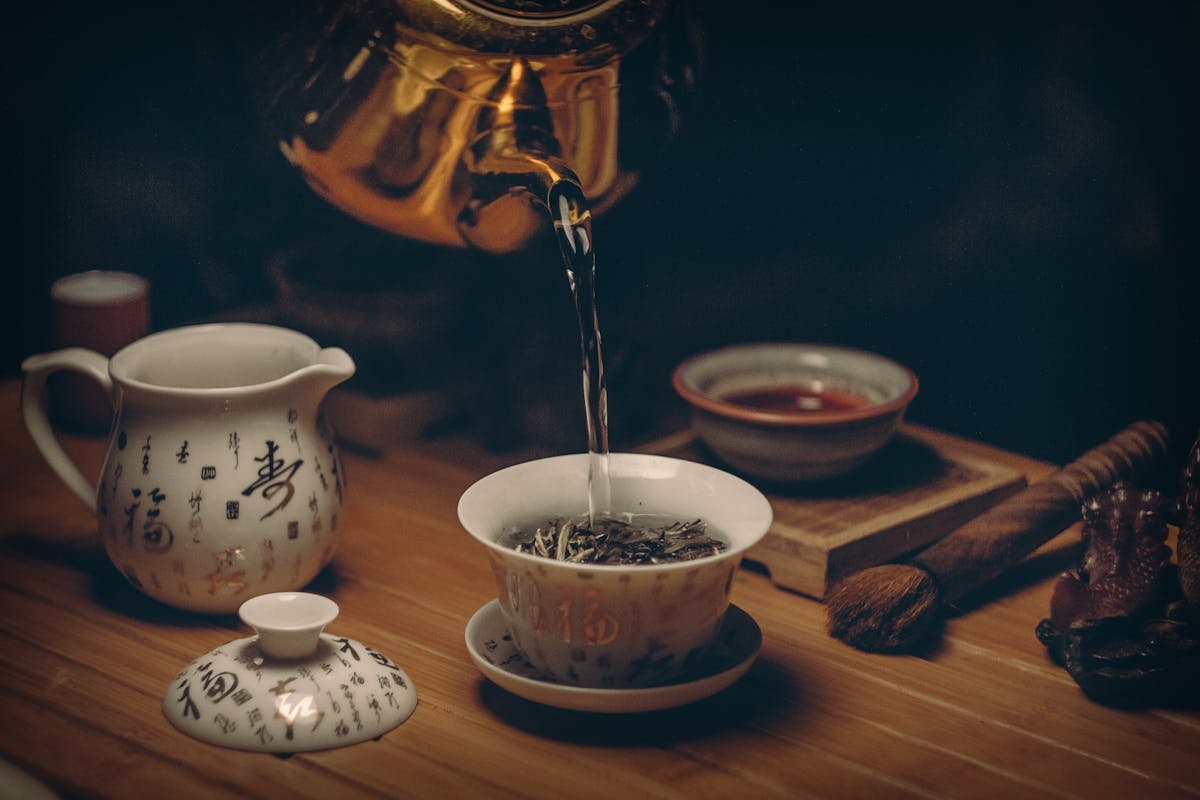
What Leung Cha Actually Is
"Leung cha" translates literally as "cool tea," but the name does not refer to temperature. In traditional Cantonese medicine, foods and drinks carry "warm" or "cool" properties that influence the body's internal balance. Leung cha is the catch-all term for herbal infusions designed to clear what Cantonese speakers call 熱氣 (jit6 hei3) — "heat" — the cluster of symptoms commonly believed to follow too much fried food, late nights, summer humidity or general stress.
In practice, that means a small bowl of bitter brown liquid is a household-level remedy for sore throats, mouth ulcers, mild fevers, hangovers and the post-dim-sum slump. You drink it, you grimace, you move on with your day.
The Founding Story: Wong Lo Kat, 1828
The most famous name in Cantonese herbal tea is 王老吉 (wong4 lou5 gat1), Wong Lo Kat, founded in 1828 in Guangdong by a herbalist named Wong Chat Bong (王澤邦). His recipe — a sweetened decoction of cooling herbs — was originally sold as a street remedy in small stalls. Wong Lo Kat survived the dynastic turbulence of the next century, expanded across southern China and Hong Kong, and is today one of mainland China's best-selling non-carbonated beverages, sold in distinctive red cans worldwide.
Wong Lo Kat is the brand that proved leung cha could leave the apothecary and enter the supermarket — but the older form of the drink, brewed daily in shop-front urns, never disappeared.
廿四味: The Legendary Bitter
Of all the leung cha varieties, the most fearsome is 廿四味 (jaa6 sei3 mei6), literally "twenty-four flavours." The name refers to the rough number of herbs in the blend — in practice some shops use as few as ten and others use closer to twenty-eight. Common ingredients include mulberry leaf, chrysanthemum, honeysuckle, bitter melon, dandelion and houttuynia, all chosen for their cooling, detoxifying or fever-clearing properties in traditional Chinese medicine.
The flavour is famously punishing — so bitter that the polite custom is to chase the bowl with a sweet preserved plum or a small cup of sugar water. Hongkongers who grew up drinking it remember exactly the face their grandmother made when handing them a bowl: half stern, half sympathetic.
Beyond 24 Flavours: The Other Bowls in the Shop
A typical Cantonese leung cha shop offers a small menu of named brews, each with its own purpose:
五花茶 (ng5 faa1 caa4) — Five Flower Tea. A gentler, often sweetened blend of chrysanthemum, honeysuckle, kapok flower, plumeria and other dried blossoms. The go-to for everyday hot weather.
夏枯草 (haa6 fu1 cou2) — Self-heal infusion. A darker, herby brew traditionally drunk for liver "heat" and sore eyes. The base of several classic bottled leung cha drinks.
雞骨草 (gai1 gwat1 cou2) — Chicken Bone Grass tea. Made from a vine called Abrus, this earthier brew is associated in Cantonese practice with caring for the liver after rich meals.
龜苓膏 (gwai1 ling4 gou1) — Turtle jelly. Strictly speaking a dessert, not a tea, but it lives on the same counter — a glossy, deeply bitter herbal jelly served with syrup or condensed milk, traditionally believed to cool the body and clear the skin.
Why the Shops Matter
The 涼茶舖 is one of the small everyday institutions that holds Cantonese street life together. Many of the oldest shops have been in the same family for three or four generations. The interiors share a recognisable look: a long counter, a row of tall ceramic or copper urns kept warm with charcoal or electricity, a TV in the corner, and a few stools where regulars sit with their bowl in one hand and the racing pages in the other.
In a culture that has long blurred the line between food and medicine — see also the tong sui sweet soup tradition and the slow art of Cantonese congee — leung cha is the most pharmacy-like of the everyday rituals. You don't go to a leung cha shop because you are thirsty. You go because you can feel a sore throat starting.
2006: Heritage Recognition
In 2006, Cantonese herbal tea was inscribed onto China's first national list of Intangible Cultural Heritage, with Hong Kong, Guangdong and Macau jointly recognised as its home regions. The listing was a meaningful piece of paperwork — the kind that validates what every Cantonese grandmother had been saying for a hundred years: this isn't just a drink. It is a practice, a knowledge system, and a piece of who we are.
Hong Kong's own Intangible Cultural Heritage Office still lists herbal tea as a representative element of Hong Kong culture, alongside Cantonese opera and the Cheung Chau Bun Festival.
The Modern Leung Cha Moment
For a while in the 1990s and 2000s, old leung cha shops seemed to be quietly disappearing — squeezed by rent, supermarkets and the convenience of canned drinks. The last few years have seen a soft revival. Younger Hongkongers, the same generation that has rediscovered cha chaan teng culture, are once again ordering five flower tea after a heavy hot pot dinner. Independent shops are experimenting with lower-sugar versions and adding new herbal blends aimed at screen-time fatigue and air-conditioning chills.
The bitterness is still there. The grimace is still part of the ritual. But leung cha continues to do what it has always done — meet the Cantonese body where it is, in a small bowl, on a busy street.
📖 Related Articles
👉 Shop Cantonese Guy — Modern Streetwear for the Global Cantonese Community