

Let us get one thing out of the way immediately: the Hong Kong pineapple bun contains no pineapple. There never has been any pineapple in it. The name 菠萃包 (bo1 lo4 baau1) — literally "pineapple bun" — refers entirely to the bun's appearance: that cracked, golden, slightly scored crust on top that, to a sufficiently imaginative eye, bears a faint resemblance to the skin of a pineapple. This small comedic fact is, somehow, entirely in keeping with Hong Kong's character — practical, self-deprecating, more concerned with texture and flavour than literal accuracy. The pineapple bun is one of Hong Kong's most beloved bakery creations, and its story is a window into the city's unique culinary identity.
The Anatomy of the Perfect Bo Lo Bao
A proper pineapple bun has two distinct components that must both be right. The first is the bun itself: a soft, pillowy, slightly sweet milk bread made with enriched dough — eggs, butter, sugar, and milk combined to produce a crumb that is tender and cloud-like, substantial enough to hold its shape while still yielding at the slightest pressure. This is the Hong Kong-style white bread tradition (港式麵包) — softer and sweeter than European bread, designed for maximum comfort.
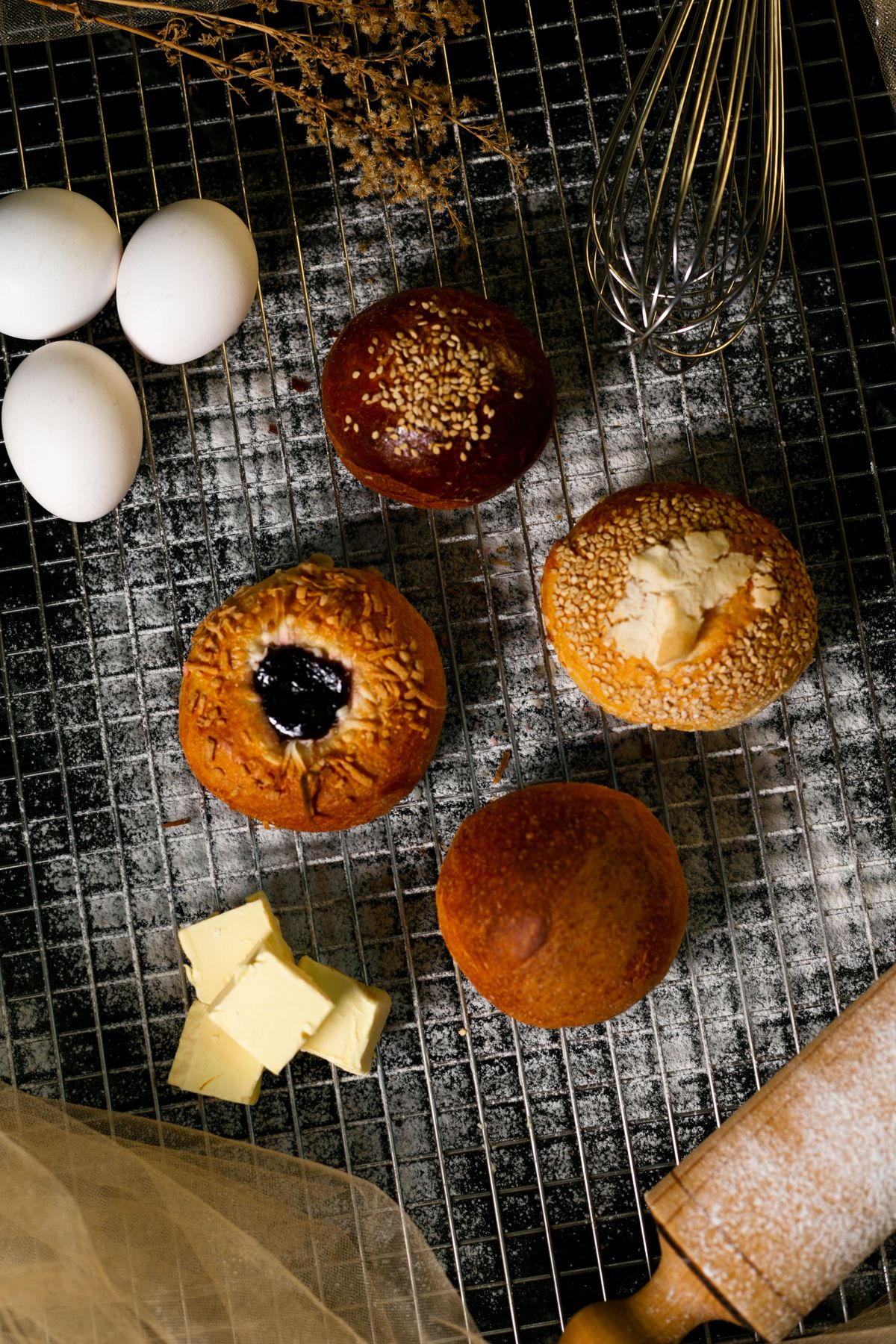
The second component is the top crust: a separate cookie-like mixture of butter, sugar, eggs, and flour pressed onto the top of the bun before baking. As the bun rises and bakes, the crust cracks in a characteristic pattern — the distinctive "pineapple" surface that gives the bun its name. The crust bakes to a golden, slightly crisp exterior that provides textural contrast to the soft bread beneath. In the oven, the butter in the crust caramelises, giving the top a rich, shortbread-like flavour that deepens and sweetens as it cools. The quality of this crust — its thickness, its degree of crack, its butter-to-sugar ratio — is the mark by which Hong Kong people judge a bakery.
Bo Lo Yau: The Butter Upgrade That Changed Everything
The pineapple bun is excellent on its own. But 菠萃油 (bo1 lo4 jau4) — pineapple bun with butter, sometimes called 冰火菠萃油 ("hot pineapple cold butter") — is on another level entirely. In this version, a fresh-from-the-oven bun is split horizontally and a thick, cold slab of salted butter is placed inside — sandwiched between the warm bread so that it begins to melt immediately but has not yet fully dissolved when you take your first bite.
The contrast is extraordinary: the warm, soft bun, the cool, slowly melting butter, the slight sweetness of the bread meeting the salt of the butter. The butter must be cold and thick — not a thin scraping but a generous, almost ridiculous slab, because restraint is not the point. This is comfort food at its most unapologetic. In Hong Kong's cha chaan tengs, a bo lo yau with a glass of hot milk tea is one of the most perfect breakfast combinations in any food culture on the planet.
The Cha Chaan Teng: The Bo Lo Bao's Natural Habitat
The pineapple bun rose to prominence alongside the cha chaan teng (茶餐廳) — Hong Kong's iconic tea restaurant — in the 1960s. As these affordable local cafes developed their distinctive menus of Hong Kong-style Western food, the pineapple bun became a staple: affordable, filling, delicious, and requiring no utensils. It could be eaten standing up, taken away in a paper bag, consumed alongside a cup of silk stocking milk tea, or dunked, if you were bold, into a bowl of macaroni soup. Its versatility made it the perfect food for a city that is always in motion.
Hong Kong's bakery culture — of which the pineapple bun is the crown jewel — is a synthesis of Cantonese tradition and British colonial influence. The enriched milk bread comes from Japanese and Cantonese bread-making traditions. The cookie crust has echoes of European pastry. The result is unmistakably Hong Kong — a hybrid that absorbed multiple influences and created something entirely original. Like the city itself, the pineapple bun is a product of crossroads culture, and it carries the energy of that crossroads in every bite.

Cultural Heritage Recognition
In recognition of its cultural significance, the art of making the Hong Kong pineapple bun has been included as part of Hong Kong's intangible cultural heritage. This is not hyperbole. The pineapple bun represents a genuine and irreplaceable piece of Cantonese Hong Kong identity — a food that has been part of daily life for generations, made by skilled bakers who understand that the crust must crack at exactly the right angle, that the bun must be eaten fresh (not yesterday's bun!), and that the butter in the bo lo yau must be cold enough to provide genuine contrast. These are standards that Hong Kong people enforce with quiet but serious conviction.
Bo Lo Bao in the Diaspora
In cities with significant Cantonese communities — Vancouver, San Francisco, Sydney, Toronto — the search for a proper pineapple bun is a cultural pilgrimage. Diaspora Cantonese bakeries work to reproduce the exact texture and flavour of the Hong Kong original, and the debate about whose bo lo bao is closest to the authentic article is a conversation conducted with the same seriousness that Italians bring to pizza. The pineapple bun is, in this sense, a cultural anchor: a specific, technically demanding, deeply personal food that connects the diaspora to the city that invented it.
Find out more about Hong Kong food culture in our post on Hong Kong Night Markets: The Street Food Scene That Never Sleeps, and explore the full range of Cantonese food beyond dim sum.
📖 Related Articles
👉 Shop Cantonese Guy — Modern Streetwear for the Global Cantonese Community