

There is a specific quiet that falls in a proper Hong Kong wonton noodle shop the second the bowl hits your table. The steam rising off the broth. The plump prawn wontons half-submerged like little pillows. The springy strands of egg noodle coiled beneath them so tight they haven't touched water in decades. You lift the chopsticks and the whole room seems to lean in.
This is wan4 tan1 min6 — wonton noodles — the most Cantonese thing you can eat for under HK$70. It looks simple. It is not. Every element is the product of a century of refinement, and the story runs from the wharfs of 1920s Guangzhou to the alleys of Jordan.
If you like your Cantonese food history worn on the sleeve, our Mami Says collection puts the phrases your Cantonese mother said around the dinner table on tees you can eat siu mei in.
Born in 1920s Guangzhou, Made Famous in Hong Kong
Wonton noodles were not invented in Hong Kong. They came south with the Mak family. Mak Woon-chi (麥煏池) opened his first noodle shop in 1920s Guangzhou and, at his peak, ran as many as eight branches. He was the man who standardised the bowl — four wontons, one nest of noodles, one soup — and he was famously fussy about the noodles themselves.
His method broke the rules. Where most Cantonese noodle makers used water to bind their dough, Mak used only eggs — duck eggs and chicken eggs, no water at all. Then, instead of kneading with hands, he sat on a bamboo pole (竹升麺) and bounced the dough into shape. That's what gives real Cantonese wonton noodles their signature bite: an audible crunch, springy against your teeth, holding shape even after 30 seconds in scalding broth.
🎚 The Move That Changed Hong Kong Food Forever
In 1945, as postwar China collapsed into chaos, the Mak family moved south to Hong Kong. Mak Woon-chi's eldest son, Mak An (麥奵), opened Mak's Noodle in Central based on his father's techniques. That single shop became the mother-tree of Hong Kong wonton noodles. Nearly every serious wonton shop in Hong Kong today can trace its lineage back through Mak An — disciples, apprentices, in-laws, cousins.
Why the Bowl Is So Small
First-time visitors to Mak's Noodle in Central always say the same thing: the bowl is tiny. It is. That's on purpose. A traditional Cantonese wonton noodle is served as a sai3 jung4 (細蓉) — a small serving. The idea was that the noodles had to sit on top of the wontons, above the broth, so they never got soggy. If the bowl was too big, the noodles drowned before you finished them.
Old-timers order two sai jung in a row rather than one big bowl. Every bite stays perfect. It's the same instinct behind the Hong Kong cart noodle philosophy: build the bowl for eating, not for looking.
The Broth That Takes Hours
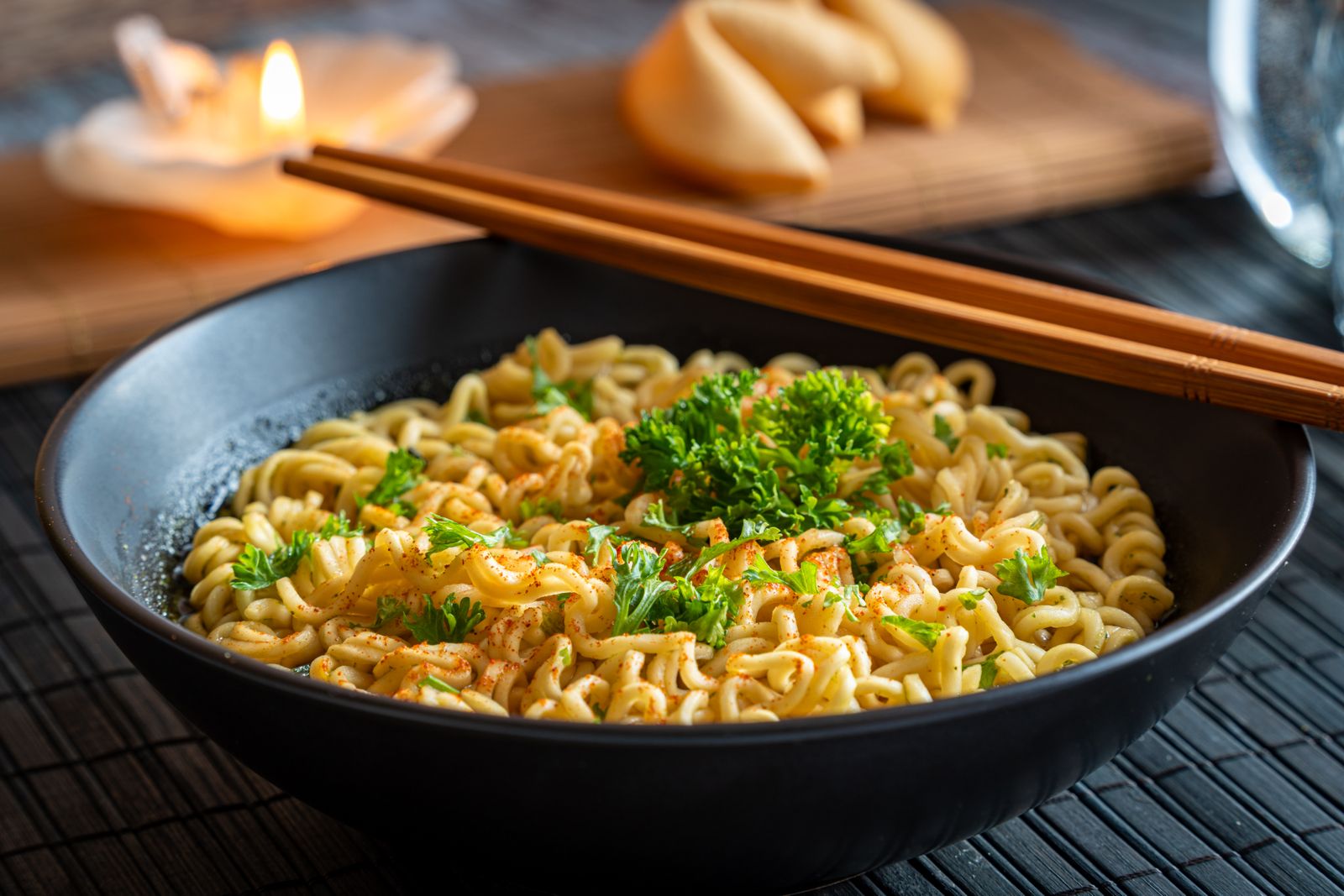
Ask any old Cantonese chef what makes a wonton noodle shop legit, and the answer is not the wontons — it's the soup. A real Cantonese wonton broth starts with three ingredients: pork bones for depth, dried shrimp for umami, and, most importantly, daai6 dei6 jyu4 (大地魚) — dried flatfish, roasted till it goes fragrant, then simmered for hours. That's what gives the broth its ghostly savoury edge, the flavour you can't quite name but recognise immediately.
Old shops guard their soup like a secret. Ho Hong Kee in Wan Chai — opened in 1946 by Mak's apprentice Ho Chi Hong — has been running the same broth base for decades. Mak Man Kee in Jordan, opened by Mak's brother-in-law Mak Keng Man, keeps the same fire alive.
🍽 The Four-Wonton Rule
Mak Woon-chi's other lasting rule: four wontons per bowl. Not three. Not five. Four. The number was practical — four wontons was exactly enough to arrange in a cross pattern under the nest of noodles, all the same size, so every bite got the same ratio of filling to noodle to broth. Cantonese engineering, applied to soup.
The Wontons Themselves
The classic Cantonese wonton is not a big ravioli-style dumpling. It's a delicate little pocket — mostly whole prawn, a small amount of pork, tied off in yellow egg-skin wrappers so thin they turn translucent in broth. When you bite, the prawn snaps first (the springy "crunch" Cantonese cooks call song1, 爷), then the pork releases, then the broth from the pocket. Three textures, one bite.
The best shops still hand-fold every wonton. That's why the good ones sell out by 8pm.
The Late-Night Ritual
In Hong Kong, wonton noodles are not really breakfast food, despite what tourist guides say. They're a late-night thing. Old Cantonese friends catching up after work, the mahjong crowd on the way home, the film-crew guys wrapping a shoot at 2am — they all pile into a wonton shop and order two sai jung and a plate of gai lan with oyster sauce on the side.
If that late-night, post-shift Cantonese energy is your entire personality, our 食飯 Dinner is Ready oversized tee and 叉燒 Char Siu oversized tee are made for it.
Where to Eat It, and How to Order Like a Local
Hong Kong's classic three: Mak's Noodle (Central and Jordan), Mak Man Kee (Jordan), and Ho Hong Kee. In Guangzhou, several shops still run versions of the original Mak broth. In San Francisco Chinatown you'll find diaspora shops keeping the tradition alive — sometimes with two more wontons in the bowl.
To order like a local, ask for sai jung (small bowl), or daai6 jung4 (大蓉, big bowl) if you're starving. Add gaa1 min6 (加麺) for extra noodles. Squeeze a bit of red vinegar over the top before you eat — the acid cuts the richness and makes the flavour pop. That's not optional. That's the way.
📖 Related Articles
👉 Shop the Mami Says collection
Modern streetwear for the global Cantonese community.