

In September 2009, UNESCO inscribed Cantonese opera — 粵劇 (jyut6 kek6) — on its Representative List of the Intangible Cultural Heritage of Humanity. The decision recognised something Cantonese-speaking communities have known for centuries: that the painted faces, soaring falsetto and clashing percussion of Yueju are not just entertainment, but one of the great living art forms of the Chinese world.
A Southern Art Form, Centuries in the Making
Cantonese opera grew up in the Pearl River Delta — the lush, river-laced lowlands around Guangzhou — but its roots run deep into northern Chinese theatrical traditions. Most scholars trace its formative period to the late Ming and early Qing dynasties (roughly the 16th and 17th centuries), when travelling opera troupes from the north met southern folk music and the Cantonese language and slowly mixed into something distinct.
By the 19th century, Cantonese opera was the dominant entertainment of Guangdong and Guangxi provinces, and as the Cantonese diaspora pushed outward, the art form travelled with them. Touring troupes performed in San Francisco's Chinatown by the 1850s, in Sydney by the late 1800s, in Singapore and Vancouver soon after. Cantonese opera was a global art form before anyone in English-speaking countries had heard the term "world music."
The Six Pillars: How a Performance Is Built
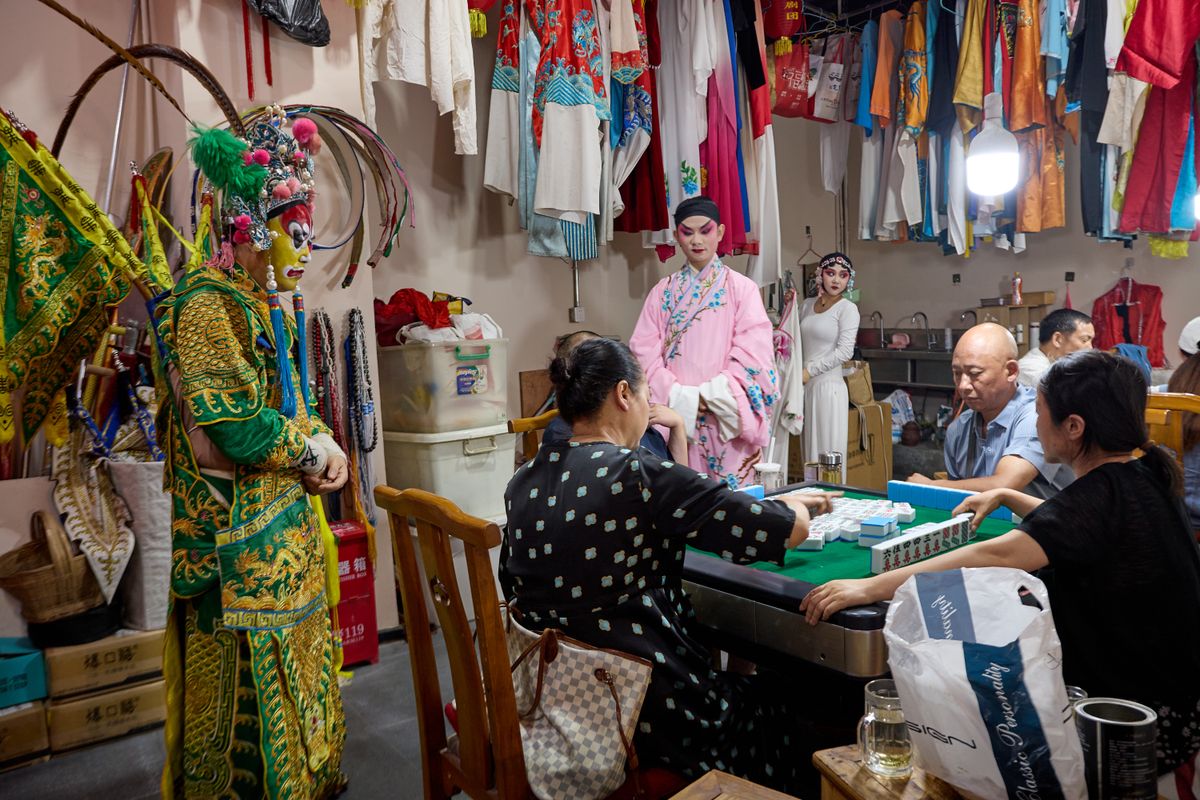
A Cantonese opera performance is built from six elements that every performer must master. Singing (唱), speech (做白), acting (做手), martial arts (打), face make-up (面譜) and costume (服飾) work together as a single language. Every gesture has meaning: a sleeve flicked over the face is shame; a hand raised at a specific angle is a horseback ride; a turn of the head is a thousand-mile journey. To watch Cantonese opera fluently is to read a vocabulary that has been refined for four hundred years.
The music is unmistakable. A small orchestra mixes Chinese string instruments — the gaohu and yehu (high-pitched fiddles), the yangqin (hammered dulcimer), the pipa — with a percussion section of gongs, cymbals and the wooden clapper (板) that drives the rhythm. The famous Cantonese opera 大喉 (daai6 hau4, "big throat") singing style is a powerful, resonant chest voice traditionally used for warrior and seasoned-man roles, and can carry across an open-air market without amplification.
The Golden Age — and the Stars Who Defined It
Cantonese opera's modern golden age ran from the 1930s through the 1960s, when Hong Kong became the unofficial capital of the art form. Names like Sit Gok-sin (薇覺先), Ma Si-tsang (馬師曾), and Yam Kim-fai (任劍輝) — a legendary female performer who played male warrior roles — drew sold-out audiences for years. Yam's partnership with Bak Sheut-sin (白雪仙) is still considered the greatest pairing in Cantonese opera history, and their performances of classic works like The Purple Hairpin (紫釵記) and The Reincarnation of Red Plum (再世紅梅記) remain reference points today.
The same era saw the founding of Cantonese opera schools in Hong Kong and the rise of female-led troupes. Yam and Bak's "Sin Fung Ming" troupe (仙鳳鳴劇團) produced their most celebrated classic works, and in 1965 the pair founded the "Chor Fung Ming" troupe (雛鳳鳴劇團) specifically to train the next generation of performers. Many of Hong Kong's great Cantopop singers and actors of the 1970s and 80s, from Roman Tam to Liza Wang, came up through Cantonese opera training first.
The UNESCO Decision — and Why It Was a Save
By the time UNESCO inscribed Cantonese opera in September 2009, the art form was in trouble. Television, Cantopop and Hollywood had carved away its audience. Many of the great troupes had folded. Young Cantonese-speakers were more likely to recognise a Stephen Chow film reference than a Yam Kim-fai aria. The UNESCO inscription — sought jointly by Hong Kong, Macau, and Guangdong — was an active rescue operation, designed to fund preservation, training, and the restoration of historic venues like the Sunbeam Theatre in North Point and the Yau Ma Tei Theatre.
Since then, the Xiqu Centre at West Kowloon Cultural District in Hong Kong (opened 2019) has become a dedicated Cantonese opera venue, and government-backed training programmes are bringing a new generation of performers into the art. The audience is still ageing, but the lights have not gone out.
Why Diaspora Cantonese Should Care
For the global Cantonese community — from Toronto to Sydney to London — Cantonese opera is more than a museum piece. It is the art form that travelled with our great-grandparents. The opera houses in San Francisco's Chinatown and the Cantonese clubs of early Toronto were where diaspora Cantonese went to hear their own language sung, to feel at home for three hours in a strange city. The connection between Cantonese opera and Cantopop identity is direct: the music industry of the 1970s and 80s grew straight out of opera traditions.
Even if you have never sat through a four-hour performance, the art form has shaped the rhythm of how Cantonese people sing, joke, and stage stories. To pay attention to Cantonese opera is to listen to the original soundtrack of Cantonese culture.
📖 Related Articles
👉 Shop Cantonese Guy — Modern Streetwear for the Global Cantonese Community