

Walk down Dundas Street in Mong Kok on a humid Friday night and the smell hits before the sight does — turmeric, garlic, hot oil, and something faintly fishy bouncing off the concrete. Then you spot the cart: a metal vat of golden balls bobbing in burnt-orange curry, a stack of bamboo skewers, and a line of teenagers reaching forward with five-dollar bills. Curry fish balls (咖哩魚蛋) might be the most photographed snack in Hong Kong, but their backstory is more interesting than most people realise.

Fish balls before they were Hong Kong
The fish ball itself is older than the British colony. It traces back to the Chiu Chow (Teochew) and Fujian coastal provinces of southern China, where fishermen pounded leftover catch into a springy paste and rolled it into white spheres. They were traditionally simmered in a clear broth and eaten as a light snack — none of the curry, none of the swagger.
When Chiu Chow migrants began arriving in Guangdong and Hong Kong in waves, they brought the fish ball with them. For decades it stayed a quiet, soup-based food. The transformation into the orange, skewered, spice-stained icon Hong Kong knows today happened later, and it took two specific historical pressures to make it happen.
How curry arrived in Hong Kong
Curry came to Hong Kong through the British. During colonial rule, Indian soldiers, merchants, and laborers settled in the territory, and they brought turmeric, cumin, coriander, and chili with them. By the early twentieth century, curry was already part of the city's pantry — a bold, fragrant import that locals slowly absorbed into their own cooking.
This is a recurring pattern in Cantonese cuisine: outside influences get adopted, adapted, and made unmistakably local. The same thing happened with milk tea, egg tarts, and the entire cha chaan teng menu. Curry on a Chiu Chow fish ball is part of the same lineage.
The 1950s hawker boom
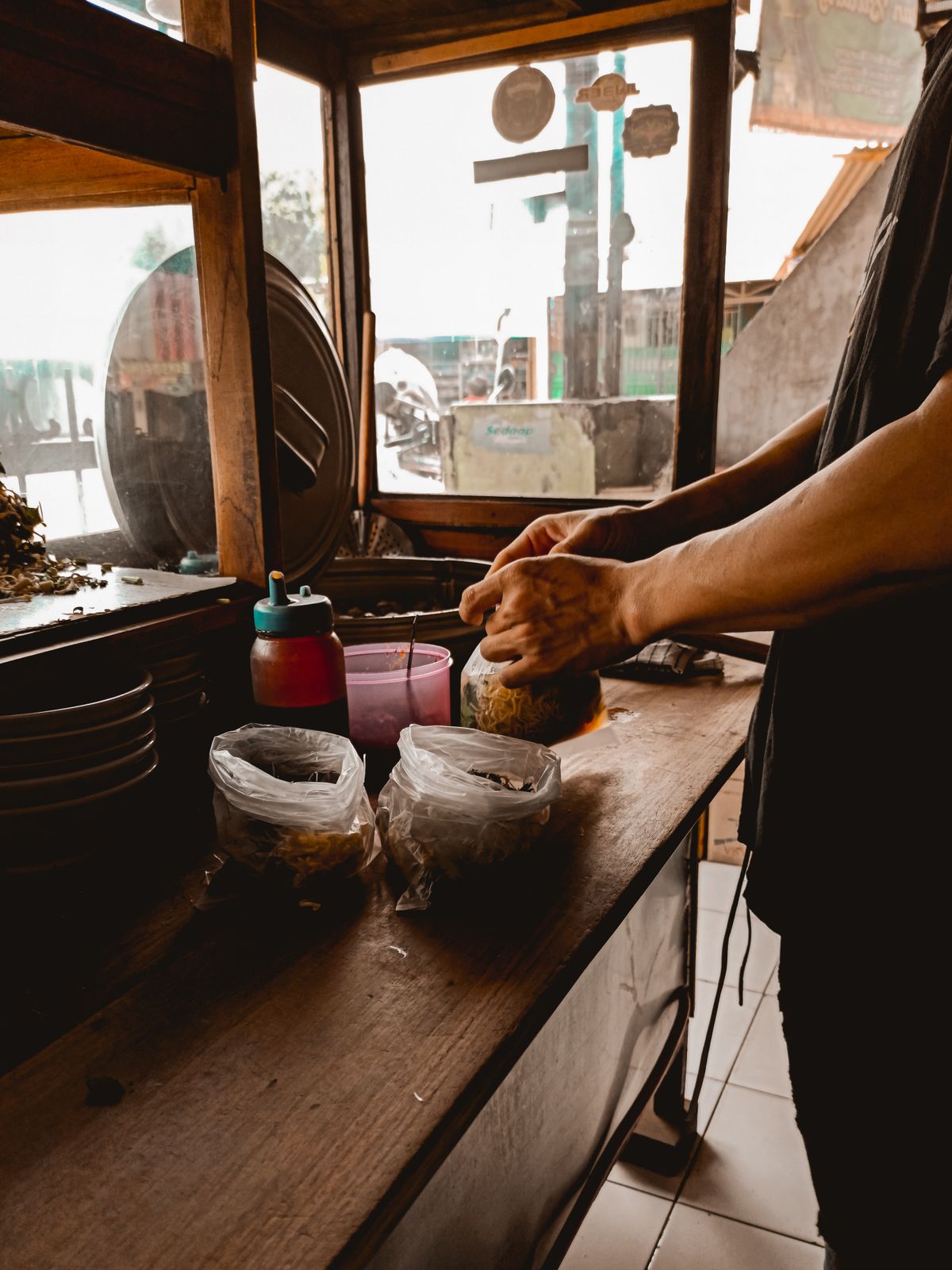
The real birth of the curry fish ball was post-war Hong Kong in the 1950s and 60s. The city was overflowing with refugees from the mainland, housing was scarce, and a generation of new immigrants needed to make a living however they could. Street hawking exploded — push-cart vendors lined Temple Street, Sham Shui Po, and every other working-class district, selling whatever could be cooked over a small flame and handed off in a paper bag.
Fish ball vendors faced a problem: cheap fish paste meant the balls weren't always the freshest. Curry sauce — strong, spicy, aromatic — masked any off-notes while turning the snack into something craveable. The balls were deep-fried for a golden crust, then simmered in curry to soak up flavour. For a few coins, working-class Hong Kongers got a hot, satisfying, deeply addictive snack on their way to and from the factory.
What makes Hong Kong's version different
If you've eaten fish balls in mainland China or Taiwan, you'll notice the Hong Kong version is its own creature. A few things set it apart. First, the balls are smaller, denser, and chewier — Hong Kong fish balls have an almost bouncy texture locals call 彈牙 (daan2 ngaa4), literally "bouncing teeth." Second, they're golden, not white, because they're fried before being added to the curry. Third, the curry itself is lighter and sweeter than Indian curry, leaning on coconut, sugar, and a softer chili kick.
The standard order is four to six balls on a bamboo skewer, generously ladled with curry sauce, often with a side cup of curry to dip the last bites into. The whole thing costs the price of a coffee and disappears in three minutes flat.
A symbol bigger than the snack
Curry fish balls are deeply tied to Hong Kong's working-class identity. They're democratic — eaten by office workers, schoolchildren in uniform, and triad enforcers alike. The South China Morning Post once argued that the humble fish ball helps define Hong Kong itself, weaving together sex, money, food, and politics into a single skewered snack. They also figured into the 2016 Mong Kok unrest, which was nicknamed the "Fish Ball Revolution" after the street hawkers protesters were defending.
In 2013, a tourism survey ranked Hong Kong's street food the best in the world, with curry fish balls cited as one of the defining items. They are, for better or worse, the snack that travels in postcards and Instagram captions.
Where to eat them today
The classic spots are still the iconic ones: Temple Street Night Market in Yau Ma Tei, the Dundas Street corner in Mong Kok, the laneways of Sham Shui Po. Some carts have been run by the same family for three generations. The diaspora has carried the tradition outward too — you'll find decent curry fish balls in Sydney's Cabramatta, London's Chinatown, and Toronto's Pacific Mall. They never quite taste like the original, but the ritual is the same: warm paper bag, bamboo skewer, sauce on your fingers.
For more on the broader Hong Kong street food tradition, see our piece on dai pai dong, the vanishing open-air stalls that gave Hong Kong its food identity, and our deep dive on the colonial roots of Hong Kong milk tea — another local creation born of foreign ingredients.
📖 Related Articles
👉 Shop Cantonese Guy — Modern Streetwear for the Global Cantonese Community