

The Cantonese egg tart, or 蛋撻 (daan6 taat1), is deceptively small. It sits in the palm of your hand — a warm shell of pastry cradling a wobble of golden custard — and it looks like nothing more than a snack. But held inside that little tart is a hundred-year story that runs through Guangzhou department stores, colonial trading ports, a Portuguese enclave, cha chaan teng counters, and one very famous British governor who admitted he could not go a day without one. This is the pastry that quietly became Cantonese cuisine's most beloved handheld.
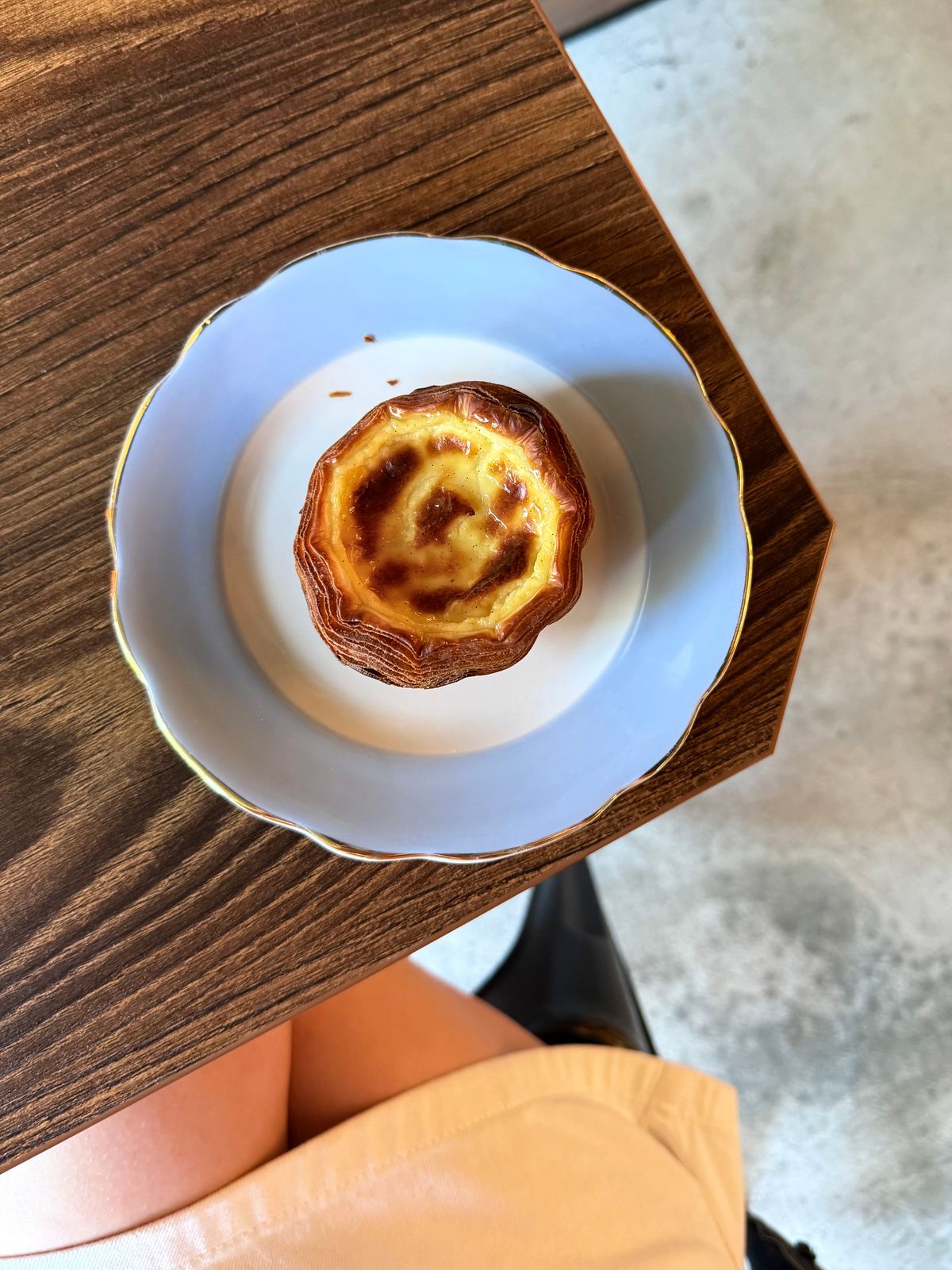
Guangzhou, 1920s: A British Custard Meets a Cantonese Kitchen
Contrary to the popular story, the egg tart did not arrive in Hong Kong first. Its Cantonese life began in 1920s Guangzhou (Canton), the only Chinese port then open to European trade. British merchants brought their custard tarts along with them; department stores in Guangzhou began weekly "weekend specials" featuring Western-style baked goods, and Cantonese pastry chefs quickly got their hands on the recipe. Unfamiliar with British shortcrust, they reached instead for what they already knew: the flaky, lard-based puff pastry (酥皮) used in traditional dim sum. They swapped butter for lard, adjusted the ratios, and out came something that was neither British nor Chinese — it was Cantonese.
By the late 1920s, the newly invented 蛋撻 had migrated south to Hong Kong via Guangdong bakeries and cha chaan tengs, arriving on the counters of casual eateries that served everything from milk tea to French toast. After World War II, when cha chaan tengs exploded across the city, the egg tart went from side item to standard-issue. If a bakery in Hong Kong didn't sell egg tarts by the 1960s, people wondered what it was even doing there.
The Great Egg Tart Debate: Puff Pastry vs Cookie Crust
Ask two Hong Kong grandmothers which egg tart is superior and you may witness an actual argument. Cantonese egg tarts come in two rival schools of crust, and choosing sides is a lifelong commitment.
The first is 酥皮 (sou1 pei4) — flaky puff pastry. Imagine layers of paper-thin dough that shatter when you bite, showering your shirt with crumbs. This is the classical, dim-sum-parlour version. It's what you'll find at old-school teahouses that serve 蛋撻 straight from the bamboo trolley.
The second is 曲奇皮 or 牛油皮 — cookie-style crust. Firm, buttery, holding its shape like a shortbread biscuit. This variant was famously pioneered and popularised by Tai Cheong Bakery (泰昌餅家), which opened on Lyndhurst Terrace in Central in 1954. Their crust is buttery, dense, and holds together like a proper baked good rather than a shell of laminated shards.
Chris Patten, "Fat Pang," and How Tai Cheong Went Global
In the mid-1990s, Chris Patten — the last British governor of Hong Kong, affectionately nicknamed 肥彭 (Fei4 Pang4, or "Fatty Pang") for his rounder frame and his warmth toward local Cantonese food — famously declared his love for the egg tarts at Tai Cheong Bakery, saying he could not go a day without one. The bakery immediately renamed its signature the "Fat Pang Egg Tart" (肥彭蛋撻), and the shop, already loved, transformed into a genuine landmark. Today, Tai Cheong produces tens of thousands of tarts a day and has franchises well beyond Hong Kong. All from one British politician's public sweet tooth.
The Macau Cousin: How the Portuguese Egg Tart Came Back Around
If the Cantonese egg tart is one branch of the family, its Macau cousin is another. Macau's famous 葡撻 (pou4 taat1) — the caramelised, blistered-top Portuguese-style egg tart — arrived through a very different route. In 1989, British-born baker Andrew Stow opened Lord Stow's Bakery in the village of Coloane, Macau, and produced his own adapted version of the Portuguese pastel de nata. His recipe swapped some ingredients to suit local supply and taste. It exploded across Macau in the 1990s and eventually leapt to Hong Kong, mainland China, and the rest of Asia via KFC. Today, when someone asks "which egg tart?", a Cantonese person will always want to know: Hong Kong-style, or Macau-style?
Anatomy of a Perfect Cantonese Egg Tart
Ask a Cantonese pastry chef what a good 蛋撻 must have and you'll get a short list of non-negotiables. The custard must jiggle when you tap the tin, never rubbery. The surface should be a matte golden yellow, without dark burn marks (the Portuguese cousin gets a scorched top; the Hong Kong version does not). The pastry must be freshly baked and warm — a cold egg tart is a heartbreaking egg tart. And when you bite in, the custard should be 滑 (waat6) — silky, almost melting. Any Cantonese eater knows within one bite whether the person behind the counter took the job seriously.
Why the Egg Tart Belongs to the Cantonese Diaspora
Walk into any bakery in a Cantonese-heavy neighbourhood anywhere in the world — London's Chinatown, Vancouver's Richmond, San Francisco's Sunset, Sydney's Chatswood — and you will find egg tarts sitting behind the glass. They cost pocket change. They come in trays of six or twelve. Grandmothers buy them warm for grandchildren. Uncles buy them by the dozen for meetings. Kids come home from Chinese school with a paper bag full and eat them in the taxi.
The Cantonese egg tart survived because it did what Cantonese culture always does best: absorb something foreign, translate it into the local grammar, and quietly make it better. It's a British custard tart raised by Guangzhou pastry chefs and finished by Hong Kong bakeries. That mixed lineage is exactly why it feels so deeply Cantonese — not despite its outside origins, but because of how thoroughly Cantonese cooks made it their own.
📖 Related Articles
👉 Shop Cantonese Guy — Modern Streetwear for the Global Cantonese Community