

There is no drink more Hong Kong than a steaming cup of 港式奶茶 — Hong Kong-style milk tea. Strong enough to wake the dead, smooth enough to drink three a day, and recognised since 2014 as part of Hong Kong's intangible cultural heritage, it is the beverage that powers cha chaan tengs, taxi drivers and construction crews from Kowloon to Causeway Bay. This is the story of how a leftover idea from British colonial tea culture became a globally recognised craft.

A British Habit, Reinvented for Hong Kong
When the British brought afternoon tea to Hong Kong in the 19th century, it was a colonial-elite ritual: bone china, soft cubes of sugar, and a splash of fresh milk. Local Cantonese cooks watched, tasted, and asked an obvious question — why use weak black tea and a splash of fresh dairy when working-class Hongkongers wanted something stronger, sweeter, and built to wake you up at 6 a.m.?
By the mid-20th century, Hong Kong tea masters had answered with a brew of their own: a custom blend of Ceylon (Sri Lankan) black teas of different leaf sizes, brewed thick and dark, then mixed with evaporated milk — shelf-stable, richer, creamier than fresh milk, and perfectly suited to the dai pai dong economy of the post-war years.
Why It's Called "Silk Stocking" Milk Tea
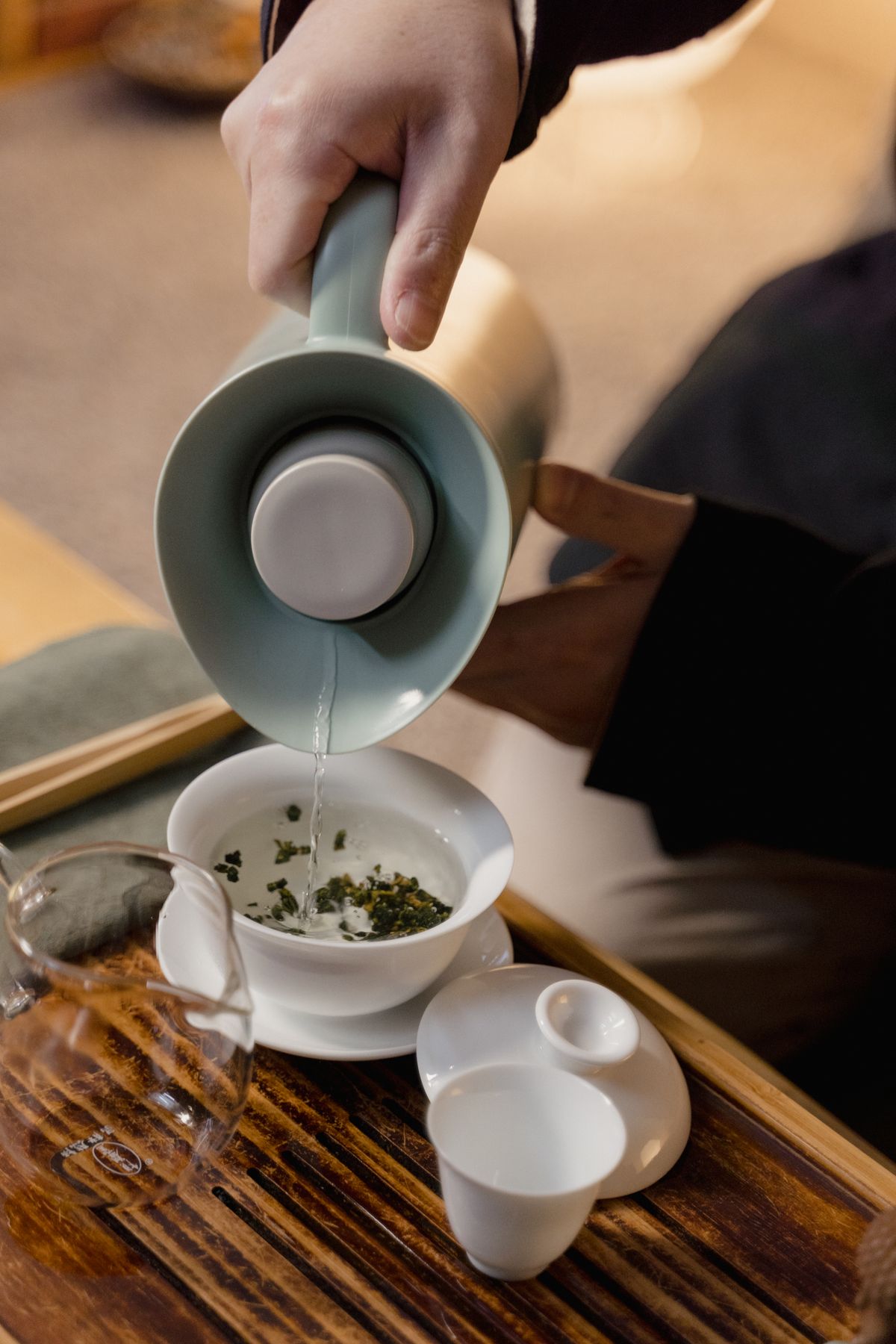
The signature technique is the cloth strainer, a long sock-like bag of fine cotton that the tea is repeatedly poured through — a process locals call 撞茶 (zong6 caa4, "ramming the tea") that aerates the brew and pulls out the bitterness. After thousands of pours, the white cloth turns a deep, stained tea-brown, looking eerily like a woman's silk stocking. The nickname stuck: 絲襪奶茶 (si1 mat6 naai5 caa4) — silk-stocking milk tea.
The most famous origin story belongs to Lan Fong Yuen (蘭芳園) in Central, a dai pai dong that claims its founder Lam Muk Ho invented the silk-stocking technique in 1952. The shop still operates today, and tourists queue around the block to drink from the source.
The Anatomy of a Perfect Cup
A proper cup is a balance of four things: tea strength, milk richness, sweetness, and 香 (heung1, aroma). Every cha chaan teng has its own recipe, but the formula generally follows a few rules. The tea blend is usually a mix of three or four Ceylon black teas — fine ground for body, mid-cut for colour, coarse for aroma. The tea is steeped, then poured through the cloth bag repeatedly at a high angle to develop a frothy, almost velvety body. The evaporated milk goes in last, sometimes with sweetened condensed milk replacing both milk and sugar.
The aim is what Cantonese drinkers call 滑 (waat6, "slippery-smooth"). When you sip a great cup, it should glide across the tongue. When it does not, the cha chaan teng probably needs to retrain its kitchen.
Cultural Heritage Status — Why It Matters
In 2014, the "Hong Kong-style milk tea making technique" was officially inscribed on Hong Kong's First Intangible Cultural Heritage Inventory. In 2017, the Leisure and Cultural Services Department further elevated it to the Representative List of the Intangible Cultural Heritage of Hong Kong — the highest cultural recognition the territory grants. It now sits alongside Cantonese opera and the Cheung Chau Bun Festival as one of Hong Kong's officially protected traditions.
For a drink that costs HK$22 at most cha chaan tengs, that is an extraordinary recognition. It says, officially, that the way Hongkongers brew tea is part of who Hongkongers are.
The Yuenyeung Cousin
No discussion of milk tea is complete without its caffeinated sibling: 鸳鸦 (yuenyeung), a 7:3 mix of milk tea and Hong Kong-style coffee. Where milk tea is the morning brew, yuenyeung is the late-night taxi-driver fuel — and an entire cultural identity in itself. We covered its full story in our Yuenyeung deep dive.
How To Order Like a Local
Walk into any cha chaan teng and the menu will list multiple variations:
凍奶茶 (dung3 naai5 caa4) — iced milk tea, served unsweetened with sugar packets on the side. 走甜 (zau2 tim4) — "skip the sugar." 走冰 (zau2 bing1) — "no ice" (a way to get a stronger pour). 茶走 (caa4 zau2) — milk tea with condensed milk instead of evaporated milk plus sugar, a sweeter, richer cup that has become a Hong Kong cult favourite.
Pair it with a pineapple bun or an egg tart, and you have the most quintessentially Hong Kong breakfast on Earth.
📖 Related Articles
👉 Shop Cantonese Guy — Modern Streetwear for the Global Cantonese Community