

Imagine a single city block, six and a half acres wide, holding as many as 50,000 people. Concrete stacked twelve storeys high with almost no gap between buildings. Sunlight only reaching the ground floor through narrow shafts. Dentists, noodle shops, sweatshops, temples, unlicensed clinics, plumbers, opera clubs and gangs all layered on top of each other in a single organism. That was 九龍寨城 (gau2 lung4 zaai6 sing4) — Kowloon Walled City. And it was, at its peak, one of the most densely populated places human beings have ever built.
For most of the 20th century, the Walled City was a Cantonese city inside Hong Kong, ungoverned by anyone and run by its own residents. When it was finally demolished in 1993 and 1994, it left behind more than just concrete rubble. It left behind an aesthetic — vertical, chaotic, hand-built, luminous with mismatched neon — that shaped everything from Ghost in the Shell to modern Cantonese streetwear.
A city that no country wanted
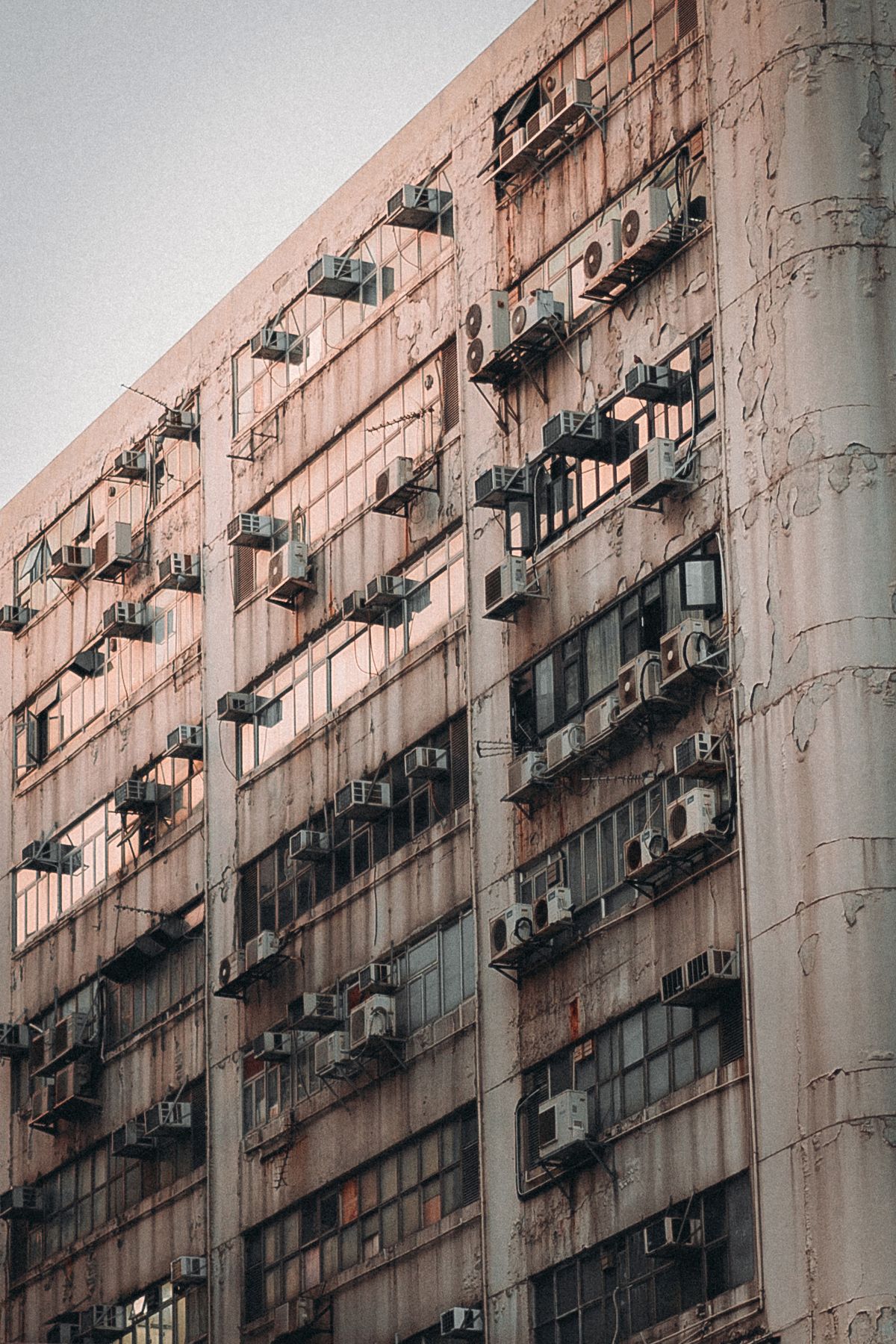
The Walled City started as a small Qing dynasty military fort on the Kowloon peninsula. When Britain leased the New Territories in 1898, Chinese officials were technically allowed to stay inside the fort walls, but the arrangement was murky from day one. Britain claimed jurisdiction. China refused to give it up. Neither party actually enforced law inside. Over the next century, this legal grey zone hardened into something extraordinary: a Cantonese enclave that ran itself.
After the Japanese occupation of Hong Kong ended in 1945, refugees fleeing the Chinese Civil War flooded into the Walled City. There was no zoning, no permits, no building code. People just built up. And up. Ceilings became someone else's floor. Alleys narrowed until they were only shoulder-wide. Water pipes and electrical wires became a hanging jungle overhead. And still more people came.
The densest place on Earth
By the late 1980s, roughly 35,000 people were living inside 2.6 hectares — that's around 1.2 million people per square kilometre. Some later estimates suggest peak density hit close to 2 million per km². To put that in perspective: modern Manhattan density is around 27,000 per km². Nothing else in modern history has come close to what the Walled City packed into one block.
Everything was Cantonese-speaking. Cantonese was the language of the market stalls, the dai pai dong food carts, the plumbers fixing tangled pipes, the illegal dentists doing US$5 crowns, the mahjong parlours, and the Triad-affiliated gambling dens on the lower floors. If you couldn't speak Cantonese, you couldn't survive inside. It was the last place in Hong Kong where the local dialect wasn't just dominant — it was operationally mandatory.
Not the lawless hellhole it's often painted as
Popular Western media has often described the Walled City as a lawless slum controlled purely by Triads. The reality was messier and much more human. Yes, organised crime operated inside — particularly through the 1950s and 1960s. But by the 1970s a major police crackdown had significantly weakened Triad control. What remained was a genuine, functioning working-class community: families raising kids in bunk beds, kids playing on rooftops that were stitched together into a single sky-level playground, small manufacturers producing noodles and fish balls that ended up in restaurants across Kowloon.
Photographer Greg Girard and architect Ian Lambot spent years documenting the interior of the Walled City in the years before its demolition. Their photographs show barbers giving haircuts under bare fluorescent bulbs, kids doing homework on tiny fold-down tables, elderly men playing cards in the corridors. It looks nothing like a crime scene. It looks like every dense Cantonese neighbourhood — just compressed by a factor of ten.
The demolition — and everything it left behind
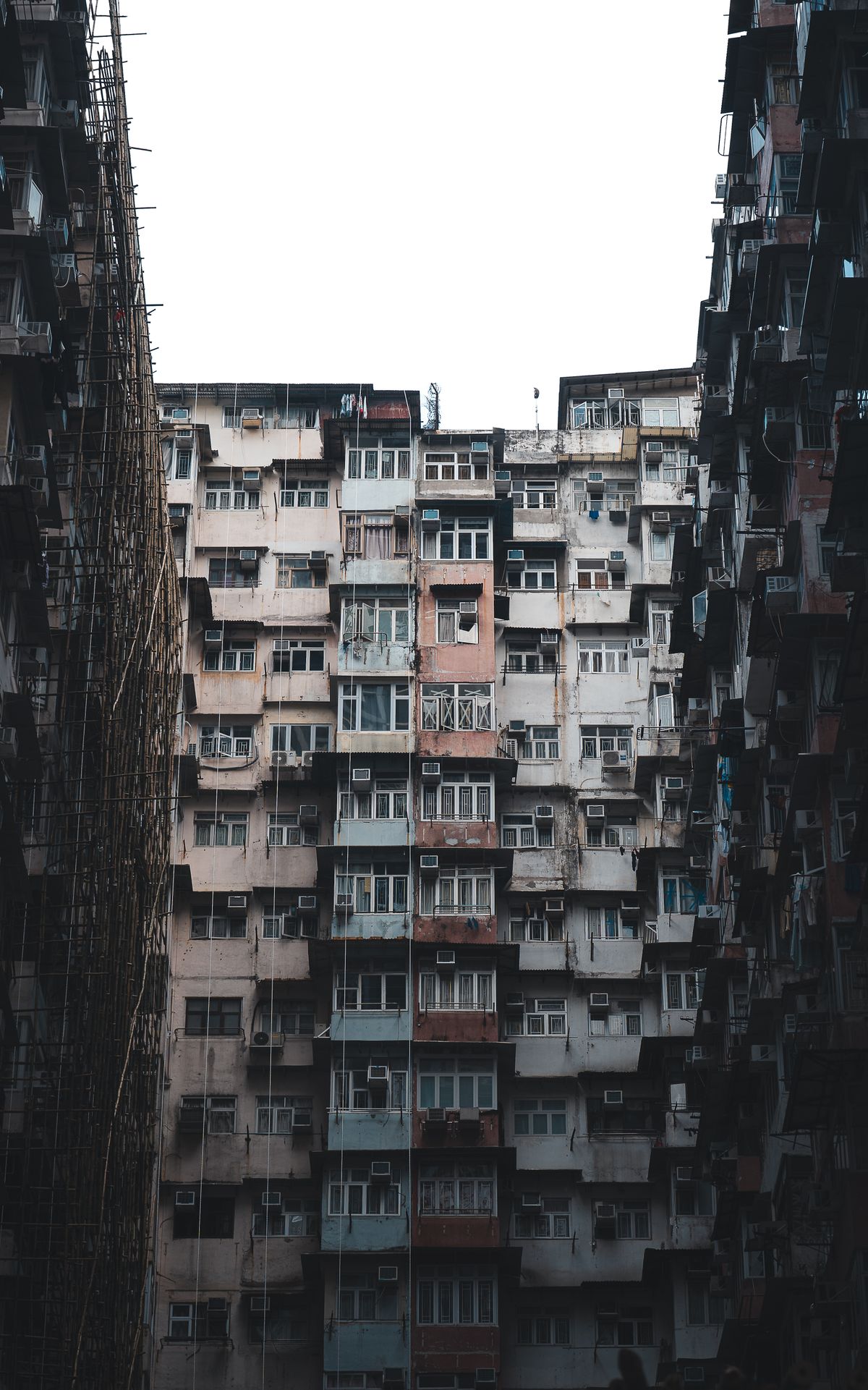
In 1987 the Hong Kong and British governments jointly announced the Walled City would be demolished. Residents were compensated and relocated over several years — not without protests and heartbreak. Demolition began in March 1993 and was complete by April 1994. In its place sits the Kowloon Walled City Park, a quiet Qing-style garden that today feels almost impossible to reconcile with what was there before.
But the Walled City didn't disappear. It exported itself, in image. Katsuhiro Otomo's Akira, Mamoru Oshii's Ghost in the Shell, William Gibson's Neuromancer, the Kowloon-set arcades in Shenmue II, Christopher Nolan's Batman Begins — the entire cyberpunk visual grammar of the late 20th century pulled directly from photographs of the Walled City's interior. Every neon-drenched, wire-tangled, vertical-stacked cityscape you've seen in an anime owes something to that six-acre Cantonese block.
Why the Walled City matters to streetwear
Cantonese streetwear owes an enormous visual debt to the Walled City. The neon, the mixed English-Chinese signage stacked twenty deep, the DIY confidence, the hand-drawn logos, the sense that a working-class city can produce its own iconography without asking anyone's permission — all of it goes back to what was happening inside those walls. When brands today drop Kowloon-inspired graphics, they're referencing a very specific kind of Cantonese street ingenuity: build what you need, decorate it in Chinese characters and neon, and outlast the people who said it wouldn't work. That same spirit runs through everything on the modern Cantonese streetwear scene and connects directly to Hong Kong street culture.
A Cantonese lesson from the Walled City
The Walled City gave Cantonese its most poetic slang term for extreme density.
寨 (zaai6)
zaai6 — Jyutping romanisation
Meaning: Fortress; stronghold; walled town
Explanation: The character in 九龍寨城. Originally military — a fortified position — the word has taken on a broader emotional meaning in Cantonese culture: a place so tight, so self-sufficient, so identity-rich that it operates by its own rules. Fitting for what the Walled City became.
A monument that lives on in imagination
The Walled City is gone — physically. But talk to any Cantonese person over 45 and they'll have a story: an uncle who ran a shop inside, a cousin who lived on the eighth floor, a grandmother who bought her cheapest bok choy at the Walled City market because it was two dollars cheaper than anywhere else. It's the ultimate proof of what Cantonese working-class ingenuity can build when nobody is watching. Legal or illegal, safe or dangerous, planned or wildly improvised — the Walled City was ours. And that, more than any statue, is why it still matters to every Cantonese person, everywhere in the world.
📖 Related Articles
👉 Shop Cantonese Guy — Modern Streetwear for the Global Cantonese Community