

Walk past any Cantonese family gathering, any Lunar New Year reunion, any old-timer teahouse in Sham Shui Po, and you will hear it — the clacking, shuffling, tile-on-table rattle that Cantonese people call the sound of sparrows. That's not a metaphor. Mahjong in Cantonese is literally called 麻雀 (maa4 zoek3), "sparrow," because generations of grandmothers said the noise of tiles being shuffled sounds exactly like a flock of sparrows arguing in a tree. Nowhere in the world is this game more woven into daily life than in Guangdong and Hong Kong.
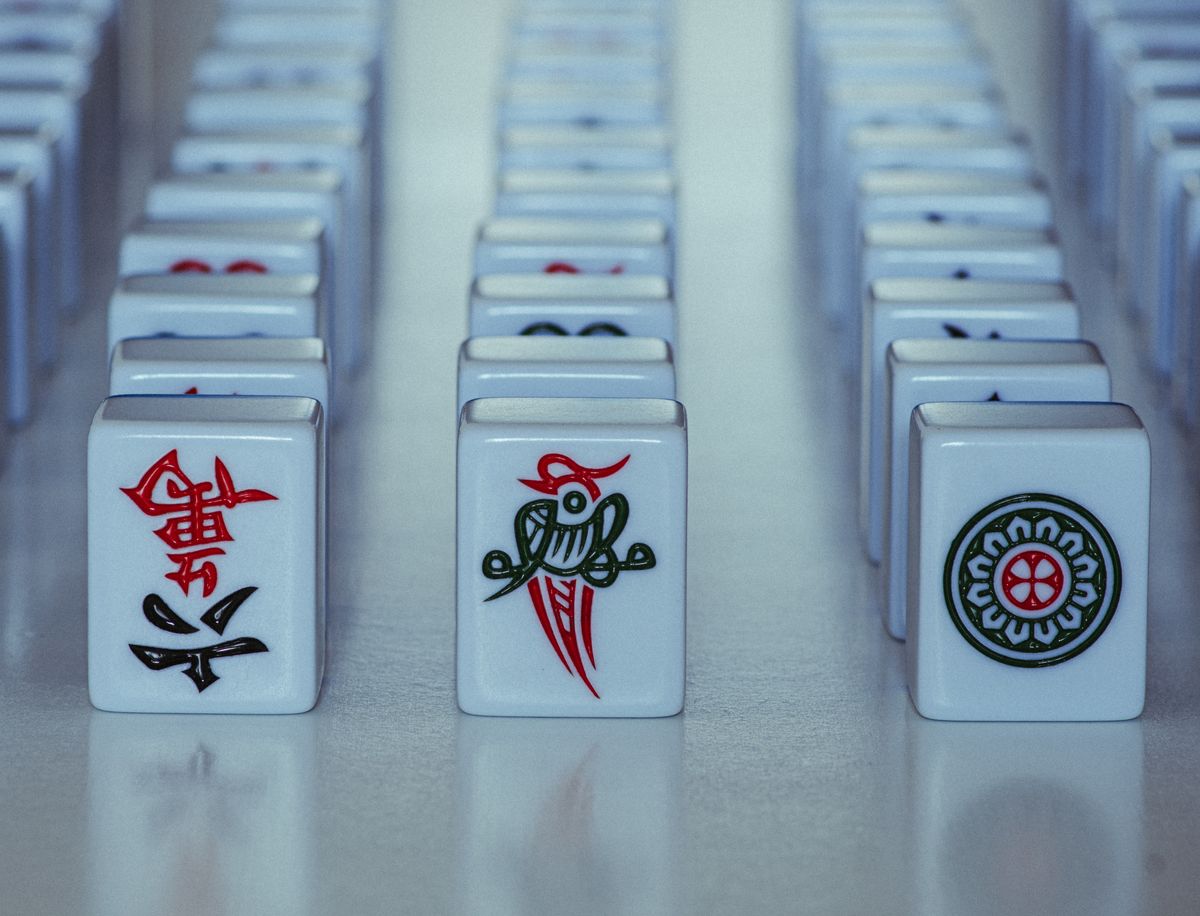
Sparrows, Tiles and the Sound of Cantonese Home
Modern mahjong is generally traced to 19th-century China, evolving from earlier Ming-era card games. The Cantonese name 麻雀 stuck in Guangdong, Hong Kong and later Japan — a reference to that unmistakable shuffling sound. Elsewhere in China the game is called 麻將 (ma jiang), but for Cantonese speakers, it has always been sparrows. And when Cantonese people phone a friend at short notice, the invitation is not "come play mahjong." It's 打麻雀 (daa2 maa4 zoek3) — literally, "hit the sparrows."
The rules the world now calls "Hong Kong Mahjong" or "Cantonese Mahjong" are the ones that spread most widely with the Cantonese diaspora — a fast, streamlined ruleset built around four melds and a pair, with a minimum "faan" (番) required to win. Compared to Japanese Riichi or mainland variants, Cantonese mahjong prioritises speed, sharp calls, and readable hands. It's the ruleset most likely to be played in a family dining room in Vancouver, a community centre in Sydney, or a corner shop in Manchester.
The Mahjong Parlour: Hong Kong's Legal Grey Zone Turned Cultural Institution
After World War II, the Hong Kong government moved to control gambling, and rather than outright ban commercial mahjong houses, it created a curious licensing loophole. Establishments that wanted to run mahjong-for-money legally had to register as 麻雀學校 (maa4 zoek3 hok6 haau6) — literally, "mahjong schools." Everyone knew they weren't really teaching. The name was a legal fiction, invented to keep the trade above ground.
These 麻雀館 (maa4 zoek3 gun2) — mahjong parlours — became a fixture of working-class Cantonese Hong Kong. Concentrated in Mong Kok, Yau Ma Tei, Sham Shui Po and Wan Chai, their neon signs are as iconic as any noodle shop's. Every player over 18 could walk in, hire a table, and pay the house a small percentage of their winnings. For decades, these smoky little rooms were where uncles socialised, retirees killed the afternoon, and taxi drivers unwound after a shift. Their numbers have shrunk in the 21st century as licences aren't renewed after operators retire, but they remain one of the most distinctly Cantonese pieces of urban culture in the world.
Three Short of Four: Why Every Cantonese Family Knows 三缺一
Cantonese mahjong needs exactly four players. Not three, not five — four. And because getting four adults into the same room on the same afternoon is genuinely difficult, the language has evolved a single phrase that echoes across every group chat, every family WhatsApp, every WeChat call from a Cantonese uncle:
三缺一 — saam1 kyut3 jat1
saam1 kyut3 jat1 — Jyutping romanisation
Meaning: "Three short one" — the universal Cantonese call when you have three players and desperately need a fourth to start a mahjong session.
Explanation: This phrase transcends mahjong. Ask any Cantonese person to describe a Sunday afternoon at their grandmother's flat and 三缺一 will come up. It's how uncles recruit strangers at a party. It's the text that pulls you out of bed to join a game you didn't plan on playing.
Mahjong in Cantopop and Hong Kong Cinema
Cantonese pop culture has treated mahjong as a shared shorthand for domestic life, tension, luck and rivalry. Cantopop legend Sam Hui (許冠傑) built entire songs around mahjong metaphors in the 1970s. Hong Kong cinema has produced its own sub-genre of mahjong films — comedies, gambling thrillers, family dramas — where a green-felt table becomes the stage for a whole social drama in the space of four hands. When directors want to show a Cantonese family's inner world in three seconds, they film them around a mahjong table. Nothing else in the culture quite does the same work.
Mahjong and the Cantonese Diaspora
Cantonese emigrants took the tiles with them. In every diaspora city — London, Vancouver, San Francisco, Sydney, Toronto, Auckland — mahjong quietly became the game grandmothers played on weekends. For second- and third-generation Cantonese kids who don't speak fluent Cantonese anymore, mahjong is often the last remaining shared ritual with 婆婆 and 嬣嬣. You may not know how to say "how are you" in Cantonese, but you know 碰 (pung3), 上 (soeng5) and 食糊 (sik6 wu4*2). That vocabulary survives even when the language doesn't.
There's a reason a mahjong set is one of the first objects Cantonese emigrants pack when they move overseas. It's the closest thing to bringing a piece of the family living room with you.
The Culture Behind the Clatter
Cantonese mahjong is not really a game. It's a language, an etiquette, a mild tribal identifier, and — for many Cantonese families — the closest thing to a religious observance. It's how grandmothers stay sharp into their 90s. It's how far-flung cousins pretend they still see each other. It's how strangers become friends within about six minutes of sitting down at the same table. Every clack of a tile is the sound of Cantonese people doing what they've done for over a century: gathering, arguing, laughing, and quietly keeping the culture alive one hand at a time.
📖 Related Articles
👉 Shop Cantonese Guy — Modern Streetwear for the Global Cantonese Community