

Every Hong Kong summer has a soundtrack of little spoons scraping the bottom of little bowls. That is the sound of 楊枝甘露 (joeng4 zi1 gam1 lou6) — mango pomelo sago — the pale-yellow, chilled, coconut-milk-soft dessert that lives in the freezer of every Cantonese household from mid-May until the first typhoon of September.
What almost nobody realises — including many Hong Kongers who have eaten it their whole lives — is that this dessert is only forty-two years old. It was invented in 1984 in a single Cantonese kitchen for a single event. Here is how a hot Singapore summer, a homesick head chef and a Buddhist legend combined to create the most iconic Cantonese dessert of the modern era.
The Restaurant That Made It: Lei Garden
By the early 1980s, Lei Garden (利苑) was already one of Hong Kong’s most respected Cantonese restaurant groups — famous for meticulous seafood, banquet dim sum, and a chef roster that felt more like a Cantonese cooking academy than a restaurant kitchen. When the group decided to open its first overseas branch in Singapore in 1984, it sent an experienced team south to build the menu.
Head chef Wong Wing-chee (黃永幟) was told to develop something new for the tropical climate. Singapore is a city where the temperature does not really drop below thirty, and traditional hot Cantonese 糖水 (tong4 seoi2) sweet soups — red bean, walnut, sesame — felt wrong at dinner. The team wanted something cold, refreshing, and clearly Cantonese in style.
The 1984 Kitchen Experiment
According to widely-reported accounts of the dish’s creation, the Lei Garden team spent that summer combining and rejecting ingredients. Mango was cheap and abundant in the tropical Southeast Asian market. Pomelo, the huge Chinese citrus, gave a bittersweet counterpoint. Sago — the tiny tapioca pearls Cantonese cooks had used for centuries in dessert soups — provided texture. Coconut milk, plus a splash of regular milk, softened everything into a pale-gold pool.
The result was a chilled dessert soup: bright with fresh mango puree, studded with juicy pomelo capsules that popped between the teeth, and slightly chewy from the sago. It hit a Cantonese sensory triangle that older desserts rarely combined — cold, fruity and softly milky.
The Beautiful Name That Sold It
Cantonese food names are their own art form. Lei Garden could have called the dessert “mango pomelo sago soup” — clear, boring, correct. Instead, the restaurant manager reportedly took the name from a Buddhist legend.
The goddess Guanyin (觀音) is traditionally depicted holding a small willow branch (楊枝) which she dips into her vase of sweet dew (甘露), sprinkling the world to relieve suffering during drought. Combining the two — 楊枝甘露 — gave the dessert a poetic name that promised exactly what it delivered: a cold sweetness that revives you on a burning day.
In Cantonese, saying you are ordering “yeung ji gam lo” sounds like a small blessing. In English, saying “mango pomelo sago” sounds like a menu translation. This is often why Cantonese food does not travel through language well — the poetry gets left behind.
The Ingredients — And Why They Matter
A traditional Cantonese 楊枝甘露 has five components:
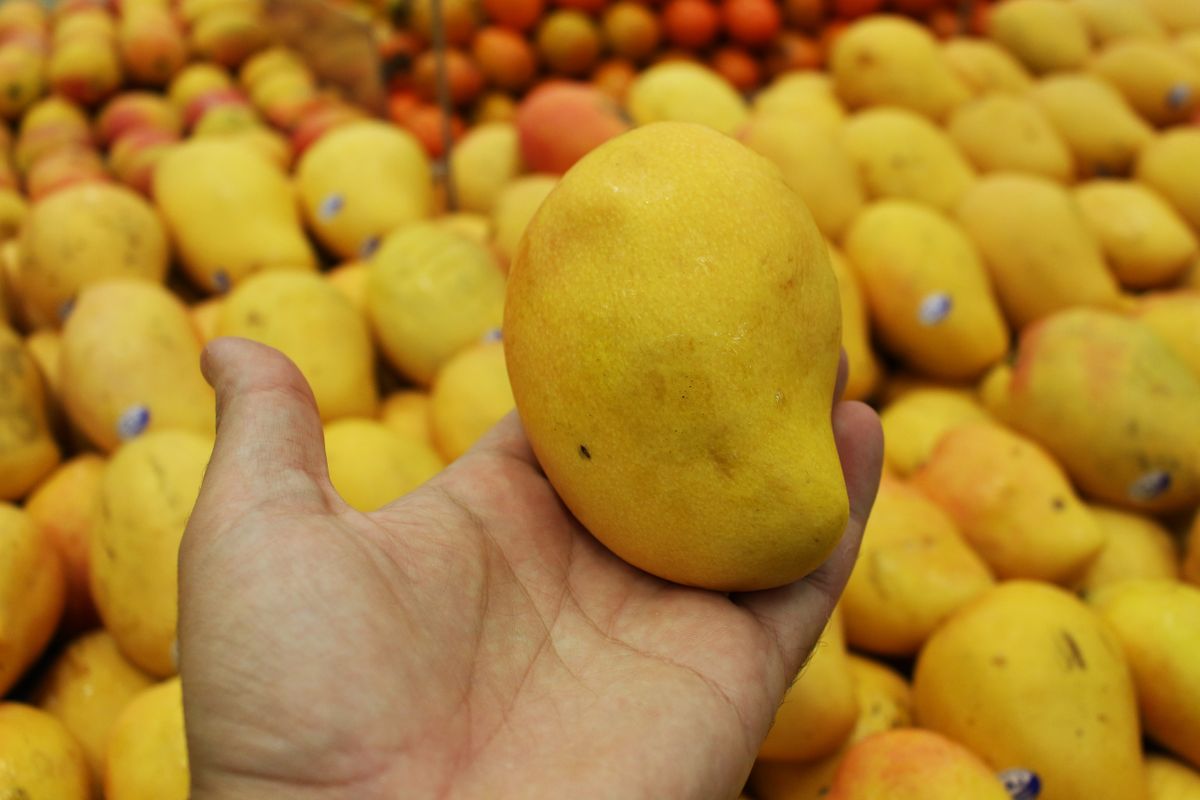
Mango. Chefs usually choose ripe, sweet cultivars — Philippine carabao mango or Thai nam dok mai are common. Half is puréed into the base; the other half is diced and folded in at the end for texture.
Pomelo (柚子). The pomelo is peeled to the point where the individual juice sacs — tiny translucent capsules — come away cleanly. These pop between the teeth and give the dessert its unmistakable bittersweet contrast.
Sago (西米). Small tapioca pearls, boiled and rinsed until they turn from opaque white to translucent. Cantonese chefs have used sago for centuries in traditional 糖水 sweet soups.
Coconut milk. Fresh coconut milk, not the heavily processed can. This gives the base its softness.
Evaporated milk (淡奶). A small splash of the classic Cantonese pantry staple used in milk tea (see our silk-stocking milk tea guide) rounds the sweetness and gives the dessert its subtle Hong Kong character.
How It Conquered the Chinese-Speaking World
Within a few years of its Lei Garden debut, 楊枝甘露 had jumped restaurants, then cities, then countries. It became a fixture on the dessert menu at every Cantonese seafood restaurant and dim sum house from Kowloon to Kuala Lumpur. Dessert shops in Hong Kong — Honeymoon Dessert (滿記甘品), Hui Lau Shan (許留山) — built entire menus around variations of it.
Today it is found across Hong Kong, Singapore, Malaysia, Guangdong, Taiwan, and Papua New Guinea. It is one of the small number of Cantonese desserts that has genuinely crossed borders and remained authentically Cantonese in the process — not gentrified into “fusion,” not simplified for wider palates.
The Diaspora Connection
For Cantonese kids growing up in Vancouver, San Francisco, London or Sydney in the 1990s and 2000s, 楊枝甘露 was often the dessert served at the end of the family birthday dinner — the pale-yellow soup that arrived after the fried rice, that everyone got a portion of, that grandma had somehow picked up from the “good” Chinese supermarket.
Because it was invented so recently, and so specifically for restaurants, it also became one of the earliest Cantonese desserts diaspora restaurants outside Hong Kong could reliably reproduce. It is one of the small handful of Cantonese sweets that translates well when you leave home. If you have ever eaten it while homesick, you know what we mean. Read more about Cantonese diaspora communities to see where the dessert lives now.
A Cantonese Dessert Vocabulary
糖水 (Tong4 Seoi2)
tong4 seoi2 — Jyutping romanisation
Meaning: The general Cantonese term for sweet soup or dessert soup — hot or cold.
Explanation: Literally “sugar water.” It covers everything from red-bean soup and black-sesame paste to modern chilled bowls like 楊枝甘露. To a Cantonese speaker, ordering 糖水 at the end of a meal is like a hug in liquid form.
Why It Still Matters
楊枝甘露 is a reminder that Cantonese cuisine is not a museum. It is a living tradition where the newest classics are only forty years old and were invented in real kitchens by real chefs solving specific problems. The dish is not older than Cantopop, older than the MTR, older than Bruce Lee’s biggest films — and yet somehow it feels like it has always been there.
That is the highest compliment Cantonese culture pays to a new creation: it forgets you invented it. It simply lets you become part of what home tastes like.
📖 Related Articles
👉 Shop Cantonese Guy — Modern Streetwear for the Global Cantonese Community