

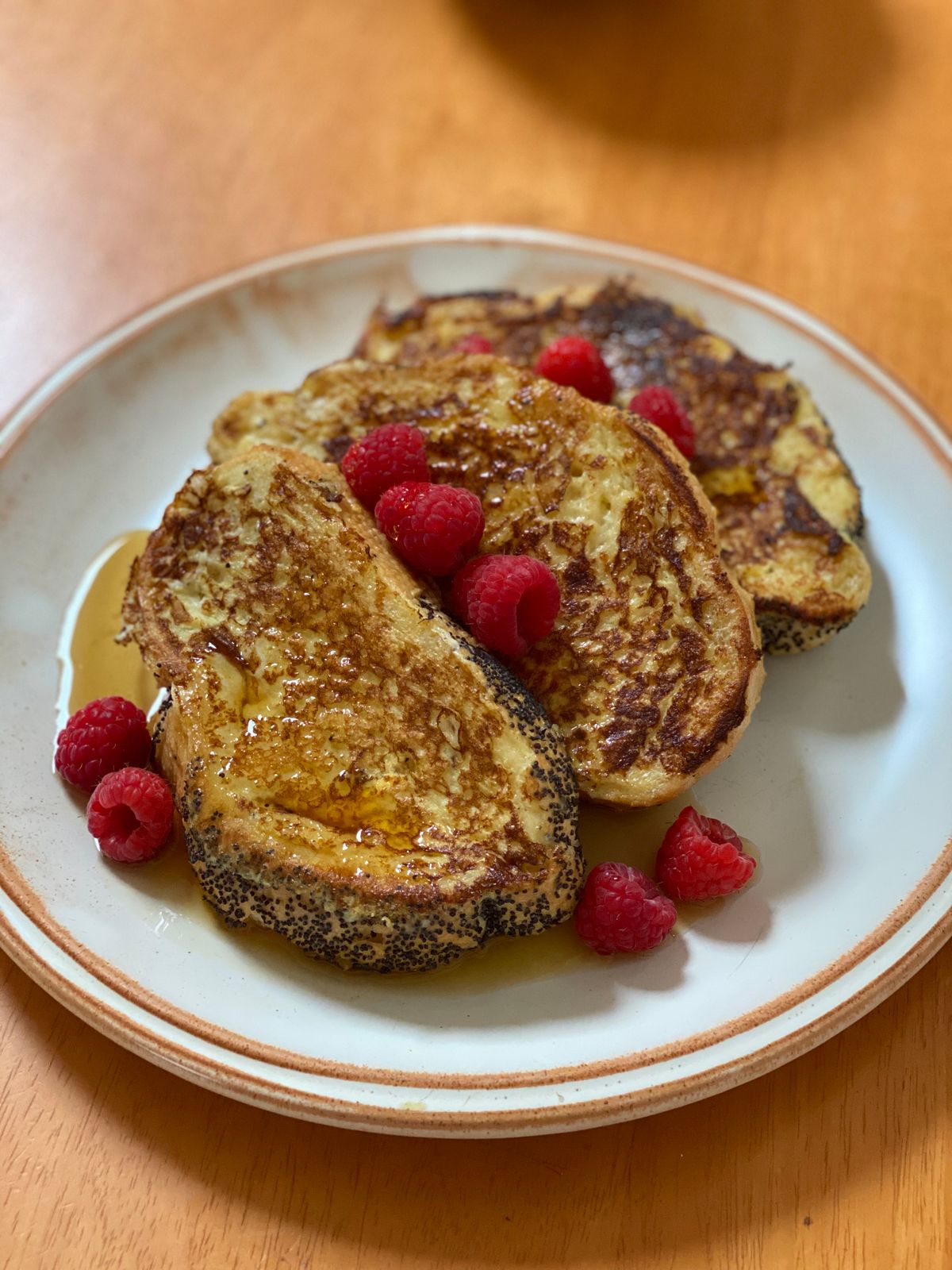
There are few breakfasts in the world as gloriously excessive as Hong Kong French toast. Two thick slices of white bread are glued together with peanut butter, dunked in beaten egg, deep-fried until gold, and then — if you're not already smiling — crowned with a pat of butter and a generous river of sweetened condensed milk or syrup. The Cantonese call it 西多士 (sai1 do1 si2), literally "Western toast." It has almost nothing to do with France.
It is, however, one of the most beloved cha chaan teng creations of the 20th century — a dish that took a Western idea, deep-fried it, sweetened it, and served it back as a piece of Hong Kong identity. Here is how Sai Do Si became the city's most unapologetic plate.
The Name That Lies
The Cantonese name 西多士 just means "Western toast." 西 (sai1) means "west," 多士 (do1 si2) is a phonetic borrowing from the English "toast." Outside Hong Kong, you might call it French toast — but the Hong Kong version has only a passing resemblance to the brioche-griddled European original.
Traditional French toast is pan-fried in butter. Hong Kong French toast is deep-fried. Traditional French toast might use brioche or challah; Hong Kong uses soft, pillowy supermarket white bread. And the European version is rarely a sandwich. Sai Do Si almost always is.
Where It Was Born: The Cha Chaan Teng Origin Story
The most credited origin point is the iconic Hong Kong tea stall Lan Fong Yuen (蘭芳園), opened in 1952 in Central by Mr. Lam. According to the second-generation operator, his father was the first to make the Hong Kong-style Western toast we know today, and the dish was on his menu in 1952. From there it spread across the city's emerging cha chaan teng network like a recipe handed mouth-to-mouth.
By the 1970s, rapid industrialisation gave Hong Kongers more disposable income for afternoon tea, and Sai Do Si moved from novelty to default. Workers on a quick break, students after school, families on Sunday — the dish slotted into every meal of the day that wasn't quite a meal.
The Anatomy of a Perfect Sai Do Si
Done well, Hong Kong French toast is a study in textural contrast. Done badly, it's a soggy regret. The classic version has six elements working together:
The bread: Cheap, thick-sliced white bread — the same kind sold at every Hong Kong supermarket. It's soft enough to absorb the egg but sturdy enough to survive the fry.
The filling: Peanut butter is the traditional choice, smoothed between the two slices. Variations exist (kaya jam in some shops, red bean paste in others), but peanut butter is the canonical move.
The dip: Whole eggs beaten with a touch of evaporated milk — the milk gives the crust a richer browning.
The fry: Deep-fried, not pan-fried. A wok of hot oil, a quick flip, and the crust shatters when you cut it.
The topping: A single thick pat of cold butter that melts as it hits the hot crust.
The drench: Sweetened condensed milk, golden syrup, or both. There is no minimal amount. There is only too little.
How to Order It Like a Local
At a cha chaan teng, French toast usually comes as part of a set meal — paired with a cup of silk-stocking milk tea or a yuenyeung. The standard order: "一件西多士, 一杯凍奶茶" (jat1 gin6 sai1 do1 si2, jat1 bui1 dung3 naai5 caa4) — "One French toast, one cold milk tea." Some shops will ask if you want it 加蛋 (with extra egg in the batter) or 双拼 (double-stacked, four slices). Both answers are correct.
Why It Endures
Sai Do Si is comfort food in its purest Cantonese form — cheap, fast, deeply caloric, and engineered to make a hard day better. It's the kind of dish that comes back to diaspora kids in unexpected moments: the smell of butter melting into condensed milk, the precise crack of a fork breaking through the crust. It tastes like Hong Kong without trying to.
In a city always racing forward, Sai Do Si is one of the things that refuses to change. Lan Fong Yuen is still serving it on the same corner. Every cha chaan teng has a version on its menu. And somewhere in the world tonight, a Hong Konger far from home is making it for themselves, with cheap bread and a wok and a tablespoon of nostalgia.
📖 Related Articles
👉 Shop Cantonese Guy — Modern Streetwear for the Global Cantonese Community