

A dockworker in Central in 1953 walks into a small alley stall, drops a coin on the counter, and calls out to the young owner: "Lam Jai, one cup of silk stocking!" The owner, a Chaozhou boy called Lam Muk-ho, nods and starts pouring hot black tea back and forth between two metal jugs through a long, tan-coloured cloth bag that really does look like a pair of women's stockings hung out to dry. That was more or less how Hong Kong-style milk tea got its name. And that small stall grew into Lan Fong Yuen (蘭芳園), still open today — the accepted birthplace of what may be Hong Kong's most quietly influential drink.
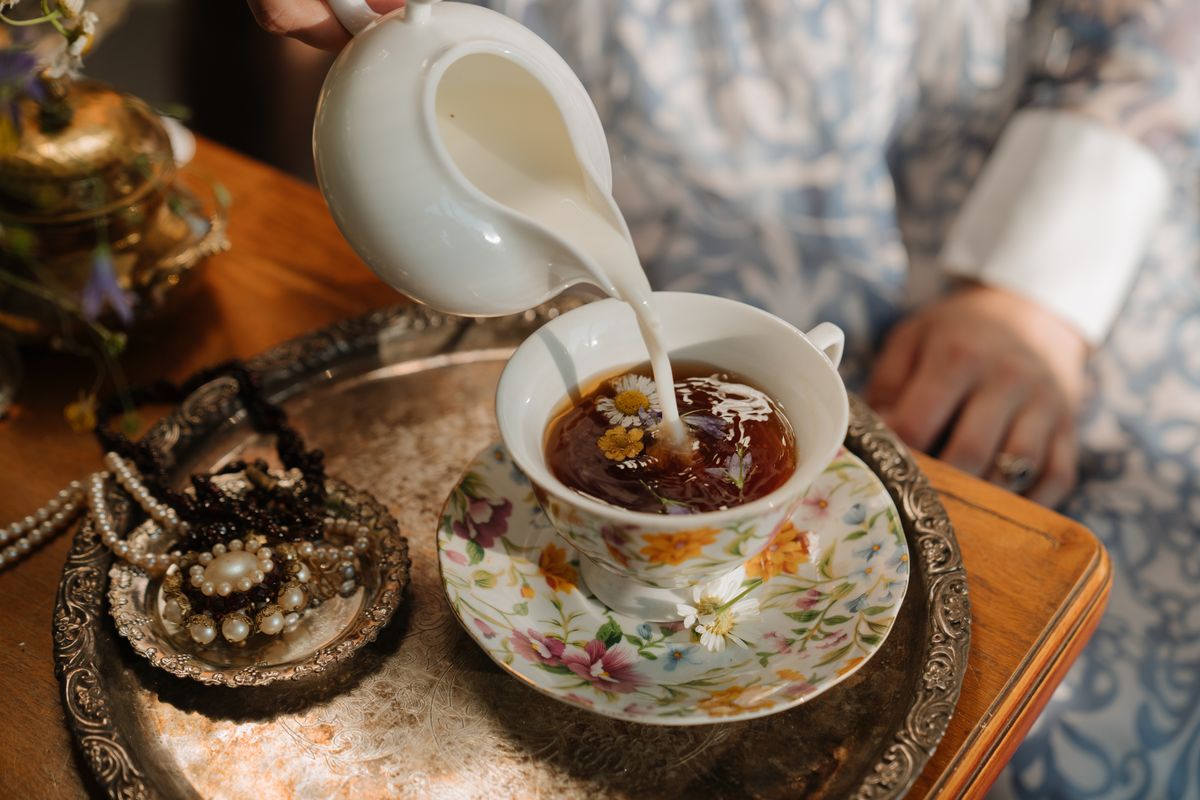
The British left the tea. Hong Kong changed it beyond recognition.
Colonial-era British afternoon tea was a luxury for the well-off in Hong Kong — tiny cups of Earl Grey served in Peninsula-style hotels. Working Cantonese people couldn't afford that. So they took the concept, industrialised it, and hardened it into fuel for a manual-labour economy. Instead of loose-leaf Earl Grey, they used strong Ceylon black tea blends. Instead of milk and sugar to taste, they used sweet, thick evaporated milk. Instead of delicate porcelain, they used cheap ceramic mugs that could survive a dai pai dong wash. And instead of a fine mesh tea strainer, they used a bag of cotton fabric — the invention that changed everything.
1952: the year Lam Muk-ho stitched a filter
Lam Muk-ho arrived in Hong Kong from Chaozhou at 19. Five years later, in 1952, he opened a modest tea stall on Gage Street in Central. Metal tea strainers were expensive and clogged easily, so Mr Lam asked his wife to sew filter bags out of an interlock cotton fabric normally used for lining suit jackets. The tea would be poured through the bag repeatedly — a technique called 撞茶 ("pulling tea") — to aerate it, cool it slightly and extract more colour. After a few days of hard use, the cream-white cotton stained a deep brown that reminded customers of a certain popular hosiery product. The nickname stuck. The Legislative Council of Hong Kong formally recognised Lan Fong Yuen's claim to inventing silk-stocking milk tea in 2007.
Why the filter matters more than the tea
Ask any Hong Kong milk tea master and they'll tell you the leaves are the least mysterious part of the drink. Most shops blend three to five different grades of Ceylon and Assam black tea — fine leaves for colour, coarser broken leaves for body, dust for astringency. What separates a great cup from a mediocre one is the age and dampness of the cotton filter. A new filter tastes raw and thin. A filter that's been used, steamed, cleaned and re-steeped hundreds of times develops a kind of patina that softens the tea and rounds off the bitter edges. The filter is basically the shop's secret ingredient.

Hot, cold, walk-away — the vocabulary of ordering
Hong Kong milk tea comes with an ordering language most tourists never crack. Hot is 熱 (jit6). Iced is 凍 (dung3). "Walk sugar" — 走糖 (zau2 tong4) — means no sugar. "Less sweet" is 少甜 (siu2 tim4). Ask for a stronger cup and you say 要中意 (jiu3 zung1 ji3), which literally means "I want a medium-preference" but idiomatically translates as "give it to me full strength." Most locals also order a bo lo bao (pineapple bun) alongside it, or in the summer, the famous yuenyeung — milk tea mixed with coffee — which Lan Fong Yuen also claims (though less definitively) to have invented.
The cha chaan teng ecosystem that grew around it
Silk-stocking milk tea didn't stay in dai pai dongs. In the 1950s and 60s, cheap sit-down cafes called cha chaan teng exploded across Hong Kong, mostly built around this exact drink. Order a set for HK$30 and you got milk tea, buttered pineapple bun, macaroni soup with ham, and scrambled eggs on toast — the whole East-meets-West Cantonese lunch culture crystallising around one filter bag of black tea. The cha chaan teng is now Hong Kong's most recognisable everyday dining format worldwide, and silk-stocking milk tea is the drink that made it possible.
The diaspora took the tea, but not the filter
Every serious Cantonese neighbourhood in the diaspora — Richmond in Vancouver, Flushing in New York, Chatswood in Sydney, Manchester's Chinatown — has at least one cha chaan teng serving milk tea. Most of them use blends imported from Hong Kong, and many still use cotton filter bags. But every diaspora local will tell you the tea always tastes slightly different back home. It's not the leaves. It's the water — Hong Kong's slightly harder tap water pulls flavour differently. That, and the fact that the filter in the little shop on Gage Street has been steeped since your grandmother's teenage years.
Still standing on Gage Street
Lan Fong Yuen is still there. The line still forms in the morning. The tea is still poured through cotton. Whether or not their founding-inventor claim is technically correct is beside the point — the entire concept of Hong Kong-style milk tea is now formally protected as an item of Hong Kong intangible cultural heritage. Every cup of silk-stocking milk tea that gets pulled anywhere in the world traces back to a Chaozhou kid with a stall on Gage Street who couldn't afford a fancy strainer, so he stitched his own. It's the kind of story that makes you appreciate the drink a little more — which is, of course, the whole point of tea.
📖 Related Articles
👉 Shop Cantonese Guy — Modern Streetwear for the Global Cantonese Community