

An hour's train ride north of Mong Kok's neon, past the housing estates and the farmers' markets of Yuen Long, there's a village surrounded by an 18-inch-thick blue-brick wall. Four cannon towers mark the corners. A moat used to run around the outside. Inside, roughly 400 descendants of the same clan still live. The village is called Kat Hing Wai (吉慶圍), and it is the most famous of a quietly extraordinary thing: the walled Cantonese villages of Hong Kong's New Territories.
Most people who think of "Hong Kong" picture Causeway Bay crosswalks and Victoria Harbour at night. But a quarter of Hong Kong's land area is the New Territories, and inside the New Territories are the ruins and remnants of some seventy walled villages — fortified ancestral compounds built by Cantonese clans between the Ming dynasty and the mid-19th century, when pirates and bandits made the Pearl River Delta a dangerous place to be anywhere but behind a wall.
Why the Walls Were Built
Guangdong's coastline is complicated — a lacework of winding shores, hilly inlets, and offshore islands. From the Ming dynasty onward, this geography made the Pearl River Delta a pirate paradise. European sources tell you a lot about the famous female Cantonese pirate Zheng Yi Sao, who commanded tens of thousands of men in the 1800s. What they tell you less about is what everyday life was like for the farming clans she and her peers menaced. The short answer: terrifying.
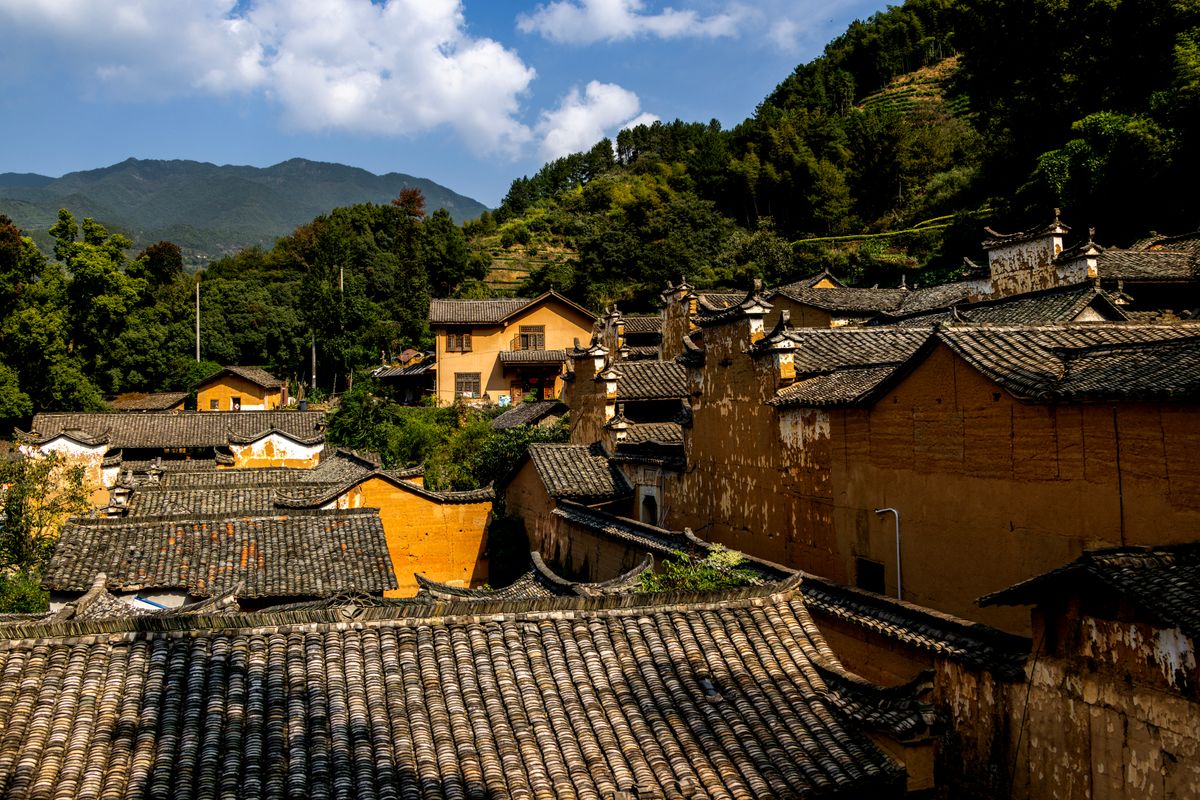
In response, Cantonese clans in what would eventually become Hong Kong's New Territories did what farming peoples under threat have always done. They built walls. Thick ones. The Tang clan — one of the "Five Great Clans of the New Territories" (新界五大氏族) alongside the Hau, Pang, Liu, and Man — were among the earliest and most prolific builders. Kat Hing Wai, their showpiece, was constructed in the 17th century with blue-brick walls five metres high and cannon towers at every corner. From inside, the layout is rectangular — roughly 100 metres by 90 — with narrow lanes radiating from a central ancestral hall.
Elsewhere in the Delta, other Cantonese and Hakka clans did the same thing. In Sha Tin, the Tsang clan broke ground on Tsang Tai Uk (曾大屋) in 1847 and spent roughly twenty years finishing it — a Hakka walled compound with an interior courtyard the size of a basketball court. In Sheung Shui, one of the very few walled villages in Hong Kong still has its original moat, dating to 1646.
Punti vs. Hakka: The Two Walled-Village Traditions
Not all walled villages are the same. Two main Cantonese-speaking groups built them, with slightly different styles.
Punti villages (本地) — "the locals" — were the earlier Cantonese settlers, who moved into the Pearl River Delta from the Tang dynasty onward. Their villages are typically single-clan — everyone inside shares one surname, descending from one founding ancestor. The Tang clan villages of Kam Tin fit this model perfectly: a village is a family tree with a roof over it.
Hakka villages (客家) — "the guests" — were built by the later Hakka migrations from northern Guangdong and Fujian, waves that arrived from the 1600s onward. Hakka walled villages are often multi-surname, housing families who travelled together but were not all related. The Hakka architectural style — long rectangular compounds with central courtyards — is a cousin of the famous Hakka round earthen tulou further north in Fujian.
The Punti–Hakka distinction eventually produced one of 19th-century southern China's bloodier conflicts, the Punti–Hakka Clan Wars of 1855–1867, over farmland and water rights. Hong Kong's New Territories were spared the worst of it, but the walled villages here still bear the imprint of two Cantonese communities who were often neighbours and sometimes rivals.
What's Inside: The Ancestral Hall
Walk through the gate of a walled village and the first space of consequence is almost always the ancestral hall (祠堂, ci4 tong4). This is where the clan's genealogy is kept, where marriages and funerals are blessed, where the tea ceremony that joins two Cantonese families traditionally took place in front of the painted ancestral tablets. The hall is the architectural heart of the village in the same way the ancestral table is the heart of a Cantonese New Year dinner.
Many of the surviving ancestral halls — Man Mo Temple in Tai Po, the Tang Ancestral Hall in Ping Shan, the Liu Man Shek Tong in Sheung Shui — are now graded historic monuments. Some are still active for clan rituals. Others are museums. All of them hold up a wooden mirror to the Cantonese value system: your village is your family, your family is your dead ancestors, your ancestors are your ultimate audience.
What Happened to the Walls
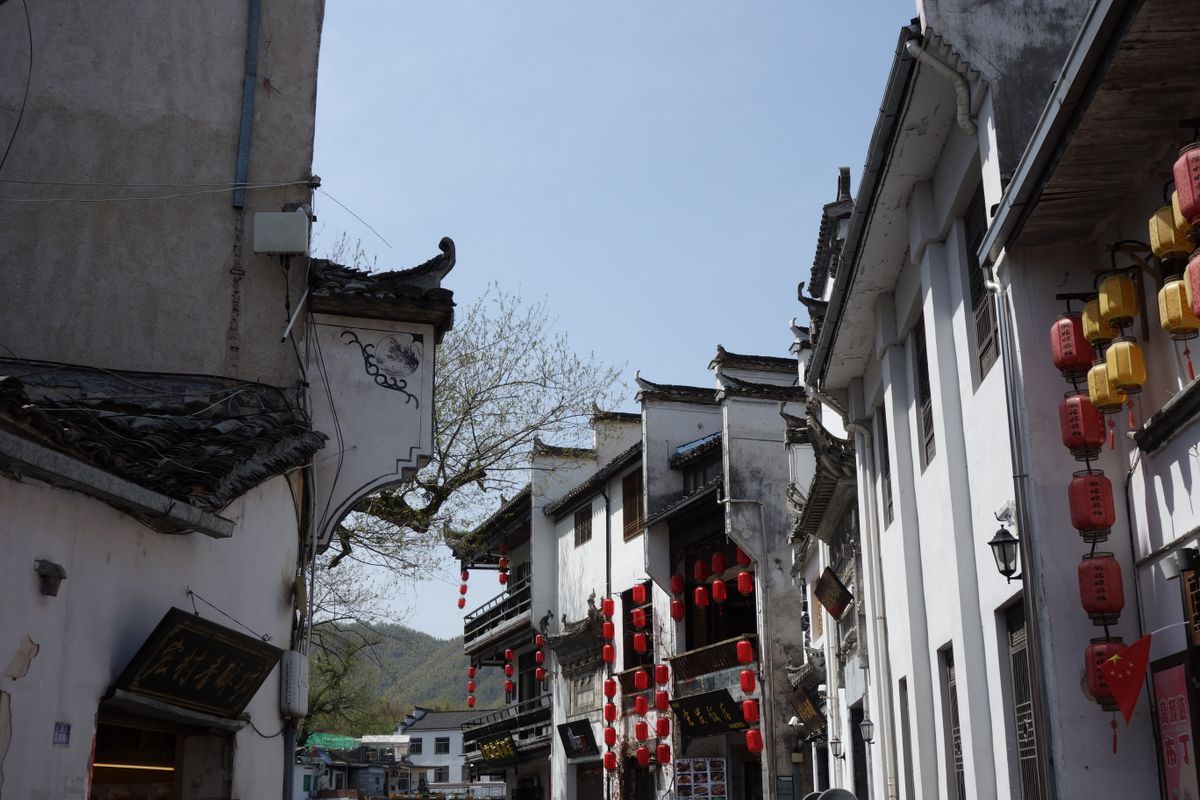
Most of Hong Kong's walled villages did not survive the 20th century intact. Urbanisation ate them from the outside. The post-war New Territories development programme bulldozed many to make way for new towns like Sha Tin, Tai Po, and Tuen Mun. Of the roughly 70–80 walled villages that once existed, only a handful remain in anything like their original form. Even the famous Kat Hing Wai has lost its moat, drained decades ago to make way for roads.
A smaller number have been preserved as living historic sites — Kat Hing Wai, Tsang Tai Uk, Lo Wai in Lung Yeuk Tau, the Ping Shan Heritage Trail — where you can still walk the narrow lanes between blue-brick walls and see cannon loopholes in the towers. The Hong Kong government's Antiquities and Monuments Office has graded dozens of walled-village structures as Declared Monuments or Grade I, II, and III historic buildings. The same cultural reflex that preserves bamboo scaffolding as living heritage is slowly, belatedly, extending to the villages.
Why They Still Matter
For the global Cantonese diaspora, the walled villages are something more than a weekend day trip from Central. They are the physical argument that Cantonese identity is older and deeper than Victoria Harbour, older than Hong Kong colonial history, older even than the city of Hong Kong itself. The Tang clan was in the Kam Tin valley in the 11th century — a thousand years before the first British governor stepped off a boat.
If your family left Guangdong in 1870, in 1950, or in 1997, your ancestors almost certainly lived behind walls like these — or in villages whose walls were torn down earlier. The Cantonese family-naming system with its elaborate kinship terms makes complete sense once you understand that whole villages were one surname. The clan is the unit. The ancestral hall is the computer.
Diaspora kids growing up in Richmond or Manchester or Flushing often don't realise this is where the quiet weight of family comes from — the sense that your decisions somehow echo backward and forward through a lineage you can't quite see. The walled villages make that lineage visible. Thick walls. Narrow lanes. One hall at the centre, with every name on the family tree carved into wood. That's the diagram.
A Word Worth Carrying
If you have Cantonese roots, you have 圍村 roots — even if your personal village was swallowed by concrete two generations ago. We make streetwear in Guangdong heritage colours precisely because that lineage deserves to be worn plain. Our 廣東仔 CANTONESE GUY oversized tee is the diaspora version of this: a clan hall folded into a cotton tee. The Cotton Tree Flower hoodie pulls in another old Guangdong symbol — the kapok tree whose scarlet blossoms open every spring over the ancestral halls' tiled roofs.
Whichever side of the wall your great-grandmother came from — Punti or Hakka, Tang clan or Man clan, farming village or fishing one — the architecture of her world was built around a very Cantonese idea: that you survive by being inside the same wall as the people whose names you share.
A thousand years later, the walls are mostly gone. The idea isn't.
📖 Related Articles
👉 Shop the Accessories collection
Modern streetwear for the global Cantonese community.