

Walk into any old-school noodle shop in Hong Kong and you'll hear the same thing: the slap of dough on a marble counter, the rattle of a bamboo strainer in boiling water, and the quiet ceremony of a bowl arriving in front of you. Wonton noodles — 雲吞麵 (wan4 tan1 min6) — is more than a dish. It's the single most storied bowl in Cantonese cooking: small enough to finish in five minutes, complicated enough that masters have spent fifty years perfecting it.
The Long Walk From Guangzhou to Hong Kong
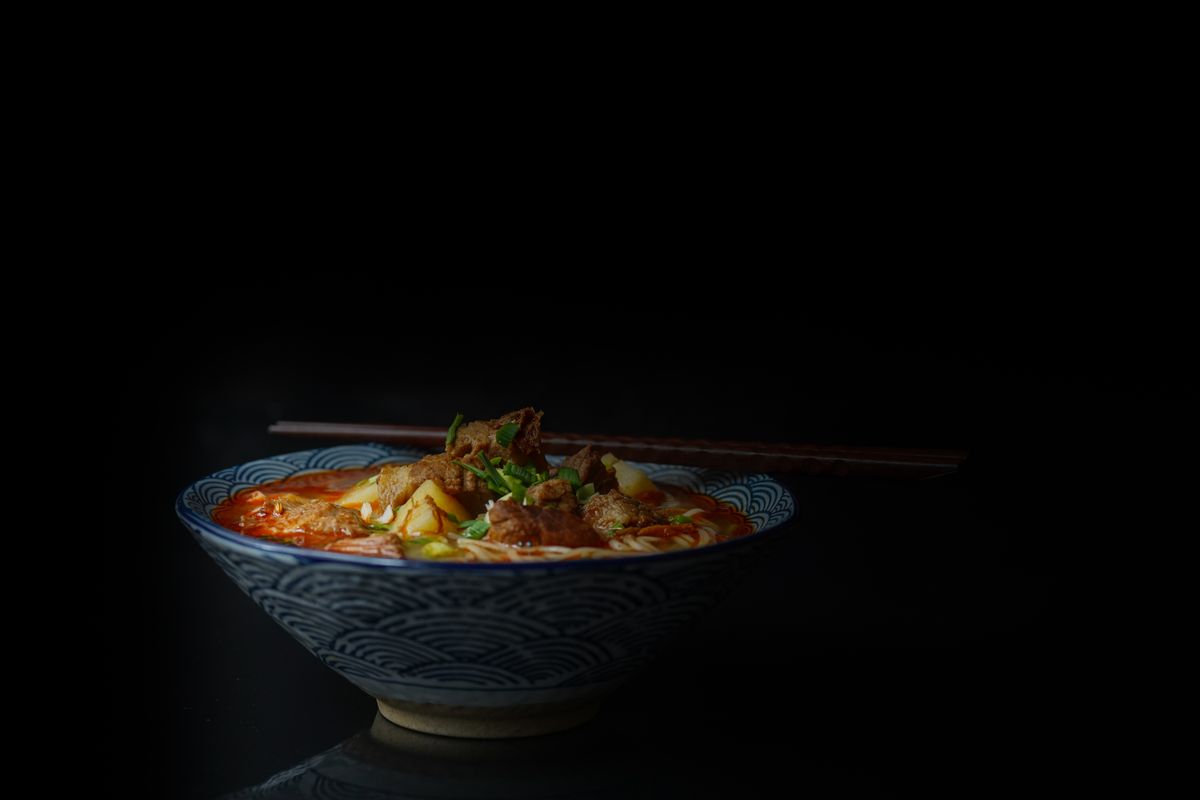
Wonton itself is ancient — the dumpling family it belongs to traces back to the Han dynasty, more than 2,000 years ago. But the wonton noodle bowl as Cantonese people know it today took shape much later, in Guangzhou during the late Qing dynasty (1644–1911), when vendors began pairing the shrimp-and-pork dumpling with thin egg noodles and a hot, clear broth.
The dish travelled south to Hong Kong with one specific man: Mak Woon-chi (麥煥池), a Guangzhou wonton maker who arrived in the 1940s and opened a stall that would eventually grow into Mak's Noodle, still one of the most famous wonton noodle shops in the city. Before Mak's, wonton noodles were essentially unknown in Hong Kong as a sit-down dish. After Mak's, they became the city's lunch.
The Anatomy of a Proper Bowl
A "real" Cantonese wonton noodle bowl follows rules so strict that long-time customers will return their order if the shop gets one wrong. Three components, each almost stubbornly traditional:
The wontons. Mostly prawn — typically whole, snappy pieces — with a small amount of pork for fat and flavour. The wrapper is paper-thin and pleated into a tail. The Cantonese word 雲吞 literally means "swallowing clouds," a nod to how the wonton's wispy tail floats in the broth.
The noodles. Thin, bouncy egg noodles, traditionally pressed using a bamboo pole — a technique called 竹昇麵 (zuk1 sing1 min6). The noodle maker rides the pole like a seesaw to knead the dough, producing the springy, slightly alkaline noodle that defines the dish. Most shops now use machines, but a handful of bamboo-pole holdouts remain in Hong Kong and a few are working to keep the tradition alive.
The broth. Clear, golden, deeply savoury — built on dried flounder fish (大地魚), pork bones, dried shrimp shells, and a handful of other carefully toasted ingredients. A good broth tastes of the sea without tasting fishy. Recipes are guarded; some shops claim their stock pot has been running for decades.
The Bowl Itself: Smaller Than You Think
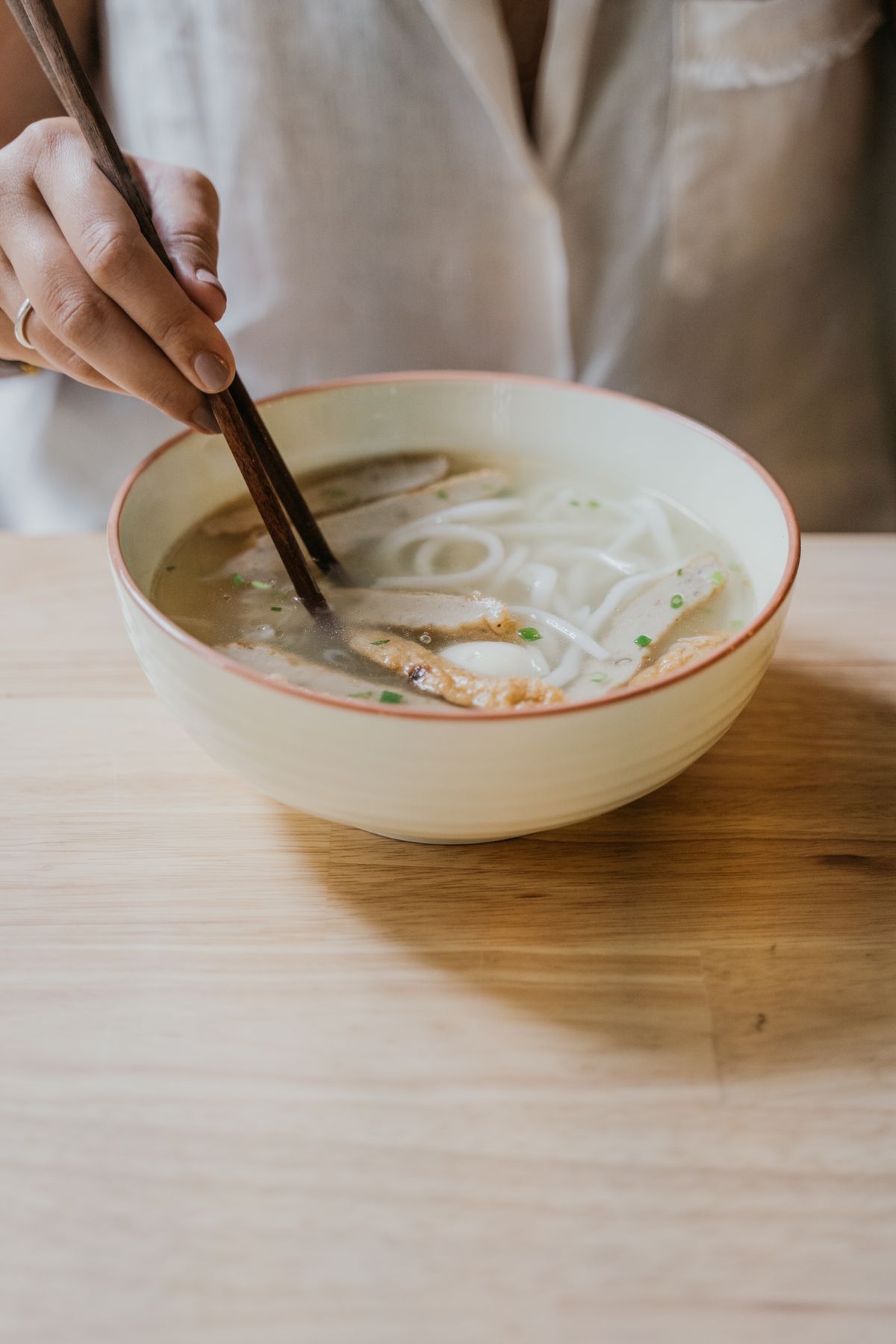
A Hong Kong-style wonton noodle bowl is famously small — often described as a "細蒓" (sai3 jung4), or "small lotus." The traditional logic: four wontons at the bottom, a porcelain spoon laid over them so the noodles don't get crushed, then a careful nest of noodles on top, finished with a few stalks of yellow chives or 韭黃 (gau2 wong4). The whole thing is meant to be eaten quickly, while everything is still hot and the noodles still have spring.
If you've ever ordered wonton noodles in a Hong Kong shop and thought the portion looked tiny — that's the point. Order two if you're hungry. The shop won't be insulted; they'll be flattered.
The Ritual: How to Eat It Right
There's an unspoken way to eat a bowl of wonton noodles like a regular. First, lift the noodles out of the broth with your chopsticks the moment the bowl arrives, then drop them back in — this loosens the strands so they don't clump and stops them overcooking in the hot soup. Add a small splash of the dark red chilli oil and a touch of red vinegar (紅醋) from the little jars on the table — never soy sauce. Eat the noodles first, then the wontons, then sip the broth from the bowl. The whole ritual takes about ten minutes.
Why It Endures
Hong Kong has cycled through every food trend imaginable in the last fifty years — bubble tea, fusion ramen, omakase counters, dessert cafes, smash burgers. Wonton noodles never moved. There are still small shops in Sheung Wan, Central and Yau Ma Tei where the broth is the same as it was in the 1970s, the noodles are the same, and the prices have barely doubled.
For the diaspora, that constancy matters. The bowl is a benchmark — the first thing many Cantonese expats search for when they land back in Hong Kong, the dish that anchors a trip home. It's also one of the most replicated dishes worldwide, with serious wonton noodle shops now in Vancouver, Sydney, San Francisco, London and beyond. The diaspora carried the bowl, and the bowl helped carry the diaspora.
The Wonton Noodle Map of Hong Kong
A short hit list of names every Cantonese food lover knows: Mak's Noodle in Central (the original wonton noodle dynasty); Mak Man Kee in Jordan (from the same Mak family lineage); Ho Hung Kee in Causeway Bay, the first wonton noodle shop to earn a Michelin star; and Tsim Chai Kee, across the street from Mak's, beloved for its larger portions and just-as-loyal regulars. Each has its devotees; the debate has been running for decades.
More Than Lunch
In a city that changes overnight, a bowl of wonton noodles is one of the things that doesn't. It's why generations of Cantonese people — in Guangzhou, Hong Kong, and every diaspora kitchen around the world — keep ordering it. It's not just food. It's a small, edible piece of cultural continuity.
📖 Related Articles
👉 Shop Cantonese Guy — Modern Streetwear for the Global Cantonese Community