

Watch a Guangzhou cheung fun master at work and you'll understand why nobody has quite duplicated the dish in another cuisine. She pours a thin rice batter onto a linen cloth stretched taut over a steaming tray, closes the lid for exactly forty-five seconds, then peels the finished sheet off with a bamboo scraper. The result is a translucent, almost weightless ribbon of steamed rice — silky, springy, and vanishing on the tongue in a way no wheat noodle can imitate.
This is 腸粉 (coeng2 fan2, dictionary form coeng4 fan2), literally "intestine noodle" for its rolled tube shape — the Cantonese rice noodle roll that started in Guangdong teahouses and became a cornerstone of dim sum culture from Guangzhou to Vancouver.
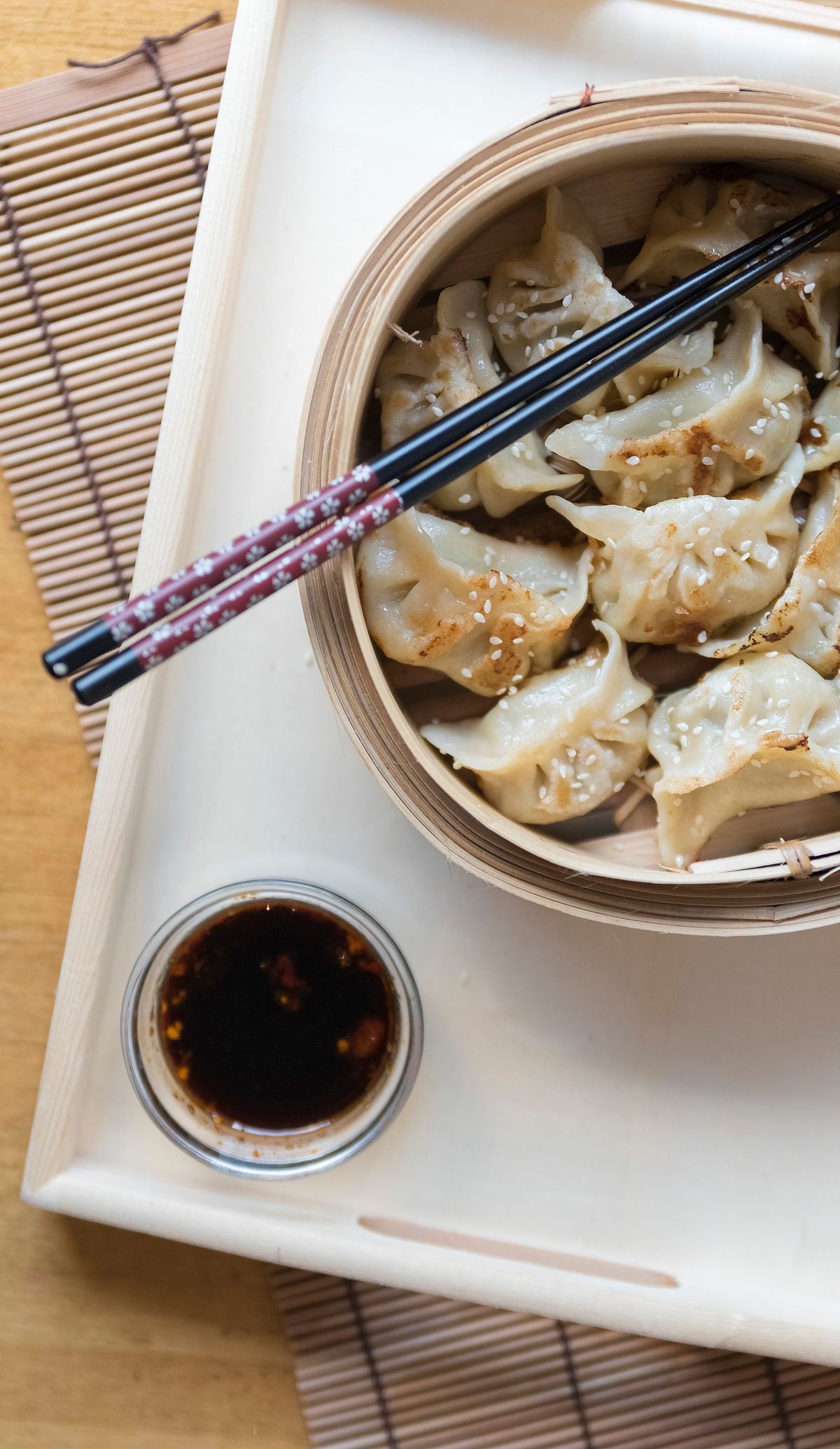
A Rice Noodle With a Tang Dynasty Ancestor
Some food historians trace cheung fun's ancestor all the way back to the Tang dynasty (618–907 CE), when Southern Chinese cooks began soaking rice, grinding it into a slurry, and steaming it into thin sheets. That basic technique — rice, water, patience — has stayed intact for over a thousand years.
The modern version, though, is a Cantonese story. Most sources trace it to the 1930s, to a Guangzhou teahouse called Pantang Hexian Guan (泮塘荷仙館) in Xiguan — today's Liwan District. That kitchen is widely credited with perfecting the technique of steaming the noodle into a rollable sheet you could stuff with fillings. The dish spread across Guangzhou's teahouses, then rode with Cantonese migrants down to Hong Kong, where it became a fixture of the yum cha tradition.
Two Cheung Funs, Two Cantonese Lives
If you order cheung fun in Hong Kong today, you're really choosing between two very different dishes.
The first is 布拉腸 (bou3 laai1 coeng2) — cloth-pulled cheung fun. This is the dim sum version: filled with fresh shrimp (鮮蝦腸粉), roast pork char siu (叉燒腸粉), or beef with spring onion (牛肉腸粉), served in a shallow pool of soy sauce sweetened with a touch of rock sugar. It arrives at the yum cha table on a small plate, cut into three or four segments, glistening.
The second is 齋腸 (zaai1 coeng2) — plain cheung fun. This is the street breakfast, sold from carts and hole-in-the-wall shops from six in the morning. You get a warm pile of rolled rice noodle drizzled with three sauces: sweet hoisin, spicy chili, and sesame paste. Toss with chopsticks, eat standing up, get on with your day. It's one of the great cheap Cantonese breakfasts, priced around HK$15–20 in most neighbourhoods.
The Technique Nobody Talks About
What makes cheung fun so hard to nail is the batter. Restaurants guard their recipes because the ratio of rice flour, wheat starch, tapioca starch, and water is what separates a limp, gummy noodle from one that's springy and shiny. Old Guangzhou cheung fun makers ferment their rice slurry overnight; some still grind their own rice on stone mills.
The steaming setup matters just as much. The traditional Guangzhou method uses a stretched cloth (布 bou3) over a bamboo frame — the cloth grips the batter just enough, and the finished sheet peels off in one continuous ribbon. Modern Hong Kong shops mostly use flat metal trays, which are faster but produce a slightly denser texture. Purists insist you can tell the difference in the first bite.
Cheung Fun in the Diaspora
Wherever Cantonese people settled, cheung fun followed. In Vancouver's Richmond, you'll find dedicated cheung fun shops steaming rolls to order all morning. In San Francisco's Chinatown, older shops in the Sunset serve it with peanut sauce Cantonese-American style. In London's Chinatown, cheung fun anchors the dim sum menu at every serious yum cha spot. It's the sort of dish that translates without losing its accent — as long as the rice batter is right.
Why Cheung Fun Endures
Cantonese cooking has a phrase — 清淡 (cing1 daam6) — that roughly means light, clean, unforced. Cheung fun is the pure expression of that value. Rice, water, heat, a sauce, and nothing else in the way. In a world of louder, more aggressively seasoned food, the Cantonese impulse to let the ingredient speak feels almost radical. A good bowl of cheung fun is a quiet, one-thousand-year-old argument for restraint.
📖 Related Articles
👉 Shop Cantonese Guy — Modern Streetwear for the Global Cantonese Community