

Every skyscraper in Hong Kong, at some point in its life, has been climbed by a man with a bundle of bamboo poles on his shoulder. He climbs 30, 40, 60 storeys with no crane and no lift. He ties each pole to the next with nylon strips, using knots his grandfather taught his father. In a city of steel and glass, this is still how the buildings get built.
Bamboo scaffolding — 竹棚 (zuk1 paang4) in Cantonese — is one of the great living Cantonese crafts. It's older than the Great Wall. It built Foster's HSBC building. It's still the fastest, cheapest way to wrap a Hong Kong tower in a working platform. And it's slowly disappearing.
A 2,000-year-old technology
Bamboo scaffolding dates back to at least the Han dynasty, roughly 2,000 years ago. The famous Song dynasty handscroll Along the River During the Qingming Festival, painted by Zhang Zeduan around 1085–1145 AD, clearly shows bamboo frameworks wrapping buildings in Kaifeng. By the 12th century the technique was already commonplace across urban China, refined by Cantonese and Guangdong builders who worked with the specific bamboo that grew in the south.
In Hong Kong, bamboo scaffolding arrived with the earliest colonial construction in the 1800s. But it exploded in the 1950s and 60s, during Hong Kong's post-war building boom — when refugees from the mainland flooded into the city and the government needed to house millions in a hurry. Skilled scaffolders from Guangdong province refined the technique for tall buildings. By the 1990s, they were building the tallest towers in the world with the same knots their ancestors used.
Two bamboos, one system
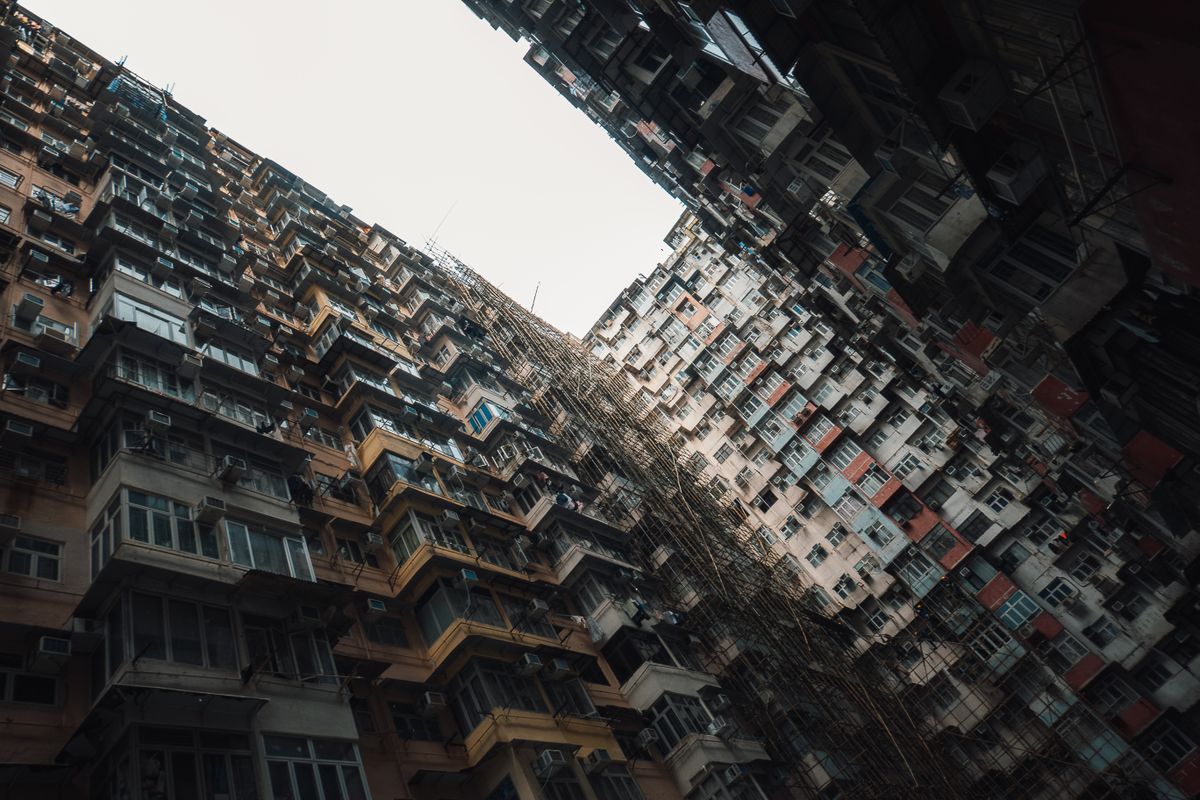
Two types of bamboo are used, and knowing which is which matters. Mao jue (毛竹) — the thicker, stronger 'hair bamboo' — is used for the vertical, load-bearing poles. Kao jue (若竹) — the thinner 'pole bamboo' — is used for the horizontal supports and platforms. A team of scaffolders assembles a matrix of these two bamboos on-site, tied together with black nylon strips (traditionally lashed with wet rattan). No bolts. No welding. No metal.
The whole system is elastic. In a typhoon, a bamboo scaffold sways with the wind instead of cracking like steel. It's why Hong Kong scaffolds survive typhoon seasons that would rip metal scaffolding off a building.
Why it's beaten steel for centuries
Bamboo grows fast, is cheap, sustainable, reusable, easy to cut on-site, and fits into narrow gaps that a steel frame never could. In a city as dense as Hong Kong — where a building might be 60 storeys tall and 3 metres from its neighbour — bamboo can be threaded up and around impossible corners. A small team can wrap an entire tower in days. Steel can't compete on speed, cost, or nimbleness in Hong Kong's terrain.
Even today, roughly 80% of scaffolding in Hong Kong is bamboo-based. This is not tradition for tradition's sake. It's a system that still, mathematically, wins.
The 'spider men' who climb
Hong Kong's bamboo scaffolders are informally called 'spider men' — they climb without ropes, without harnesses, without safety nets on many jobs. It's a Cantonese trade passed down from father to son, master to apprentice, over decades. There are unwritten rules. The scaffolders who assemble a scaffold must be the ones to take it down. It's always disassembled top to bottom, outside to inside. Before starting a new build, teams still perform blessing rituals for good fortune — a small ceremony that feels ancient because it is.
Bamboo shed theatre — the offshoot that got UNESCO recognition
One offshoot of Hong Kong bamboo craft — the bamboo shed theatre building technique used for Cantonese opera performances — has been officially recognised as intangible cultural heritage in Hong Kong. These temporary theatres, some seating 800 people, are built from scratch in days for religious festivals. When the opera ends, they're taken down and the bamboo is reused for the next one. Every element of the trade — the poles, the knots, the ritual — is part of the living heritage.
The craft is under pressure
In March 2025, Hong Kong's Development Bureau directed that metal scaffolding be adopted in at least 50% of new government public-works contracts — the first major official shift away from bamboo. The debate accelerated after a devastating high-rise fire in Tai Po in late 2025 that put safety questions in the headlines. Older scaffolders are ageing out. Fewer young Cantonese men are entering the trade. The knots that built modern Hong Kong may not survive the next generation of construction.
Whether bamboo scaffolding is safer than metal is a real debate with real numbers, and reasonable people disagree. What isn't in dispute is what would be lost — an unbroken chain of Cantonese knowledge stretching back 2,000 years, embodied in a working craft rather than a museum.
Why the bamboo still matters
Bamboo scaffolding is a rare thing: a genuinely ancient technology that never became obsolete. It's how Cantonese builders built the modern world — not by copying Western steel, but by refining their own tradition until it kept pace with the tallest cities on earth. Next time you walk under a scaffold in Hong Kong and see the bamboo poles crisscrossing above you, remember that you're looking at a craft older than most countries, still working, still saving lives, still holding up the city.
📖 Related Articles
👉 Shop Cantonese Guy — Modern Streetwear for the Global Cantonese Community