

Walk past any Cantonese housing estate on a Saturday afternoon and you'll hear it before you see it — the sharp clack-clack-clack of ivory-look tiles being shuffled on a table. Cantonese mahjong (麻雀) isn't a hobby; it's a soundtrack. Four players, 144 tiles, and roughly two hours of gambling, gossiping, tea drinking, and mercilessly roasting each other's plays. This is one of Hong Kong's most quintessential family rituals — and, since 2014, one of its officially recognised pieces of intangible cultural heritage.
Where "Mahjong" Actually Comes From
Mahjong took shape in China during the late Qing dynasty — most historians place its modern form in the mid-to-late 1800s. Cantonese speakers call it 麻雀 (maa4 zoek3-2), which literally means "sparrow." The name is often said to come from the chattering sound tiles make when shuffled — like a flock of sparrows. Whether that etymology is strictly true is debated, but no Cantonese speaker cares. The name has stuck for over a century.
By the early 20th century, mahjong had spread across China, Southeast Asia, and eventually the rest of the world. Different regions developed their own rulesets. The Cantonese version — often called Hong Kong Old Style — became one of the most widely played mahjong variants globally, favoured for its fast pace, bold scoring, and heavy emphasis on the flower and bonus tiles.
The Hong Kong Living Room
Between the 1950s and 1980s, mahjong became embedded in Hong Kong daily life. It was played at weddings, at funerals (in a subdued form, to keep grieving families company), at Chinese New Year gatherings, and — most of all — at home. Four folding chairs, a green felt table, a set of clacking tiles, and the afternoon disappeared.
For diaspora Cantonese kids, mahjong is often a first memory. You didn't play — you weren't old enough or good enough. You watched. Grandmothers slapped tiles down with force. Aunts complained loudly about their hand. Uncles chain-smoked. There was tea, there were snacks, and there were arguments that everyone forgot by the next round. It's the soundtrack of a Cantonese childhood.
The 144 Tiles
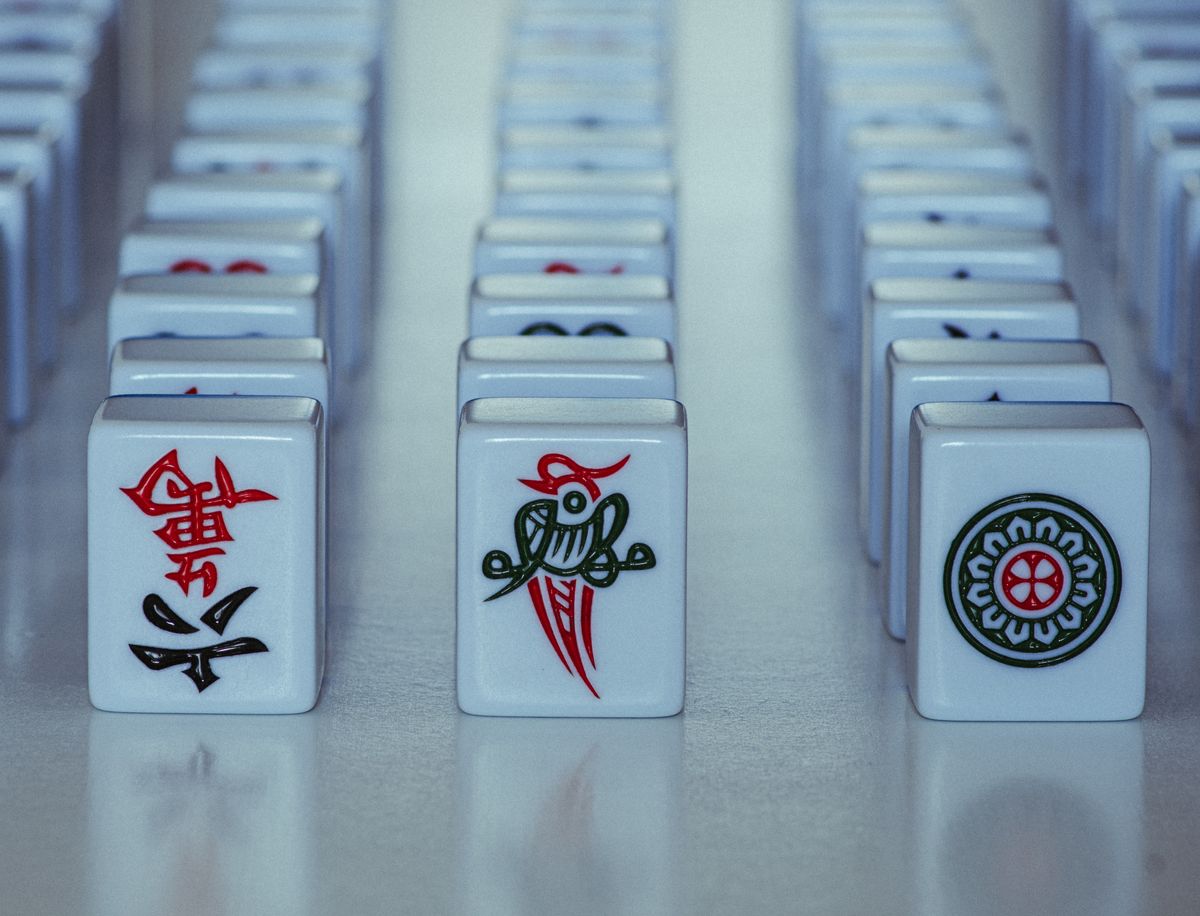
A full Cantonese mahjong set has 144 tiles across three main suits and two special categories:
The three suits (36 tiles each, 4 of each design): the Dots (筒子), the Bamboo (索子), and the Characters (萬子). Honour tiles (28 total): the four Winds (東南西北 — East, South, West, North) and the three Dragons (中發白 — Red, Green, White). Bonus tiles (8 total): the four Flowers and the four Seasons — small side bets that add score without being part of the main hand.
The goal, put simply, is to be first to form a complete winning hand: four sets of three (either three-of-a-kind or a run) plus a pair. Doing it while collecting the right bonuses gets you more points. Doing it with a rare pattern gets you more still. Doing it while everyone at the table thinks you have nothing — that's mahjong at its best.
The Cantonese Vocabulary of the Table
Mahjong has its own Cantonese dialect. When you win, you shout "食糊!" (sik6 wu4-2 — "eat the pot"). When you draw a tile that completes another player's hand, you've fed them, and they'll thank you sarcastically for the assist. A great hand is called a "大糊" (daai6 wu4 — "big pot"). A cheap hand that only just wins is called "雞糊" (gai1 wu4 — "chicken pot"), which is exactly as disrespectful as it sounds.
And the sounds. The 洗牌 (sai2 paai4-2, "wash the tiles") — the ritual shuffle where all four players push the tiles around the table with both hands before building their walls — is so distinctive that Hong Kong film soundtracks use it as shorthand for "we're in a Cantonese home."
Recognised Cultural Heritage
In 2014, hand-carved mahjong tile-making was officially added to Hong Kong's Intangible Cultural Heritage list. There are now only a handful of master tile makers left in the city — artisans who hand-cut, sand, carve and paint each of the 144 tiles by eye. Most modern sets are machine-made, mostly overseas, but the traditional handmade sets — some of them heirlooms — are treated with the same reverence as a good jade bangle.
A properly heavy hand-carved set has a specific weight when you slam it down. Cantonese players will notice immediately. Playing on plastic feels wrong.
The Global Cantonese Living Room
Every Cantonese diaspora community has kept mahjong alive in some form. In Toronto's Chinatown apartments, in San Francisco's Sunset District, in Melbourne's Chinese seniors' clubs, in London's Cantonese takeaway back rooms after the shop closes — the tiles come out on weekend evenings. In the past decade, a new generation of diaspora Cantonese kids have started reclaiming the game, learning from parents and grandparents, using it as a way to reconnect to a language and culture they didn't always take seriously growing up.
Mahjong is more than a game. For Cantonese families, it's the physical thing you gather around — the table that pulls three generations into one room, forces you to speak Cantonese at speed, and reminds you exactly where your family is from. Every clack of every tile is a small act of cultural inheritance.
Next time you hear the shuffle sound behind an open Cantonese apartment window, listen for a second. That's the sound of a language, a community, and a whole tradition — clacking away, refusing to be quiet.
📖 Related Articles
👉 Shop Cantonese Guy — Modern Streetwear for the Global Cantonese Community