

In 1851, when gold was discovered in the New South Wales hills at Ophir, tens of thousands of prospectors from around the world sailed for Australia. Among them were farmers and labourers from Guangdong Province — mostly from the Sze Yup (四邑) counties around Toisan — who had already made the journey to California a few years earlier. They called Australia San1 Gam1 Saan1 (新金山) — "New Gold Mountain" — to distinguish it from San Francisco, the original Gam1 Saan1.
Those Cantonese gold-seekers are the reason Sydney's Haymarket has a Chinatown at all. It's now Australia's largest, anchored by the twin paifang gates on Dixon Street — but its roots run back nearly 175 years, through the docks of The Rocks, past the market gardens of Botany, into the very foundations of modern Sydney.
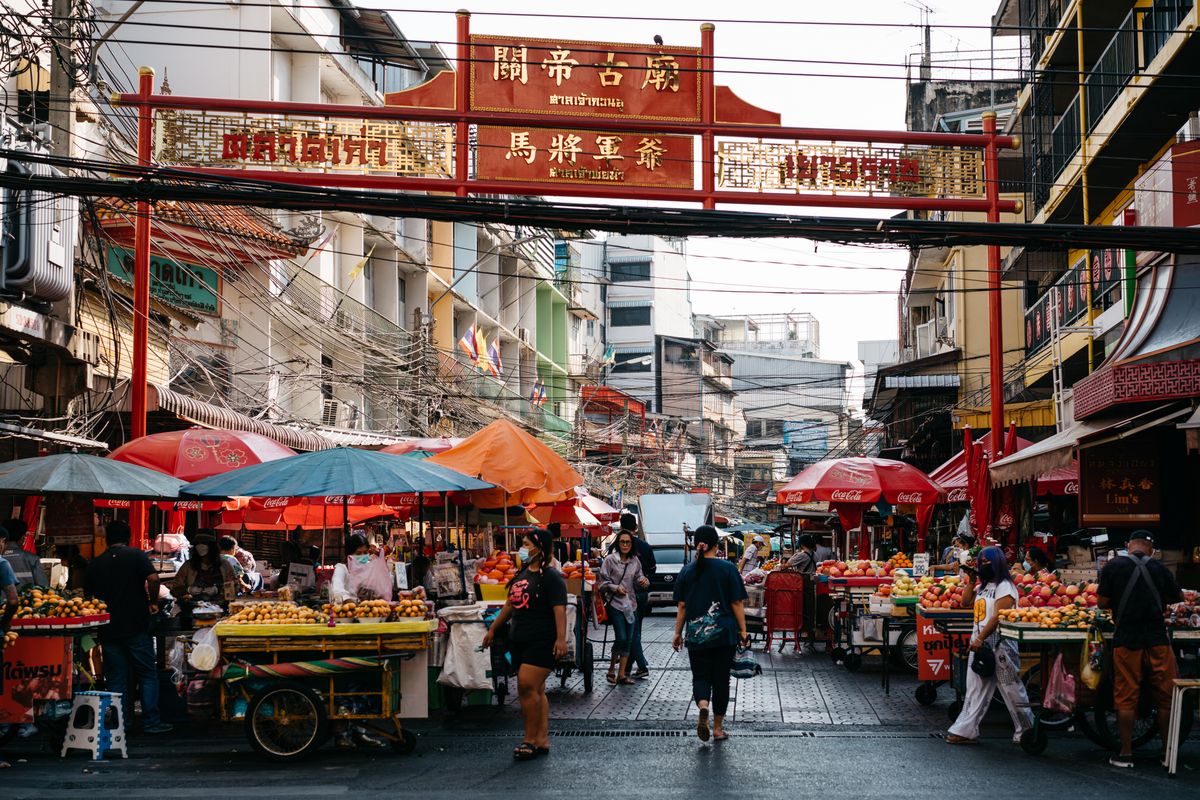
The Sze Yup Cantonese and the Gold Rush
By 1855, the Chinese population in Australia had reached around 17,000, and by 1861 there were about 13,000 Chinese in New South Wales alone. The overwhelming majority were Cantonese men from the Sze Yup counties of Guangdong — Toisan (Taishan), Sunwui (Xinhui), Hoiping (Kaiping), and Yanping (Enping). They spoke Taishanese, a Yue Chinese dialect closely related to standard Cantonese that would later become the backbone of Cantonese-American communities as well. Most had left wives and families behind, planning to strike gold and return home rich.
Most did not strike gold. When the alluvial rush faded in the 1860s, Cantonese miners drifted back to Sydney and Melbourne, where they took up market gardening, laundries, cabinet-making, and small shops. Fresh vegetables in colonial Sydney were largely the work of Cantonese hands — the reason so many suburbs still have "Chinese market garden" as a heritage listing on their local council records.
The First Chinatown: The Rocks
Sydney's first Chinese quarter formed in The Rocks — the docks district beside Sydney Harbour — during the 1860s. Chinese boarding houses, joss houses (temples), grocery stores, and clan association halls clustered along Lower George Street. The colony's newspapers called it "the Chinese Quarter," and colonial policing treated it with a familiar mix of suspicion and neglect.
This first Chinatown was pushed out by successive waves of anti-Chinese legislation. The Chinese Restriction Acts of the 1880s, and then the Immigration Restriction Act 1901 — the notorious White Australia Policy — sharply curtailed Chinese migration and made life in The Rocks unsustainable. Many families relocated further south, toward the produce markets around Haymarket.
The Move to Haymarket
By the 1920s, Sydney's Chinatown had migrated to the area around Campbell Street and the popular Capitol Theatre, in what is now Haymarket. The district was close to the wholesale fruit and vegetable markets — the very sector Cantonese growers had built up over decades — so it made economic sense to concentrate Chinese trade there. Dixon Street, originally a narrow colonial back-lane, gradually filled with Cantonese restaurants, clan associations, herbal medicine shops, and the small businesses that anchor any migrant neighbourhood.

The 1980 Gates and Henry Tsang's Vision
The paifang gates at each end of Dixon Street were constructed in 1979–80, designed by architect Henry Tsang OAM. Tsang, a Hong Kong-born architect who became a Sydney city councillor, worked with the Dixon Street Chinese Committee to remake the pedestrianised strip into a proper cultural precinct. The gates were formally handed over to the City of Sydney on 12 September 1981, the Mid-Autumn Festival, and dedicated the following April.
In April 2024 the gates were finally heritage-listed. Restoration works finished in June 2025. It's a small bureaucratic acknowledgement of what Cantonese migrants have known all along — those arches aren't decoration, they're a statement about who helped build this city.
Sydney's Cantonese Present
Today the Cantonese community in Sydney is one of the most established and culturally influential in the Southern Hemisphere. Post-1997 Hong Kong migration added a wave of professionals, restaurateurs, and creatives who reshaped suburbs like Chatswood, Hurstville, and Eastwood. Cantonese-language schools operate across the city. Yum cha weekend brunches at places like the Marigold and East Ocean remain a genuine Sydney institution — passed down parent to child in Cantonese families for three or four generations.
The Cantonese diaspora in Australia now sits alongside our other diaspora communities in Vancouver, San Francisco, and London — each shaped by different histories, but all descended from that same tight cluster of Guangdong counties that sent their sons out to look for gold.
Why Sydney Chinatown Still Matters
Every generation of Sydney Cantonese has had to defend the neighbourhood from something — Chinese Restriction Acts in the 1880s, wartime racism, urban renewal bulldozers in the 1970s, rising rents in the 2020s. And each generation has kept it standing. Walking Dixon Street on a Saturday night with the roast duck windows glowing and the sound of Cantonese arguments over dim sum floating out of doorways, you feel the long thread. New Gold Mountain never stopped being Cantonese.
📖 Related Articles
👉 Shop Cantonese Guy — Modern Streetwear for the Global Cantonese Community