

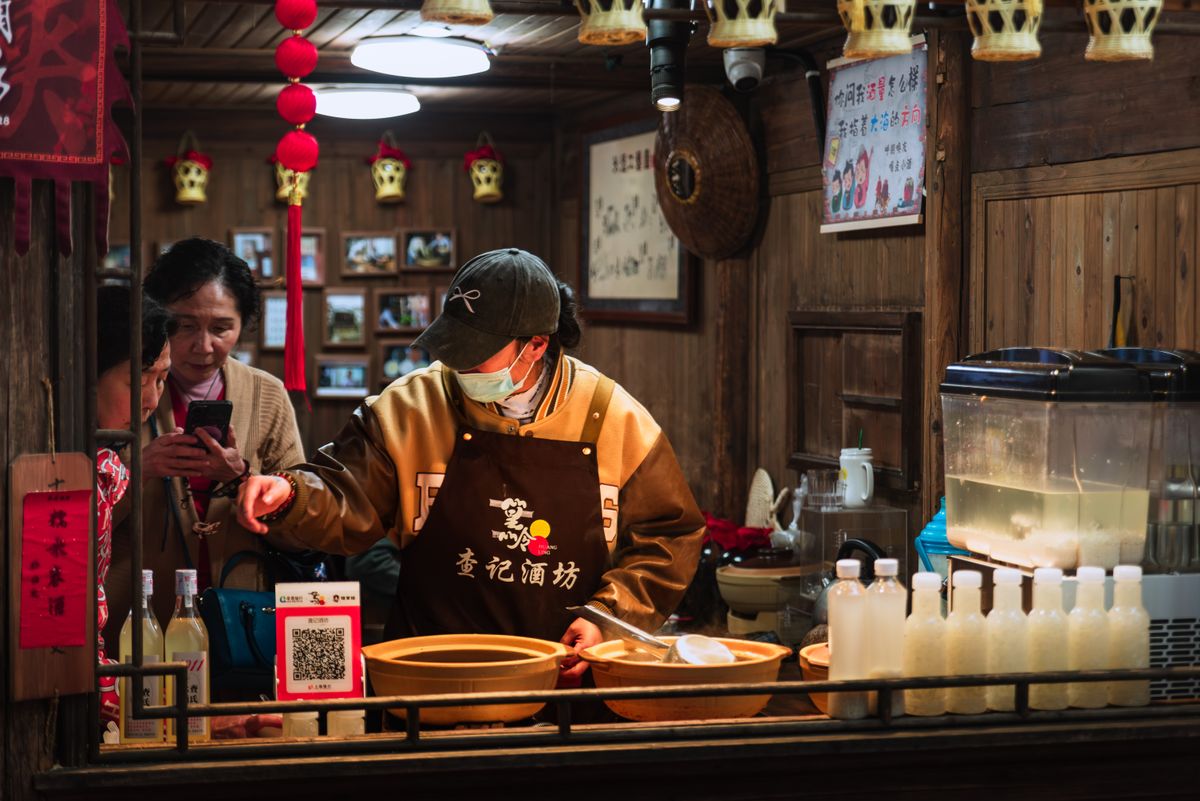
In a Guangzhou congee shop at 4am, someone is stirring. A wooden paddle scrapes the sides of a vat the size of a small child, breaking down rice grains that have been dissolving for eight hours. The porridge is white, silken, almost like beaten cream. This is 粥 — zuk1, Cantonese jook — and the person doing the stirring has probably been doing it since 8pm the night before. Cantonese congee is not a quick meal. It is a discipline.
What Cantonese jook actually is
The English word congee comes to us via Tamil kanji and colonial India, and covers rice porridges from Korea to Sri Lanka. But Cantonese jook is specific. It is white rice, simmered with roughly one part rice to eight to ten parts water or stock, stirred slowly until the grains dissolve completely and the liquid becomes uniformly silky. No visible grains. No lumps. Just a pale, glossy porridge you could almost drink.
In Guangzhou, congee is one of the three foundational street foods, immortalised in the sign above every corner shop: 粥粉麵 (zuk1 fan2 min6) — congee, rice noodles, wheat noodles. If a dai pai dong serves any of those three, it probably serves all three.
The overnight technique
The reason a home cook cannot quite replicate the congee at Sang Kee or Mui Kee in Hong Kong comes down to time. Cantonese jook shops start their vats the night before, keeping them at the barest simmer while somebody stirs them intermittently for hours. The rice grains do not just soften; they disintegrate. The starch releases into the broth until the whole pot has the consistency of thin cream. By morning, that base is ready to be portioned into individual bowls and jazzed up with whatever the customer orders.
Most Cantonese congees use chicken stock, pork bone stock, or dried fish broth as the base — water alone produces a thin, sad congee that a Cantonese grandmother would judge you for. The classic ratio is one cup of rice to eight to ten cups of liquid, cooked at least three hours (professionals go longer). A splash of oil at the start helps the rice break down. A pinch of salt at the very end — never at the start — preserves the sweetness.
Iconic Cantonese congees you should know
The base is white and neutral. The joy is in what goes into it. A short list of the ones every Cantonese kid grew up eating:
🥚 Pei Daan Sau Juk Zuk (皮蛋瘦肉粥)
Century egg and lean pork congee — the most famous export. Alkaline-cured duck egg cut into little dark jewels, thin slices of lean pork, ginger, spring onion, white pepper. The bowl every Cantonese child was fed when they had the flu.
🌟 Kap Dai Zuk (及第粥)
"Passed-the-imperial-exam congee." Pork balls, pork liver slices and pork intestine slices — the three ingredients correspond to the top three ranks in the imperial exam (Zhuangyuan, Bangyan, Tanhua). Legend has it a poor Guangdong student was fed this congee by a stall owner and later topped the imperial examination. Guangzhou families still order it before big tests.
⛵ Teng Zai Zuk (艇仔粥)
"Sampan congee." A Qing-dynasty specialty born on the Pearl River, when sampan boats served hot bowls to river folk. Loaded with a bit of everything: peanuts, dried squid, shredded lettuce, jellyfish, roasted pork, thin egg omelette. A whole waterfront in one bowl.
🐟 Caai Jyu Faa Sang Zuk (柴魚花生粥)
Dried fish and peanut congee. Humble, deeply savoury, made from ingredients any Guangdong household kept in the pantry. This is a countryside congee — the one your paternal grandmother made when there was nothing else in the fridge, and it turned out to be the best bowl of the year.

Congee as memory
Every Cantonese person has a congee memory. It is the food you eat when you are sick and your grandmother orders pei daan sau juk zuk from the shop downstairs. It is the plain white bowl you eat when your stomach is unsettled and you need something that will not fight back. It is the 3am supper after a wedding banquet when everyone is drunk on brandy. It is the bowl your parents pack for you in Los Angeles, in Sydney, in Toronto — microwaving zuk1 in a glass jar because it tastes almost like home.
In Hong Kong, a proper jook shop still uses the eight-hour method. The most famous ones — like Sang Kee in Sheung Wan and Law Fu Kee in Central — draw queues of locals in the morning who want their kap dai zuk with a side of yau tiu (fried dough sticks). You tear the yau tiu, dip it into the congee, and the salty crunch dissolves into the silky base. That is Cantonese comfort in one bite.
Why jook is not "just porridge"
If you were raised on a Western breakfast, congee can feel confusing. It is not bland. It is quiet. Cantonese cuisine trusts subtraction more than any other regional Chinese kitchen; the goal is often to let the ingredient itself sing without shouting. White cut chicken works on the same principle. So does silk-stocking milk tea. Congee is that same philosophy, distilled to its purest form: rice, water, time, and everything else optional.
A bowl of Cantonese jook is a lesson in what a kitchen can do when it stops trying to impress you. Guangdong has been quietly teaching this lesson for centuries. The rest of the world is finally noticing.
📖 Related Articles
👉 Shop Cantonese Guy — Modern Streetwear for the Global Cantonese Community