

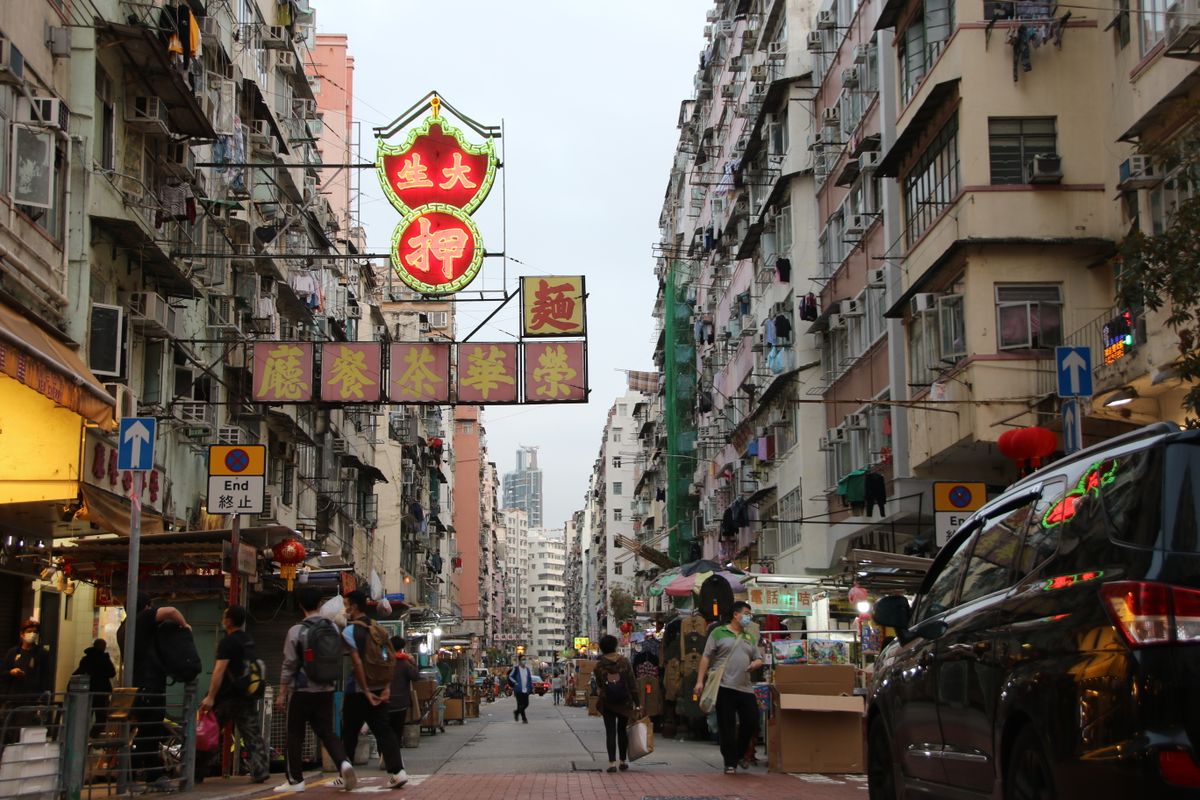
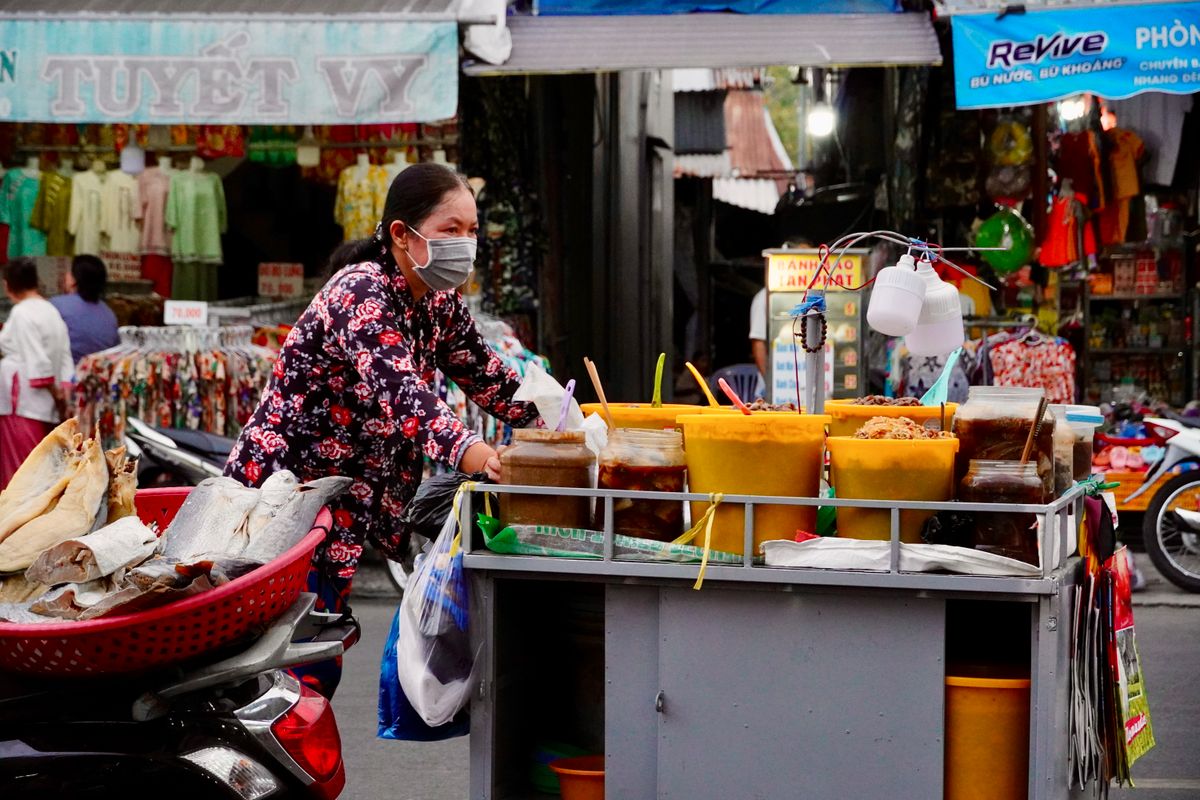
Nowhere reveals a Cantonese person's true personality faster than a Hong Kong wet market or a Sham Shui Po back-alley stall. The whole language pivots — you get faster syllables, sharper particles, and a whole vocabulary of price-based warfare that no textbook ever teaches. Volume 63 is a survival guide to the Cantonese art of shopping, haggling, and squeezing that last dollar out of an auntie who has heard every excuse in the book.
The 10 words every Cantonese shopper knows by heart
1. 貴
gwai3 — Jyutping romanisation
Meaning: Expensive.
Explanation: The single most-uttered word in a Hong Kong market. It's a full sentence, an accusation, and an opening move all in one syllable. Draw it out — "gwaaaai3 aa3!" — and you've already started the negotiation.
2. 平
peng4 — Jyutping romanisation
Meaning: Cheap, inexpensive.
Explanation: The mirror twin of 貴. In Cantonese, 平 is a good word — no shame in it. Locals brag about how 平 they scored something, especially the aunties who circle Mong Kok looking for prey.
3. 平靚正
peng4 leng3 zeng3 — Jyutping romanisation
Meaning: Cheap, good-looking, and top-quality — all at once.
Explanation: The holy trinity of Cantonese consumerism. Three syllables that describe the impossible dream every shopper is chasing. Vendors love shouting it; buyers love pretending to believe them.
4. 講價
gong2 gaa3 — Jyutping romanisation
Meaning: To bargain, to haggle.
Explanation: Literally "talk price." It's not rude in Cantonese culture — in most street markets, refusing to 講價 is basically a sign you don't know what you're doing. The dance is part of the deal.
5. 抵
dai2 — Jyutping romanisation
Meaning: Worth it. Value for money.
Explanation: Something that isn't just 平 — it's genuinely worth what you paid for it. Cantonese people rank the world into 抵 and 唔抵 (m4 dai2, "not worth it"), and building a reputation for spotting 抵 things is basically a lifelong sport.
6. 劈價
pek3 gaa3 — Jyutping romanisation
Meaning: To slash prices dramatically.
Explanation: The verb 劈 means to chop or hack — so 劈價 is "chopping the price down." It's the vocabulary of a going-out-of-business sale, an aggressive competitor, or a customer who's had enough of the vendor's opening number.
7. 減價
gaam2 gaa3 — Jyutping romanisation
Meaning: A discount or price reduction — the polite retail cousin of 劈價.
Explanation: This is what the department stores use in their window signs. If you see 大減價 (daai6 gaam2 gaa3), that's the Cantonese equivalent of "MEGA SALE." The whole city rearranges its weekend when Sogo starts one.
8. 執到寶
zap1 dou2 bou2 — Jyutping romanisation
Meaning: To stumble upon a treasure — the joy of finding a great bargain by accident.
Explanation: Literally "picked up a treasure." Used when the price was so absurdly good, you feel like you cheated the shop. This is the Cantonese equivalent of "I can't believe I got this for that price." It also gets used outside shopping — for finding a great restaurant, or hiring a really good employee.
9. 蝕本
sit6 bun2 — Jyutping romanisation
Meaning: Selling at a loss.
Explanation: Every Cantonese vendor's favourite dramatic exclamation when you push too hard. "蝕本啦!" — "I'm losing money on this!" — is almost never literally true, but it's part of the ritual. If a vendor says it and still sells, you know you won.
10. 益街坊
jik1 gaai1 fong1 — Jyutping romanisation
Meaning: "Benefiting the neighbourhood" — a merchant's phrase used to frame a discount as a generous gift.
Explanation: When the vendor finally agrees to your price, they don't say "you won." They say "益街坊" — "I'm doing this as a favour to the neighbourhood." It's face-saving choreography, and it's part of what makes Cantonese haggling so warm underneath the shouting.
Why haggling in Cantonese is a performance
If you've ever wandered through a Cantonese wet market or a Sham Shui Po backstreet stall, you already know: the price on the sticker is not the price. The whole exchange is a small piece of street theatre — dramatic gasps, pointed sighs, the vendor turning away like you've mortally offended them. Everyone plays their part. Nobody actually walks away angry.
These ten words are the entire libretto. Master them and you don't just save money — you get to participate in one of the most alive, entertaining, and utterly Cantonese daily rituals still going. It's the same instinct that built the dai pai dong culture and the same energy you'll catch on a Friday night at a chaan teng that's still 90 percent locals.
📖 Related Articles
👉 Shop Cantonese Guy — Modern Streetwear for the Global Cantonese Community