

If you have ever asked a Hong Konger how they got to yum cha, you didn't hear "I took the subway." You heard 搭港鐵, or 打的, or the very Cantonese complaint 塞死喇 — stuck in traffic. Transport isn't just how the city moves. It's a whole vocabulary, half of it borrowed from English, half of it invented on a red minibus. Volume 35 is a survival kit: 12 travel words the city actually uses, from the Octopus card in your wallet to the phrase you shout when you need a minibus driver to pull over.
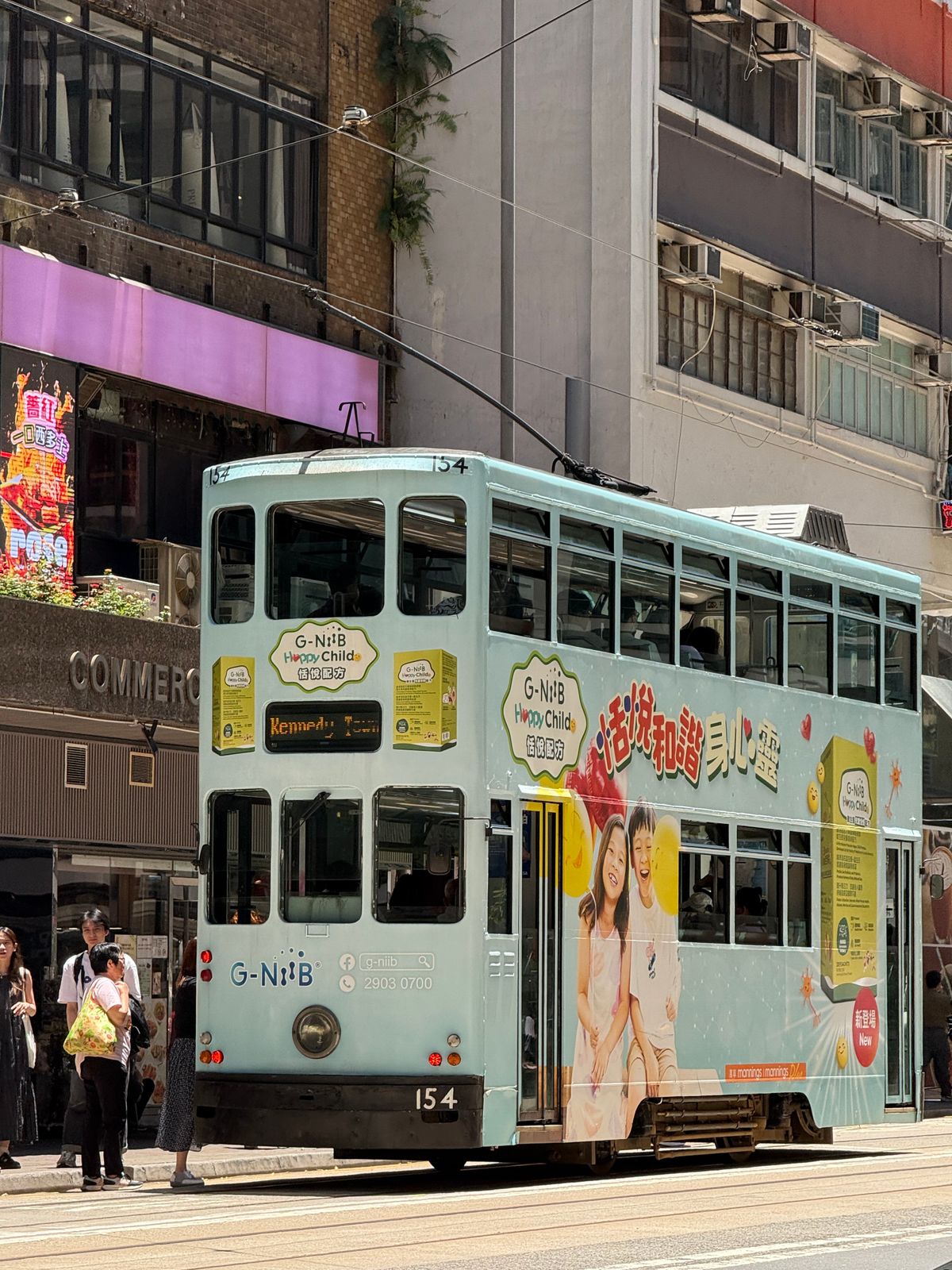
Getting on the road
1. 搭車
daap3 ce1 — Jyutping romanisation
Meaning: To take transportation / to catch a ride.
Explanation: The universal Cantonese verb for using any wheeled vehicle. You daap3 a bus, a taxi, a train, or your friend's car. The 搭 literally means "to board," and it works for everything with wheels — no separate verb needed.
2. 巴士
baa1 si2 — Jyutping romanisation
Meaning: Bus.
Explanation: A phonetic loan from the English word "bus," pronounced roughly like "baa-see." Hong Kong's colonial history left the language dotted with English-origin words rewritten in Cantonese sound. Locals still say baa1 si2 — never the Mandarin 公交.
3. 的士
dik1 si2 — Jyutping romanisation
Meaning: Taxi.
Explanation: Another English loan — from "taxi" — that has fully entered daily Cantonese. Hong Kong's red urban taxis, green New Territories taxis, and blue Lantau taxis are all dik1 si2. You'll hear this word more than any Mandarin equivalent.
4. 過海
gwo3 hoi2 — Jyutping romanisation
Meaning: To cross the harbour — Hong Kong Island to Kowloon or back.
Explanation: A phrase unique to Hong Kong's geography. Locals gwo3 hoi2 to move between Central and Tsim Sha Tsui, and every Hong Konger factors this into their day. Cross-harbour taxis charge extra, and cross-harbour tunnel traffic is a citywide obsession.
5. 港鐵
gong2 tit3 — Jyutping romanisation
Meaning: The MTR — Hong Kong's mass-transit railway.
Explanation: Literally "Hong Kong Railway," and the everyday name for the MTR system. Locals distinguish 港鐵 (the network) from 港鐵站 (the station). You'll also hear 搭地鐵 daap3 dei6 tit3, "take the underground."
6. 八達通
baat3 daat6 tung1 — Jyutping romanisation
Meaning: The Octopus card — Hong Kong's contactless payment system.
Explanation: The name references the four-character idiom 四通八達 ("reachable in all directions") — the eight suggests the eight-armed octopus and all-directional access. Launched in 1997, the card pays for the MTR, buses, ferries, trams, minibuses, convenience stores, and half the cha chaan tengs in the city. Losing it is a small tragedy.
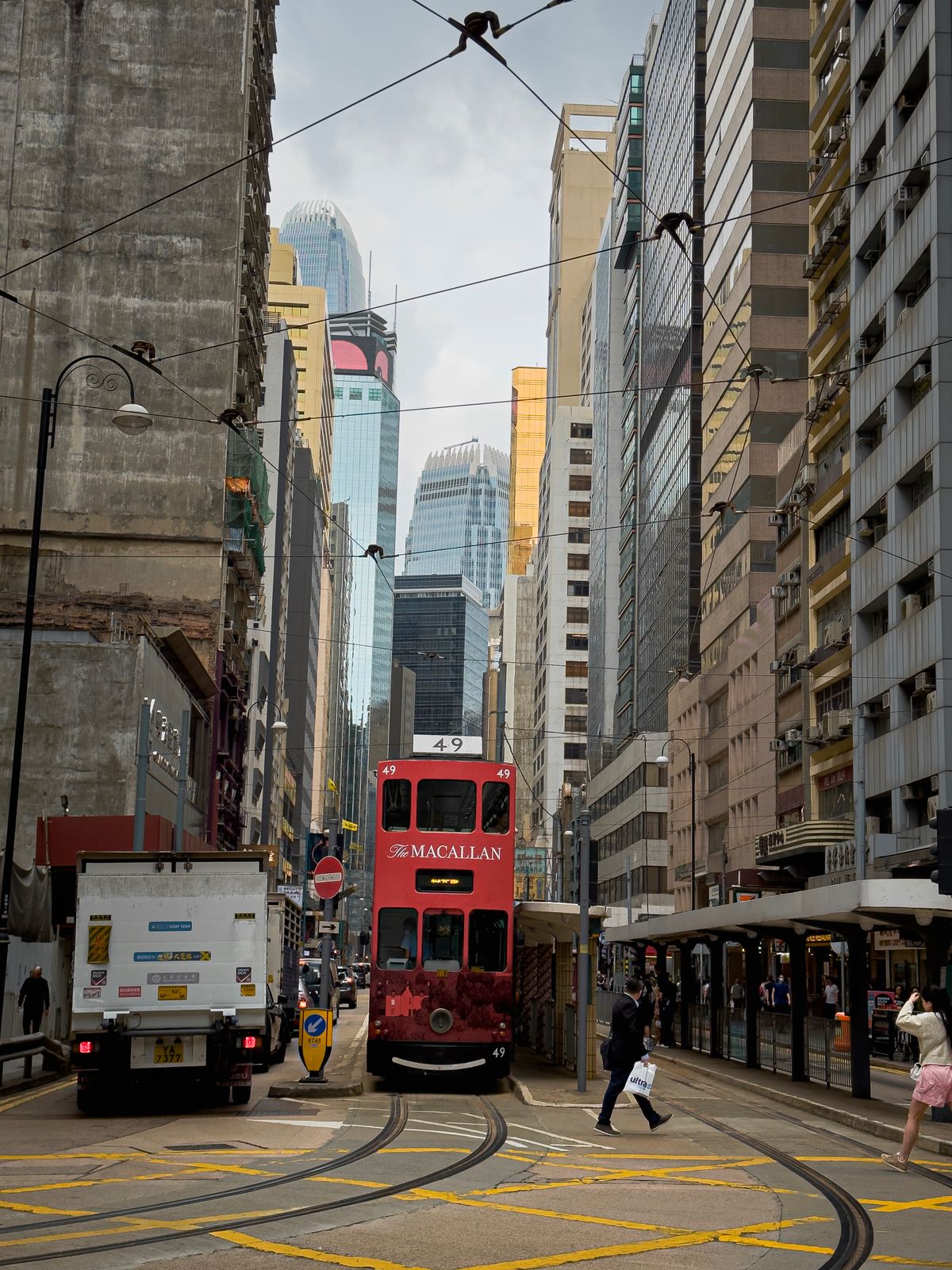
Riding, complaining, arriving
7. 塞車
sak1 ce1 — Jyutping romanisation
Meaning: Traffic jam.
Explanation: Literally "blocked car." Hong Kongers use this constantly — Central at 6pm, the cross-harbour tunnel any weekday, every road during rainstorms. Sak1 ce1 isn't just traffic; it's the universal excuse for being late.
8. 小巴
siu2 baa1 — Jyutping romanisation
Meaning: Minibus.
Explanation: Hong Kong's iconic 19-seater minibuses, split into red-topped (routes flexible, cash preferred, driver decides where to stop) and green-topped (scheduled, Octopus-accepted). Fast, cheap, occasionally terrifying — one of the most Hong Kong things there is.
9. 有落
jau5 lok6 — Jyutping romanisation
Meaning: "I'm getting off here" — shouted on a minibus.
Explanation: On red minibuses without a bell, this is how you tell the driver to stop. You call out jau5 lok6 with the street name — e.g. 「西灣河有落!」 — and the driver pulls over. Getting the timing wrong is a rite of passage for new Hong Kongers.
10. 撳鐘
gam6 zung1 — Jyutping romanisation
Meaning: To press the bell — to signal a bus or tram stop.
Explanation: 撳 is a very Cantonese verb meaning to push or press down. On buses and trams, you gam6 zung1 to ring the stop bell. If nobody presses it, the bus rolls right past — one of Hong Kong's small daily dramas.
11. 兜路
dau1 lou6 — Jyutping romanisation
Meaning: To take the long way — a detour.
Explanation: 兜 means to loop around; 路 is road. Together, dau1 lou6 is what you accuse a taxi driver of doing when he takes the scenic route to bump the meter. It also means simply taking a longer way, sometimes to avoid traffic.
12. 上車
soeng5 ce1 — Jyutping romanisation
Meaning: To board a vehicle — but in Hong Kong, also to buy your first flat.
Explanation: Literally "get on the car," this is the standard word for boarding any vehicle. In Hong Kong slang, however, soeng5 ce1 has taken on a second life as the term for finally getting on the property ladder. Given Hong Kong prices, this is the transport word that carries the most weight.
Why transport words matter
These twelve words carry more than logistics. They are Hong Kong's colonial history (baa1 si2, dik1 si2), its geography (gwo3 hoi2), its density (sak1 ce1, siu2 baa1), and its economy (soeng5 ce1). Master them, and half the small talk in any Hong Kong taxi opens up. For more of the city's daily vocabulary, see our Vol. 34 on taste and texture, our Vol. 30 on money slang, or the story of the Ding Ding tram that gave us most of these words.
📖 Related Articles
👉 Shop Cantonese Guy — Modern Streetwear for the Global Cantonese Community