

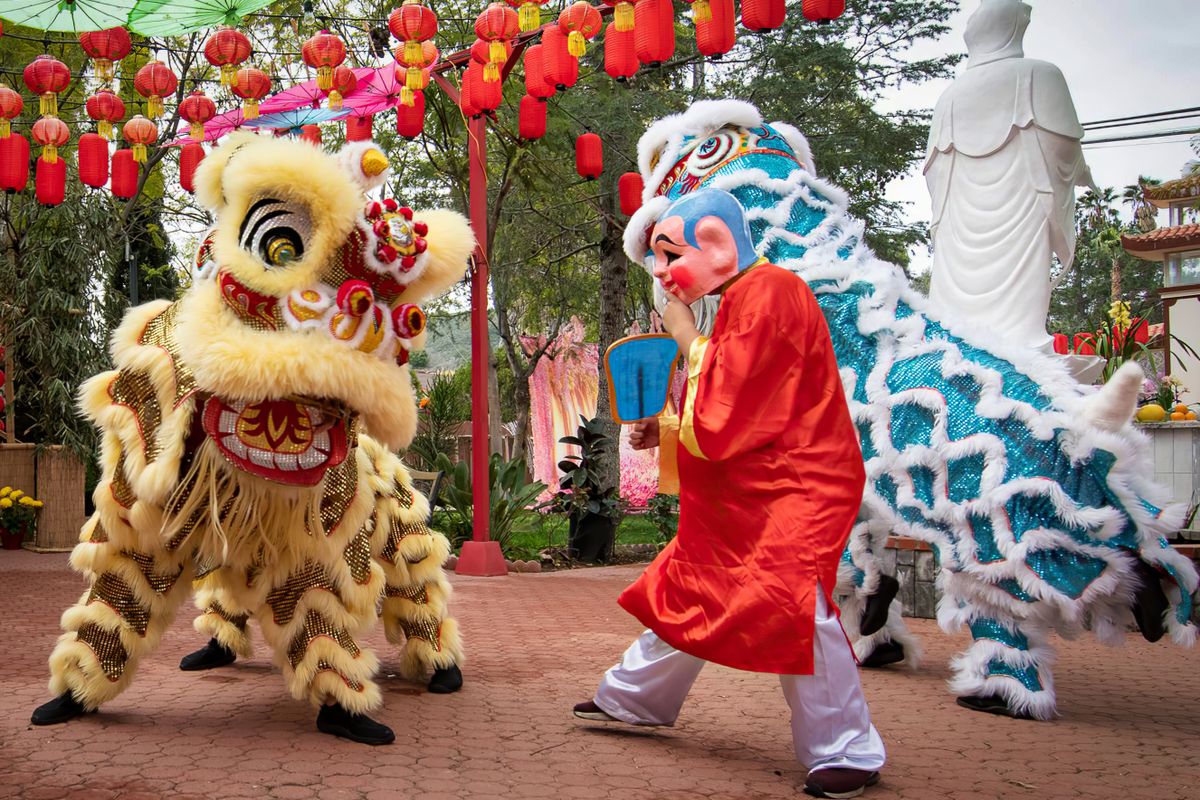
You hear it before you see it. The drum comes first — a heavy, hollow, rolling boom that vibrates in your chest from a block away — then the cymbal crash, the gong, the crackle of firecrackers, and finally the lion itself, teeth chomping, eyes blinking, huge painted head bobbing above two impossibly fast pairs of legs. For Cantonese communities from Foshan to Vancouver, the arrival of the Southern Lion (南獅, naam4 si1) means the same thing it has meant for hundreds of years: a blessing is being delivered, and evil is being chased out. This is the Cantonese martial art disguised as a dance.
A Guangdong Invention, Rooted in Foshan
Lion dance in China is ancient, but the Southern Lion — the version everyone in the Cantonese world knows — is a specifically Guangdong invention. Historians trace it to the Ming Dynasty, originating in Nanhai County, which is now part of Foshan (佛山), a city an hour west of Guangzhou. From there it spread through the Cantonese-speaking Pearl River Delta and, eventually, wherever Cantonese migrants went.
Foshan is not a random cradle. It is the historic capital of Southern Chinese martial arts — the hometown of Hung Gar grandmaster Wong Fei-hung (黃飛鴻) and, later, of Wing Chun grandmaster Ip Man. From the Qing Dynasty onwards, nearly every serious kung fu school in Foshan and the surrounding Cantonese counties had its own lion dance troupe. The dance and the fighting art grew up in the same courtyards.
The Two Cantonese Lion Styles: Fut San and Hok San
There are two dominant styles within the Southern Lion tradition, and Cantonese practitioners will happily argue for hours about which is superior.
Fut San Lion (佛山獅). Named after Foshan itself. Heavier, more grounded, more "martial." The head is larger, the movements are stiffer, and the footwork borrows directly from Hung Gar horse stances. This is the lion you see at older lion-dance associations and heritage schools. It's built to look imposing.
Hok San Lion (鶴山獅). Named after Heshan county in Guangdong. Lighter, more expressive, more "animal." The head is smaller, the eyes and ears move constantly, and the dance is full of playful, cat-like body language. Hok San lions are the ones you often see competing in modern acrobatic competitions, jumping between raised poles (樁陣).
Both share the same core: two dancers, one under the head, one under the tail, moving as a single animal. Both share the same purpose: to bless a business, greet the new year, and scare away bad luck.
Why the Lion Head Looks Like an Opera Mask
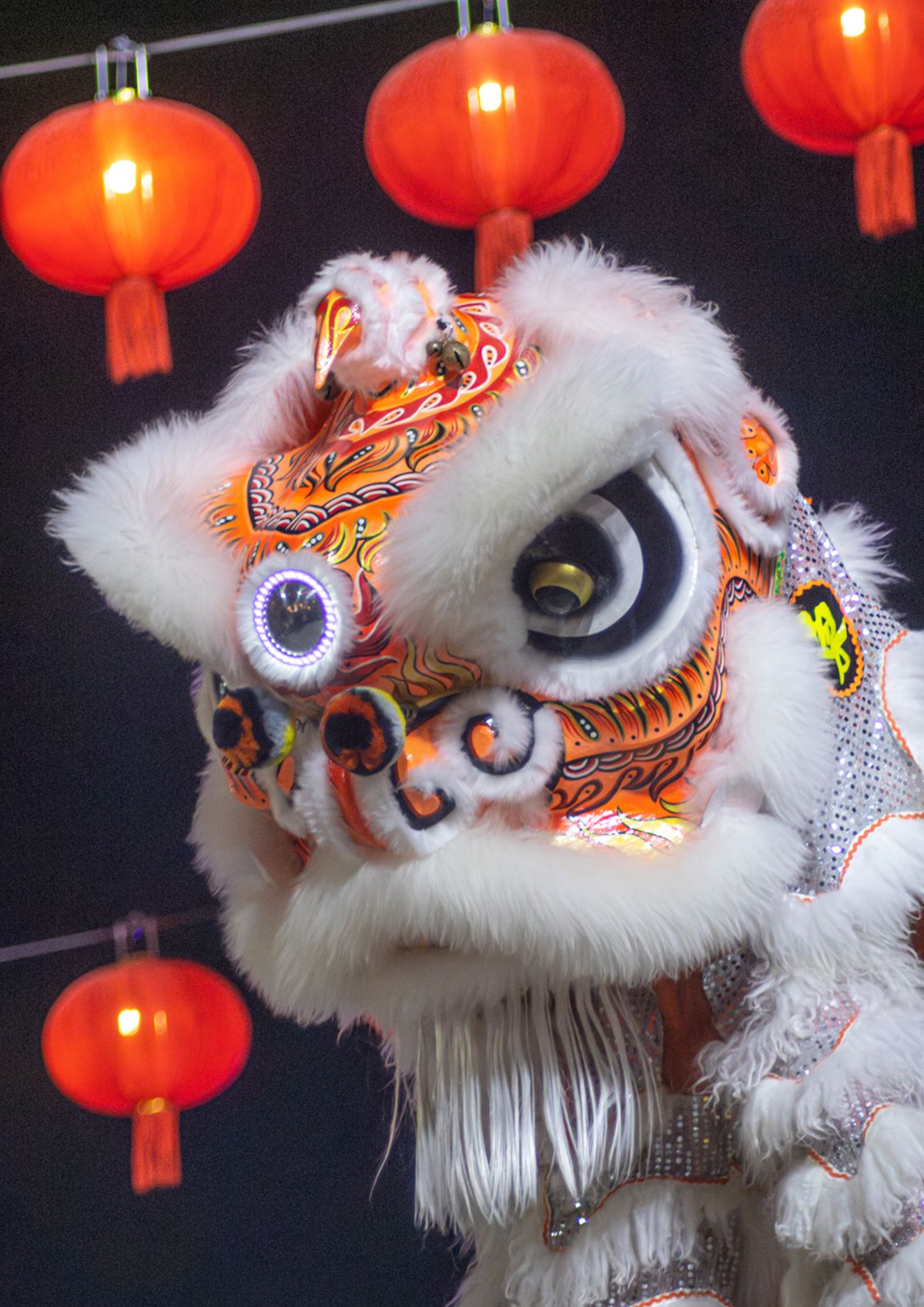
One of the joys of the Southern Lion is how obviously theatrical it is. The heads borrow visually from Cantonese opera facial makeup — the same bold reds, greens, blacks, and yellows, the same painted whiskers and moustaches. Each colour actually references a historical Chinese general:
The red-and-black lion is Guan Yu (關公), the loyal general and god of brotherhood. The yellow lion is Liu Bei (劉備), the noble emperor. The black-and-white lion is Zhang Fei (張飛), the ferocious warrior — traditionally used only by veteran troupes, because he's said to look for a fight. If you ever see two lions meet on a Cantonese street, watch how carefully they circle each other. The etiquette between different-coloured lions is centuries old and taken very seriously.
The "Plucking the Green" Ritual
The most famous Southern Lion set piece is choy cheng (採青), which literally translates as "plucking the greens." A head of lettuce — sometimes with a red envelope of lucky money tucked inside — is hung above a shop's doorway. The lion approaches, hesitates, sniffs, backs away, circles, gets curious, gets bolder, and finally leaps up to grab the greens in its mouth. It then chews, contemplates, and — crucially — spits the shredded lettuce out over the crowd, scattering it as a blessing on the business and everyone watching.
The whole sequence can last five minutes or thirty, depending on how creative the troupe wants to be. A great choy cheng is essentially a piece of choreographed theatre — the lion has moods, hesitations, personality. A great troupe can make you laugh out loud at what is technically two teenagers under a costume.
Martial Arts Under the Fabric
Look closely at the footwork of any decent Southern Lion and you'll see it isn't dance choreography. It's kung fu stances — low horse (四平馬), bow-and-arrow stance (弓箭步), cat stance (吊馬) — executed by two people who need to move as one animal, on uneven ground, in a costume that weighs 10 kilograms, sometimes on top of raised poles two metres off the pavement. Traditional Cantonese lion dancers train Hung Gar, Choy Li Fut, or Wing Chun as part of their apprenticeship. The dance is a demonstration of the school's skill — which is why rival schools were historically very careful about meeting each other's lions in the street. A wrong gesture could start an actual fight.
The Southern Lion in the Cantonese Diaspora
Cantonese migrants took the Southern Lion everywhere. In San Francisco Chinatown, lion dance troupes lead the Lunar New Year parade down Grant Avenue with the same choreography they'd use in Guangzhou. In Sydney's Haymarket, lions bless shop after shop up Dixon Street on the first day of the year. In Vancouver, Toronto, London, and Auckland, the drums roll out on the same days, in the same rhythms.
This continuity matters. In cities where the Cantonese language is fading among third-generation kids, the lion still shows up, and everyone — fluent or not — knows what it means. A grandmother lifts her grandchild up to feed a red envelope into the lion's mouth. A restaurant owner hangs the lettuce, waits for the leap, gets his blessing, and hangs the shredded remains above his kitchen for the year. The dance is a language that doesn't need translation.
A Cantonese Phrase Every Lion Dance Fan Knows
采青
coi2 cing1 — Jyutping romanisation
Meaning: To "pluck the greens" — the signature Southern Lion ritual of grabbing lettuce hung above a doorway and scattering it as a blessing.
Explanation: The phrase now doubles as slang for "performing the highlight of a show" or "delivering the good stuff." Ask any Hong Kong kid what the lion is about to do next and they'll say 採青 with a grin.
📖 Related Articles
The Lion Still Dances
In 2026, at a Sham Shui Po grand-opening, a small crowd stands three-deep around a young Southern Lion troupe. The drum kicks in. The head bobs. A ten-year-old girl in the front row — born in Hong Kong to a Cantonese family from Toisan — flinches at the cymbals and then breaks into a huge smile. She has never trained in Hung Gar. She may not fluently read the traditional Chinese poster on the shop wall. But when the lion leaps and the shredded lettuce rains down, she knows exactly what has just happened, and so does everyone around her. That's the power of the Cantonese Southern Lion: an 800-year-old choreography that still tells the entire community — without a single spoken word — that this is a good day, and this is our house.
👉 Shop Cantonese Guy — Modern Streetwear for the Global Cantonese Community